Australia’s housing market is splitting in two as higher borrowing costs and budget pressure hit stretched buyers differently across states, leaving some city markets under strain while others are starting to stabilise.
Australia Housing Market Splits Across States

The divergence matters because housing is still the biggest transmission channel from rates to the real economy. When mortgage stress rises, household spending weakens, refinancing gets harder and construction activity slows — with knock-on effects for banks, builders and landlords.
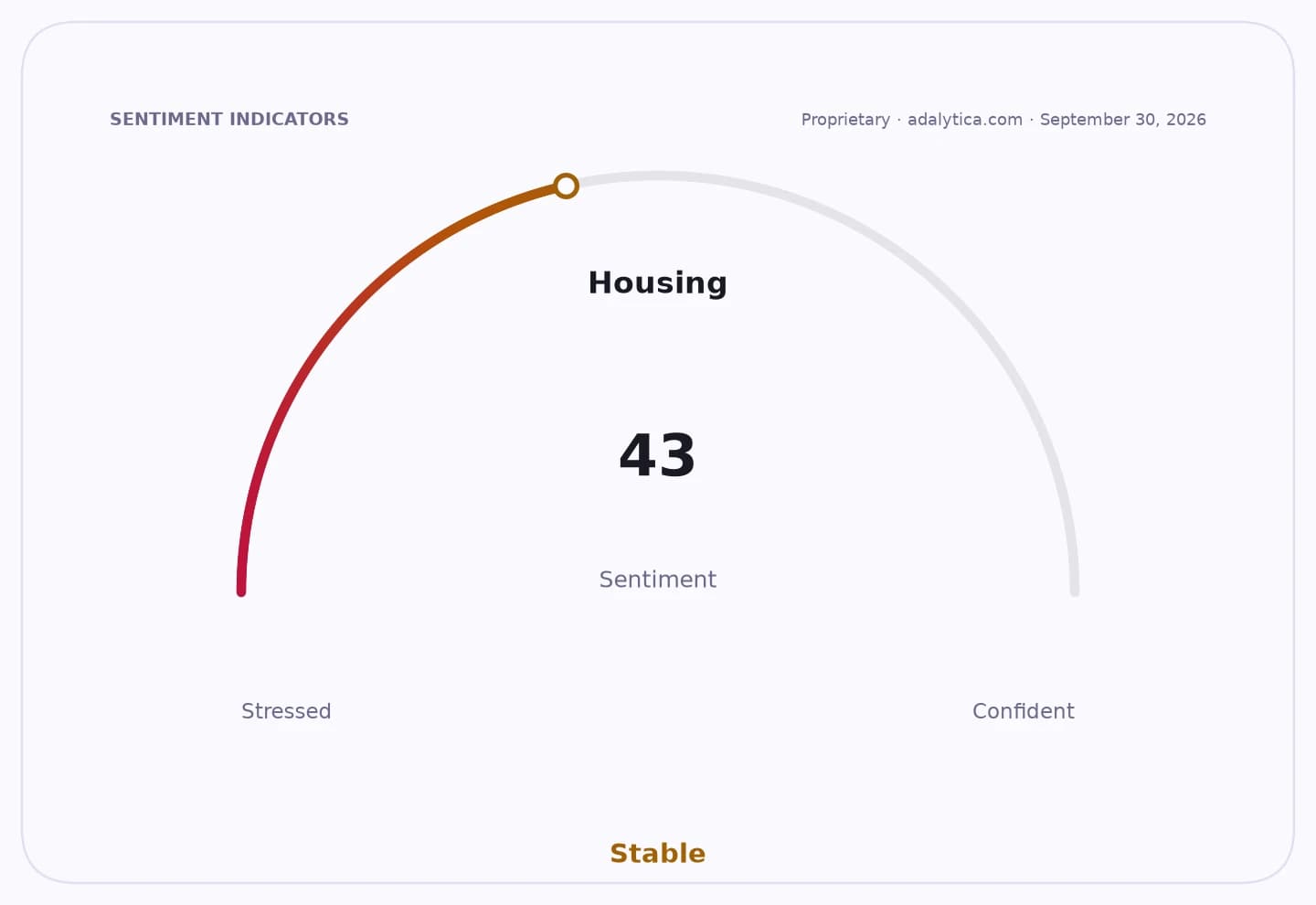
Sentiment IndicatorsⓘProprietary · adalytica.com · October 6, 2026
This is a snapshot — live sentiment, awareness and momentum for 130+ markets update continuously in the dashboard.Open AlphaPulse

That backdrop is already visible in the data. Australia’s benchmark home price index has climbed to 337.306 in July 2026 from 308.055 in June 2022, but the gains are no longer broad-based. At the same time, the housing market is being shaped by a global rates backdrop that has kept US 10-year Treasury yields near 5.28% and the Fed funds rate around 3.75%, keeping financial conditions tight and limiting how far central banks can ease.
In Australia, the pressure is most acute in Queensland and Victoria, where mortgage stress and price declines are weighing on owners and renters alike. The brief says Queensland faces a shortfall of 30,000 homes across multiple suburbs, underscoring that the problem is not simply a lack of supply, but a mismatch between what is being built and what buyers can afford.

That is pushing demand toward apartments and regional markets, a shift that could change the shape of housing investment for years. It also raises the stakes for policy, because adding more supply alone may not be enough if restrictive rules, financing costs and affordability constraints keep locking first-home buyers out of detached housing.
Investors are feeling the split in listed US housing proxies too. American Homes 4 Rent, Invitation Homes and Lennar have all seen recent share-price pressure and elevated volatility, reflecting concern that high rates and affordability strain can hit everything from rental demand to new-home margins. Lennar closed at $77.42 on Oct. 6, down sharply from $131.06 in December, while AMH was last at $30.52 and INVH at $26.45, both well below recent highs.
For markets, the message is that housing is no longer moving in one direction. The winners are likely to be landlords, builders and suppliers focused on cheaper product and faster-turning regional demand; the losers are leveraged owners in the weakest city markets, would-be first-home buyers and developers exposed to higher-cost, detached housing.
The next test is whether policymakers move beyond supply targets toward planning, zoning and construction reforms that can actually deliver lower-cost homes. If they do not, the split between affordable and unaffordable markets is likely to deepen.
| Entity | Gains | Losses |
|---|---|---|
| Apartment developers | ▲More demand from price-stretched buyers | ▼Detached-home builders |
| Regional markets | ▲Inflow from affordability seekers | ▼Weak city suburbs |
| Landlords | ▲Steadier rental demand | ▼First-home buyers |
| Policymakers | ▲Chance to act on reforms | ▼Households facing mortgage stress |