Austria’s new push into China is really a bid to protect its export base at a moment when Europe’s second-largest trade relationship with Beijing remains badly imbalanced and politically fragile.
Austria Pushes for More China Exports on Xi Visit
Chancellor Christian Stocker’s multi-day working visit to Shanghai and Beijing comes with a clear economic objective: win business for Austrian industrial groups while preserving access to the world’s second-largest economy. That matters because China is not a side market for Austria. Roughly 650 Austrian companies already operate there through about 900 local entities, and Vienna is now trying to turn that footprint into more orders for machinery, equipment and industrial components.
Sentiment Indicators
The numbers show why the trip is more than diplomatic choreography. Austria imported 17.5 billion euros of goods from China last year, while exports to China were only 5 billion euros, leaving a deficit of about 12.5 billion euros. Economy Minister Wolfgang Hattmannsdorfer says untapped export potential could reach 5.4 billion euros by 2030, a figure that would not erase the gap but could meaningfully narrow it if Austrian manufacturers can convert it into contracts. That is the real prize for investors: more demand for high-value industrial suppliers, better capacity utilization and a small but important offset to Europe’s sluggish manufacturing backdrop.
The delegation underscores where the opportunity lies. Executives from AVL List, Magna, Doppelmayr, voestalpine and RHI Magnesita are accompanying the government, a reminder that Austria’s China exposure is concentrated in cyclical, capital-intensive sectors that tend to benefit when trade ties improve and large industrial buyers keep spending. Stocker is also set to attend the China International Import Expo in Shanghai, one of Beijing’s main showcases for foreign suppliers, before meeting President Xi Jinping and Premier Li Qiang in Beijing later in the week.
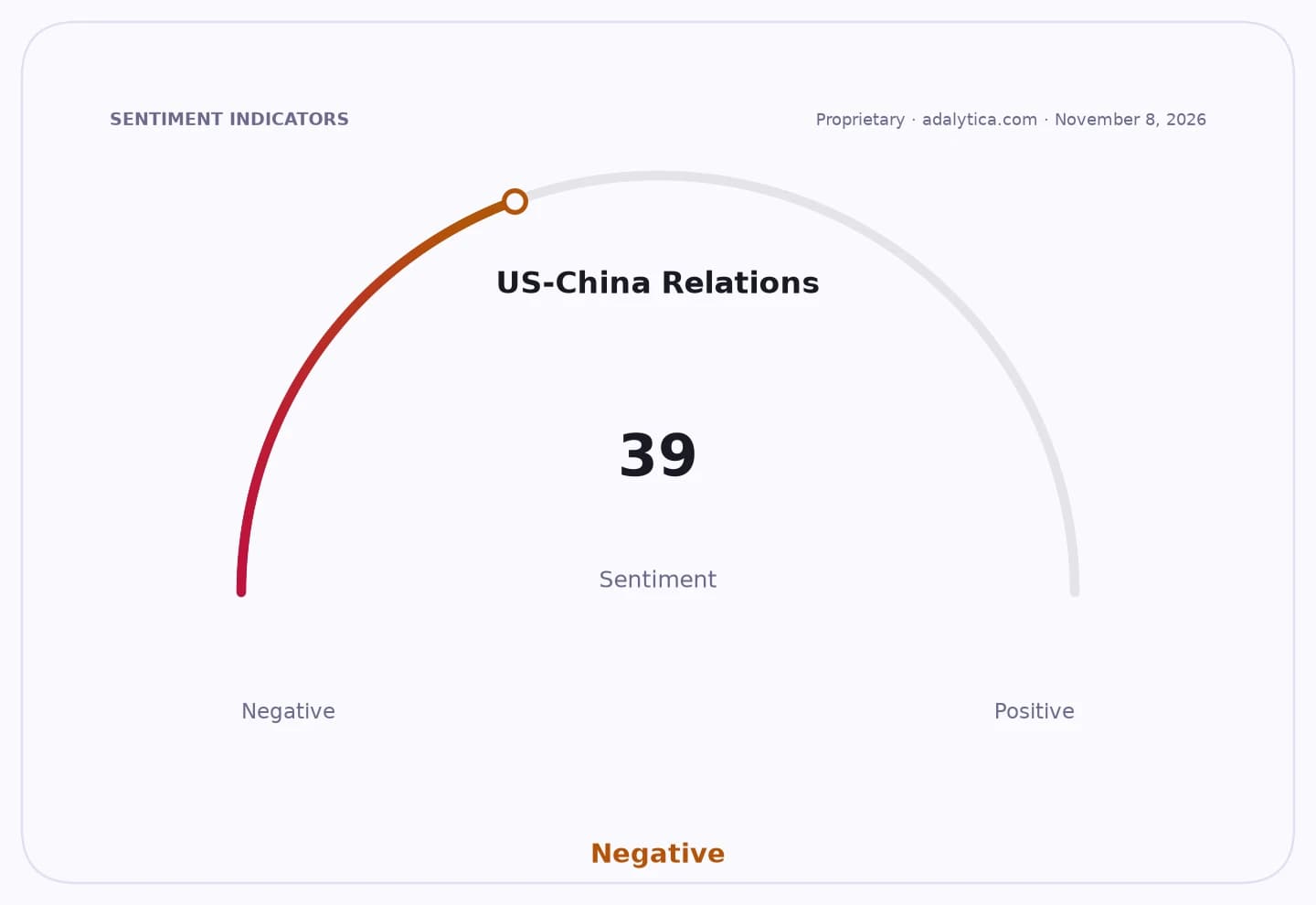
For markets, the visit is less about instant policy breakthroughs than about whether Europe can keep commercial channels open while geopolitical friction remains elevated. The latest readings from Adalytica’s US–China relations sentiment gauge show a neutral overall tone but extreme fear on awareness, suggesting investors are still pricing in volatility rather than a durable thaw. That helps explain why Chinese equity exposure remains highly reactive to any sign of improved trade access or diplomatic progress.
There is also a second-order investment angle. If Austria can press ahead with exports into China despite the broader EU-China tension, it strengthens the case for European industrial names that sell precision manufacturing, mobility and materials technology into Asia. The trade mission does not change the macro cycle on its own, but it does reinforce a theme the market often underestimates: in a fragmented global economy, governments are becoming part of the sales force for their national champions.
The key catalyst now is the meeting with Xi. Any language on expanded market access, procurement or regulatory easing would be a positive read-through for Austrian exporters and broader European industrials with China exposure. If the talks stay symbolic, the deficit story remains intact. Either way, the visit shows Vienna is betting that the next leg of growth will come from deeper commercial engagement with China, not from waiting for demand at home to improve.
| Entity | Gains | Losses |
|---|---|---|
| Austrian industrial exporters | ▲More China orders | ▼Persistent trade gap |
| China | ▲More foreign supply options | ▼Less leverage if access expands |
| Vienna government | ▲Diplomatic and commercial wins | ▼Pressure if talks disappoint |
| EU-China skeptics | ▲— | ▼Weaker case for broader decoupling |