The Bank of Korea says the drag from higher interest rates is showing up first in delinquency among vulnerable households and small businesses, with the sharpest effect arriving about nine months after a rate hike and the broader banking system feeling the worst of it roughly 15 months later.
Bank of Korea flags lagged delinquency after rate hikes
That timing matters because it shows monetary tightening does not hit all borrowers evenly. It lands sooner on low-income households, heavily indebted consumers, self-employed borrowers and smaller companies with weaker cash flow, while the full system-wide effects arrive later. For policymakers, that raises the risk that credit stress can build in pockets of the economy even if headline delinquency rates still look manageable.
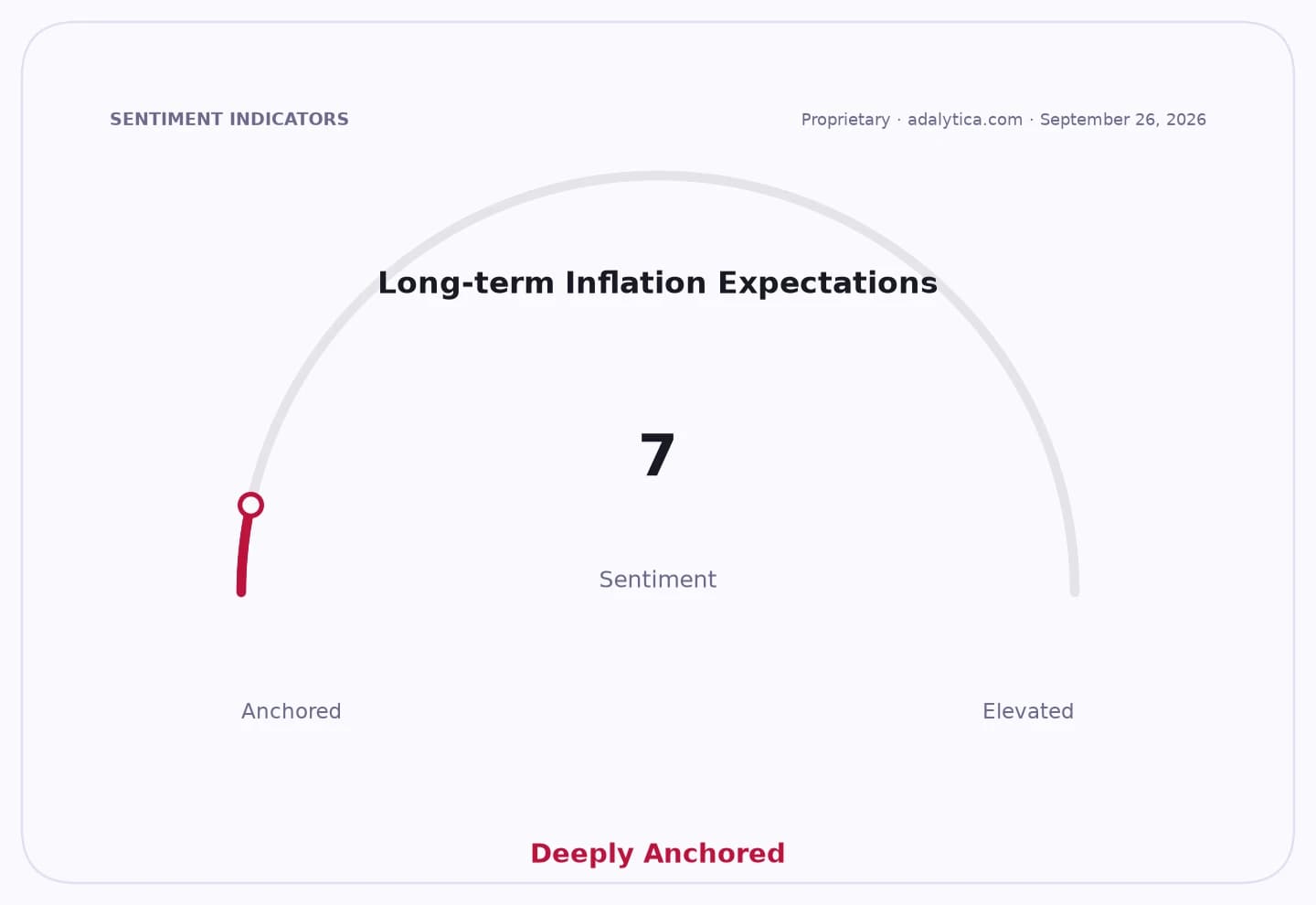
Sentiment IndicatorsⓘProprietary · adalytica.com · September 26, 2026
This is a snapshot — live sentiment, awareness and momentum for 130+ markets update continuously in the dashboard.Open AlphaPulse
The central bank’s Financial Stability Report, released Tuesday, found that bank lending rates tend to react about five months after a base-rate increase, while overall bank delinquency rates peak around 15 months later. But for vulnerable household borrowers and small and medium-sized enterprises, the impact on delinquency peaks around nine months, or about six months earlier than the average household and corporate borrower.
The finding comes after a prolonged period of tighter monetary policy. As market rates rose through the second half of last year and the Bank of Korea raised its benchmark rate by 25 basis points in July and again in August, debt-service burdens are expected to keep rising with a lag. That lag is precisely why the most fragile borrowers are now starting to feel the squeeze even before the broader economy fully reflects it.
The report quantifies how exposed borrowers are to higher rates. Some 28.6% of households have more debt that reprices within a year than interest-bearing financial assets, while the same is true for 47.2% of listed companies. Among households in the lowest income quintile that hold debt, 47.5% are in a structure where higher rates directly increase net interest costs.
The pressure is already visible in repayment metrics. The interest-balance ratio for indebted households worsened to minus 6.3% in March from minus 5.3% a year earlier, with the lowest-income borrowers posting a much deeper minus 14.0%. For self-employed borrowers, the delinquency rate rose to 1.99% at the end of the second quarter from 1.86% at year-end, above the 2012 average of 1.60%.
The strain is more acute outside the major banks. Delinquency at bank lenders to self-employed borrowers was 0.56%, compared with 3.86% at non-bank lenders, highlighting how funding costs and borrower quality diverge across the financial system. Among vulnerable self-employed borrowers who are also multiple-debt holders and low-income or low-credit, the delinquency rate was 12.71%, far above 0.69% for non-vulnerable self-employed borrowers.
Persistence is another warning sign. The delinquency continuation rate for self-employed borrowers climbed to 80.9% in the second quarter, meaning more than eight in 10 borrowers already in arrears remained in arrears the next quarter. For vulnerable borrowers, the continuation rate was 82.3%, while the rate of newly entering delinquency rose to 3.60% from 3.17% at year-end. By contrast, new delinquency among non-vulnerable borrowers fell to 0.60% from 0.72%.
The corporate side is not immune. The report said bank corporate delinquency rates and the share of variable-rate loans remain elevated relative to past tightening cycles, while the share of so-called zombie firms with an interest coverage ratio below one for three consecutive years rose to 19.1% last year. That suggests rate pressure is increasingly interacting with already weak profitability across parts of the small-business sector.
For investors, the message is twofold. On one hand, the Bank of Korea says the system should be able to absorb the shock, citing improved growth, stronger capital and liquidity buffers at financial institutions and households’ greater use of long-term fixed-rate borrowing. The share of variable-rate household loans fell to 56.1% in June from 68.4% in July 2021. On the other hand, credit deterioration is becoming more concentrated in the parts of the economy most likely to drive future loan losses, provisioning and margin pressure for lenders.
That makes the current tightening cycle less about headline rates and more about credit quality lag. If the usual transmission pattern holds, the next several quarters could see more stress among vulnerable households, self-employed borrowers and smaller firms even if aggregate delinquency remains contained. The Bank of Korea’s warning is not that the system is breaking, but that the weak points are already under direct hit.
| Entity | Gains | Losses |
|---|---|---|
| Bank of Korea | ▲Better gauge of stress | ▼Political room to ease |
| Major banks | ▲Stronger capital buffers | ▼Rising credit costs |
| Vulnerable borrowers | ▲Longer repayment terms | ▼Faster delinquency |
| Small firms/self-employed | ▲Stability if growth holds | ▼Higher arrears and refinancing strain |