Banxico is signaling that Mexico’s next rate decisions will stay data-dependent, with persistent services inflation and external shocks keeping the central bank from committing to a faster easing cycle.
Banxico Keeps Mexico Rate Cuts Data-Dependent
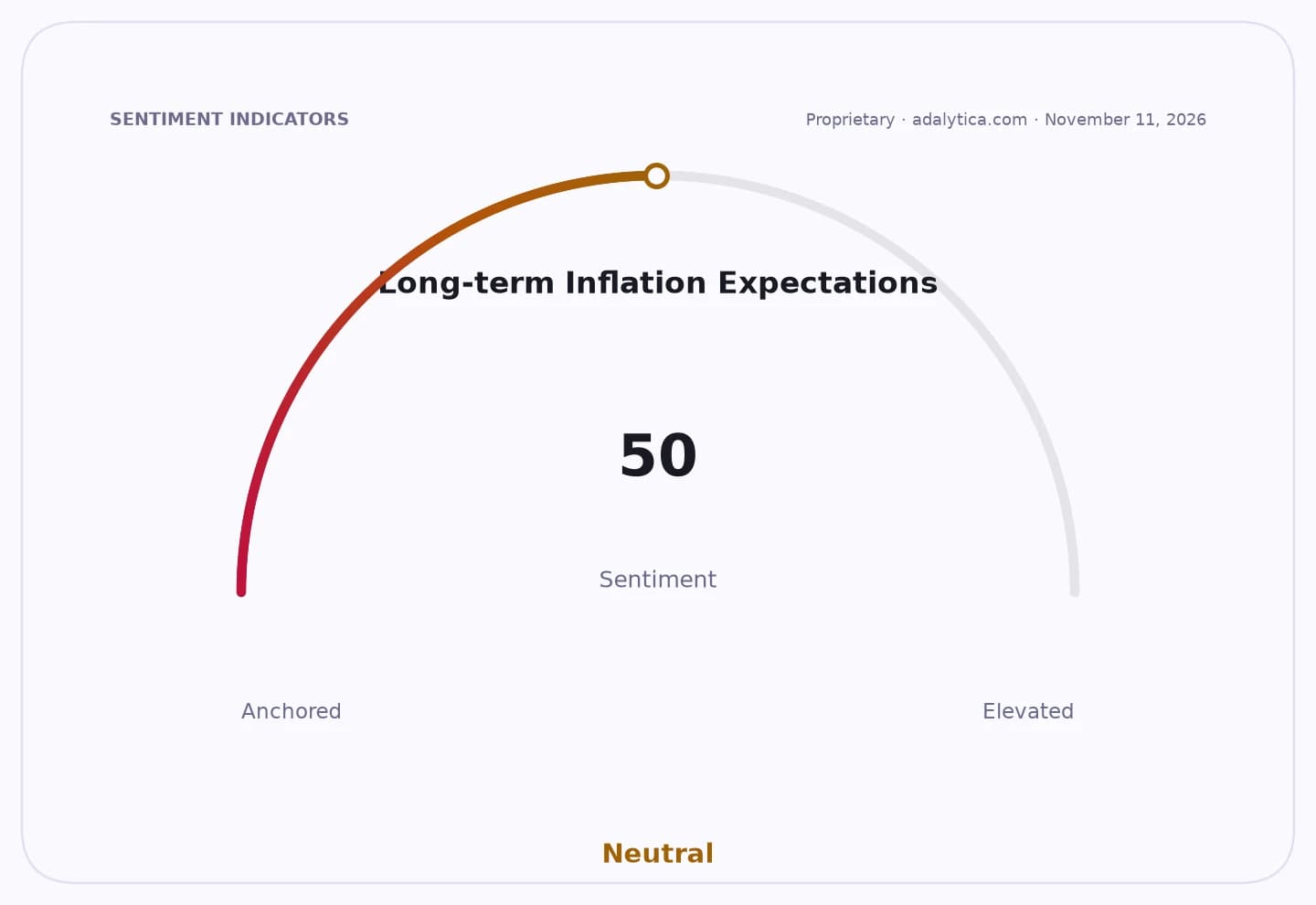
Long-term Inflation Expectations
Deputy Governor Galia Borja Gómez said the balance of inflation risks remains tilted to the upside, underscoring why policymakers are reluctant to pre-commit after recent rate cuts. The message matters because Mexico’s disinflation path is proving uneven: headline inflation has spent much of the past two years inside Banxico’s 3% target band, but services inflation is still running at 4.32% and has remained above 4% for 25 straight months. That persistence suggests domestic wage and pricing pressures are not yet fully subdued, even as broader growth cools.
Sentiment Indicators
For investors, the implication is that Banxico is unlikely to deliver an aggressive or uninterrupted cutting cycle. A central bank that sees the risks skewed higher is more likely to move in small increments and pause if inflation surprises to the upside. That keeps Mexico’s front-end rates and curve expectations sensitive to each inflation print, especially after October data came in hotter than expected.
Borja framed recent policy moves as punctual adjustments rather than a fixed commitment, pushing back on market hopes that Banxico would follow the Federal Reserve mechanically. She also pointed to escalating geopolitical tensions, trade protectionism and climate-related supply shocks as reasons the disinflation process could remain volatile. Those risks are not abstract for Mexico: climate events have hit agricultural supply chains, while Middle East tensions have fed into aviation fuel costs and tourist services.
Long-term Inflation Expectations — 30-day sentimentadalytica.com
Explore this data interactively — full history, time series and cross-market comparisons.
The domestic backdrop is more complicated than the inflation data alone suggests. Mexico’s economy has softened since early 2024, and Banxico has acknowledged a widening output gap. That would normally argue for faster easing, but the central bank is balancing weaker demand against price stickiness in services and the possibility of imported shocks. Borja said currency depreciation now ranks as the second-biggest inflation risk after core inflation persistence, with upcoming North American trade framework reviews adding another layer of uncertainty.
Mexico’s external position is still one of its main strengths. Borja cited the central bank’s autonomy, ample reserves, a well-capitalized financial system and a flexible exchange rate as buffers that have helped absorb shocks since 1994. Those fundamentals are part of why investors continue to view Mexico as relatively resilient among emerging markets, even as inflation risks remain elevated.
There is also a more positive trade story running alongside the policy caution. Mexico has benefited from supply-chain realignment away from China and remains the United States’ top trading partner. Exports of computing equipment and electronic components have surged and now account for 28% of Mexican non-automotive manufacturing shipments to the US in the January-September period, overtaking autos for the first time. That shift gives Mexico a growth buffer, but it also deepens the economy’s exposure to technology demand cycles and cross-border policy frictions.
Adalytica’s long-term inflation expectations gauge showed sentiment at 88, or “Extreme Greed,” while awareness remained in “Extreme Fear,” suggesting investors are still pricing persistent inflation risk even as confidence in a clean disinflation trend remains fragile. The same tension is visible in Mexican assets: the iShares MSCI Mexico ETF, EWW, has pulled back to $71.89 from above $80 earlier in the period, with its 50-day moving average near $74.13 and RSI readings showing recent weakness after earlier overbought conditions.
The broader message is that Banxico is trying to preserve credibility without choking off an economy already showing signs of fatigue. For markets, that means Mexico rates are likely to stay reactive rather than directional, and any rally in local bonds or equities will depend on whether services inflation finally eases enough to let the central bank speed up cuts. The next few inflation releases and Banxico’s communication around them will be the key test of whether the current cautious stance is temporary or the start of a longer pause.
| Entity | Gains | Losses |
|---|---|---|
| Banxico | ▲Policy flexibility | ▼Faster easing bets |
| Mexican savers | ▲Higher real returns | ▼Rapid rate cuts |
| Mexican borrowers | ▲Gradual disinflation | ▼Sticky lending costs |
| Mexico exporters | ▲Supply-chain reshoring | ▼Currency volatility |