The first graduates of the Basque Country’s AI degrees are landing work almost immediately, underscoring how quickly artificial intelligence is turning from an academic experiment into a labour-market engine — even if starting salaries remain modest by tech-industry standards.
Basque Country AI Graduates Find Jobs Quickly
What matters economically is not just that the Universidad del País Vasco (UPV/EHU) and Deusto moved early to create dedicated AI programmes in 2020/21, but that those courses are already feeding a market with near-full employment for a scarce skill set. In a region trying to deepen its innovation base, the early absorption of these graduates by banks, consultancies, industrial firms and public institutions suggests AI is becoming embedded in the local economy rather than confined to a handful of big tech employers.
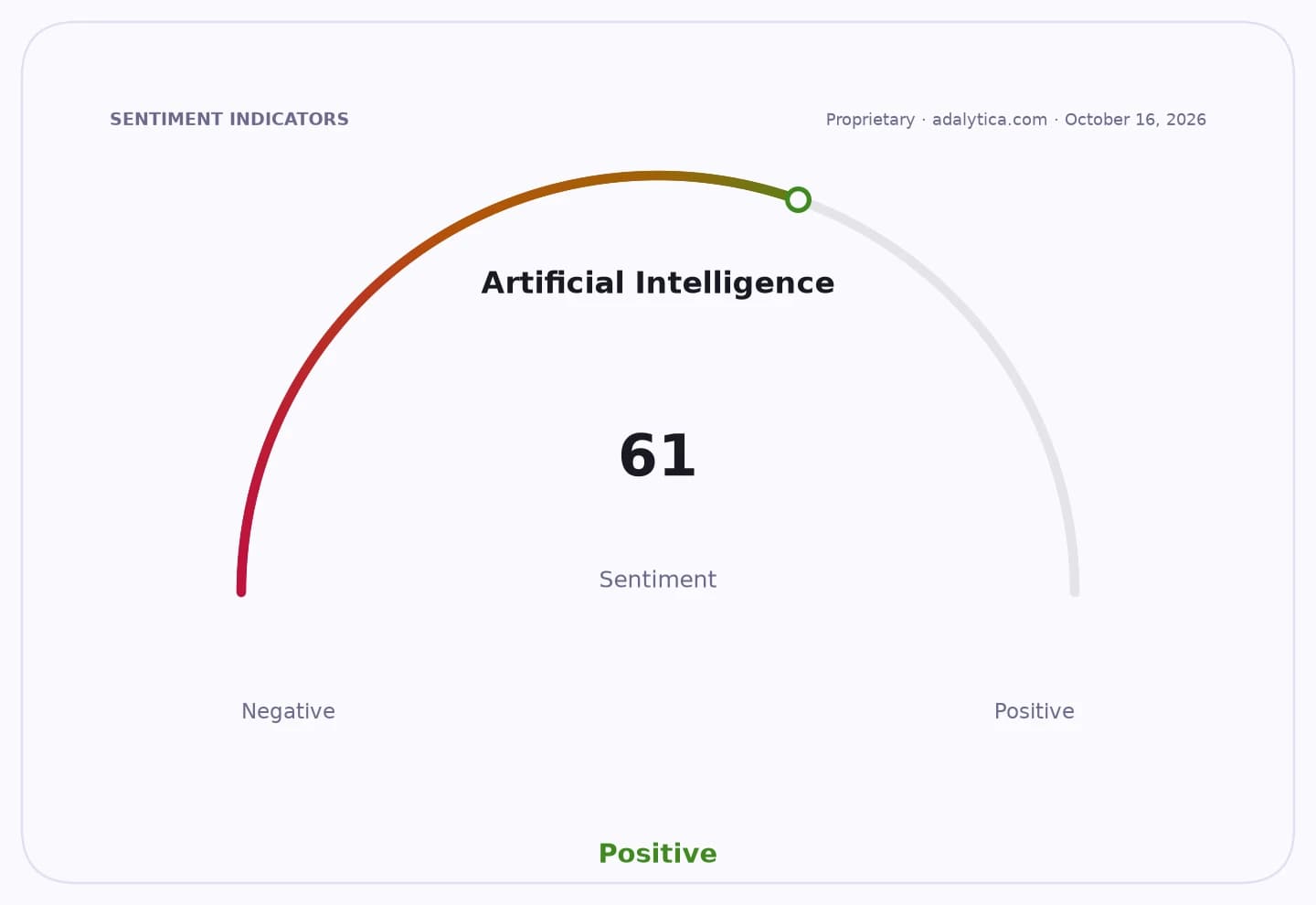
Sentiment IndicatorsⓘProprietary · adalytica.com · October 16, 2026
This is a snapshot — live sentiment, awareness and momentum for 130+ markets update continuously in the dashboard.Open AlphaPulse
The evidence from the first cohorts is clear: many students had jobs before graduating, and the career paths are spreading across sectors rather than concentrating in one. Elaia Artabe, who chose Deusto’s AI and Data Science degree, said her entire class was employed before finishing. She now works at Management Solutions after a placement at Vicomtech, building and cleaning data for operational decision-making. Sergio Camarena, another Deusto graduate, was hired into IDOM’s AI department to develop predictive models and conversational agents after time at Seidor. Nagore Bravo, from UPV/EHU’s AI degree, went on to a specialised master’s before joining Euskorpora, where she works on AI tools for Basque-language technology.
That breadth matters. AI graduates are not just joining software teams; they are being pulled into banking, consulting, engineering, language technology and the public sector. For employers, that points to an efficiency gain: AI skills are increasingly a cross-functional input, not a niche discipline. For the regional economy, it is a sign that universities are helping create a local supply of talent for sectors that have historically struggled to recruit specialised digital staff.
But the wage data show the market is still pricing these graduates as junior workers, not scarce strategic assets. Artabe said first-year pay among classmates could range from about 23,000 to 32,000 euros, with some roles rising above 50,000 euros after three or four years of experience. Camarena was blunter, saying many entry offers start around 20,000 euros and that it can be difficult to move above 30,000 euros before accumulating several years of consulting experience. Bravo said starting pay is broadly similar to other degrees, though the upside varies sharply by firm, sector and specialisation.
That creates a split investment case for students and employers. The bull case is that AI training offers near-immediate employability in a field with structural demand, and that earnings can rise quickly once graduates move beyond entry-level consulting or technical roles. The bear case is that early salary ceilings, experience requirements and a shortage of genuinely senior AI roles could temper the premium many students hoped for when they enrolled.
The contrast also reflects the broader AI economy, where companies want talent fast but still hesitate to pay top dollar for people with limited real-world experience. Some employers are demanding unrealistic qualifications, Bravo said, including years of experience in large language models that only recently emerged. That mismatch suggests the market is still settling on what AI expertise is worth, particularly outside the US and large multinational hubs.
For the Basque Country, the first promotions are an early proof point that investing in specialised AI education can pay off in employment and local capability. For investors and business leaders, the more important signal is that AI adoption is no longer only about model performance or cloud spending; it is increasingly about who can hire, train and retain the people able to deploy it. If regional firms can keep enough of this talent at home, the payoff could be higher productivity, better data use and more AI-enabled services. If not, the best graduates will keep being absorbed by Madrid, abroad or remote roles for foreign companies.
| Entity | Gains | Losses |
|---|---|---|
| Basque AI graduates | ▲Near-full employment | ▼Slow wage progression |
| Local employers | ▲Access to scarce talent | ▼Higher recruitment pressure |
| UPV/EHU and Deusto | ▲Proof of programme relevance | ▼Limited immediate salary premium |
| Students seeking AI roles | ▲Broad sector demand | ▼Experience barriers at entry level |