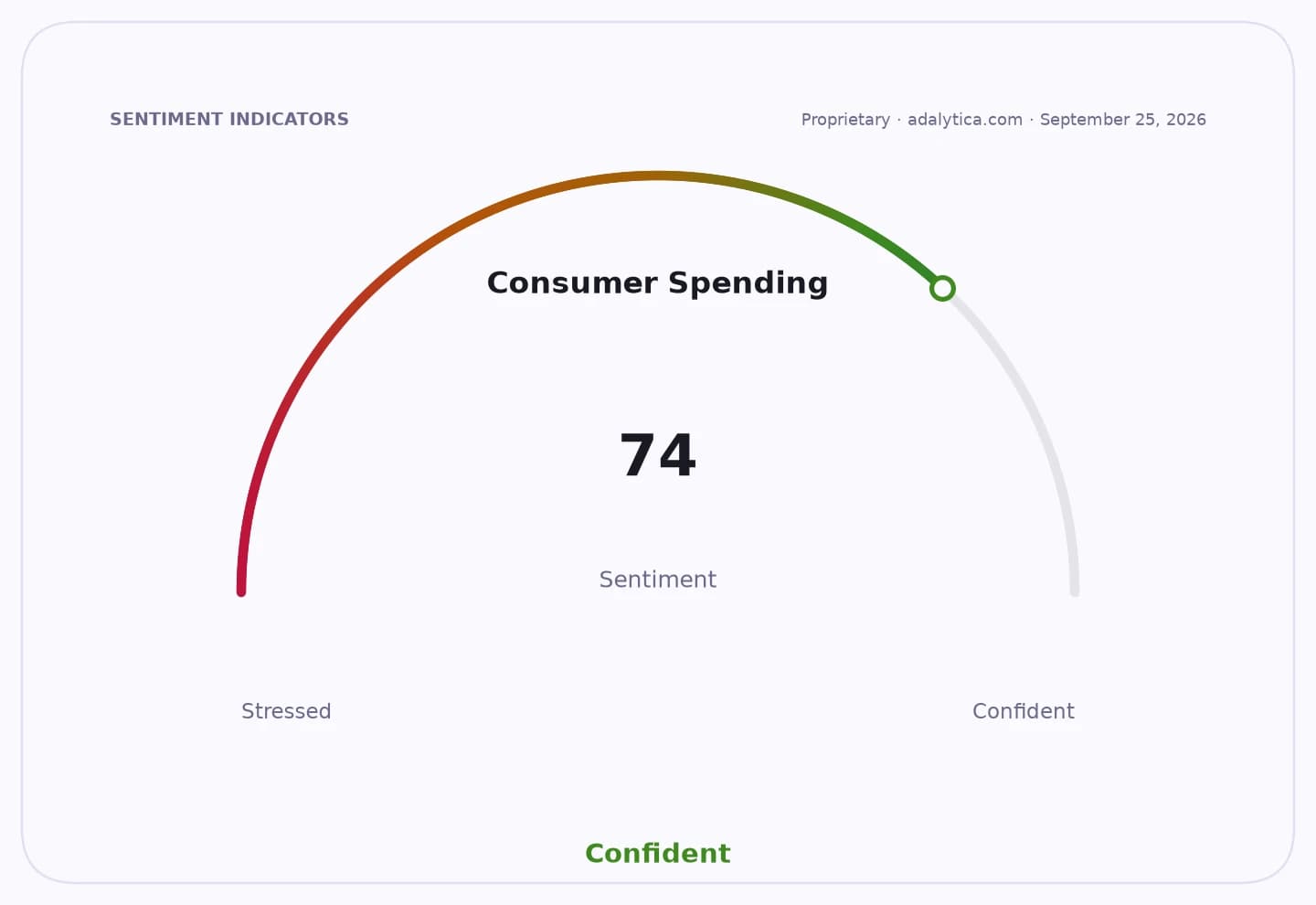
Nearly $500 billion of debt issued this year by the biggest technology companies is forcing investors to ask whether the artificial intelligence arms race is starting to outgrow the balance sheets that are funding it.
Big Tech Borrows Nearly $500 Billion for AI Buildout

The scale of borrowing matters because it shows how quickly capital needs are shifting from cash-rich software development to an infrastructure-heavy buildout that resembles old-economy utility investment more than a traditional tech cycle. Companies including Microsoft, Alphabet, Meta and Oracle are tapping credit markets to finance data centers, chips, leases and power needs, even as the cost of capital remains materially above the near-zero era that helped make tech a low-leverage sector for decades.
Sentiment IndicatorsⓘProprietary · adalytica.com · August 9, 2026
This is a snapshot — live sentiment, awareness and momentum for 130+ markets update continuously in the dashboard.Open AlphaPulse
That shift comes as the 10-year Treasury yield is around 4.6% and the Fed funds rate sits near 3.6%, a backdrop that makes every incremental dollar of debt more expensive than it was in the last AI capex cycle. High-yield credit spreads around 2.7 percentage points suggest markets are still accommodating risk, but they are no longer pricing the kind of easy-money environment that let balance-sheet expansion go largely unchallenged.
For investors, the issue is not just whether big tech can afford to borrow. It is whether AI investment will continue to produce returns fast enough to justify a bigger fixed-charge burden. That is especially relevant for names such as Oracle, which has already shown how sharply interest expense can rise after a large debt-funded expansion, and for hyperscalers that are simultaneously increasing capital expenditures, buying back stock and paying dividends.
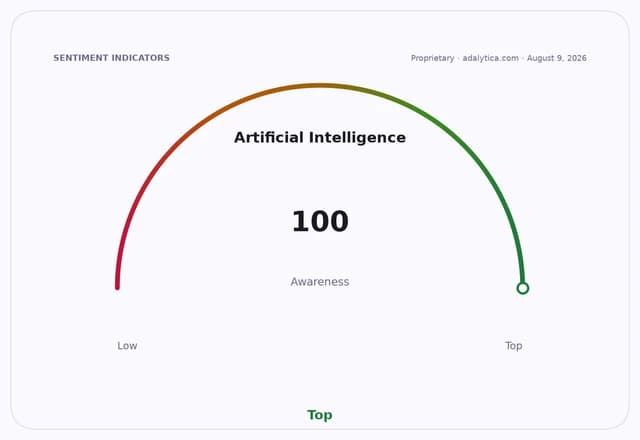
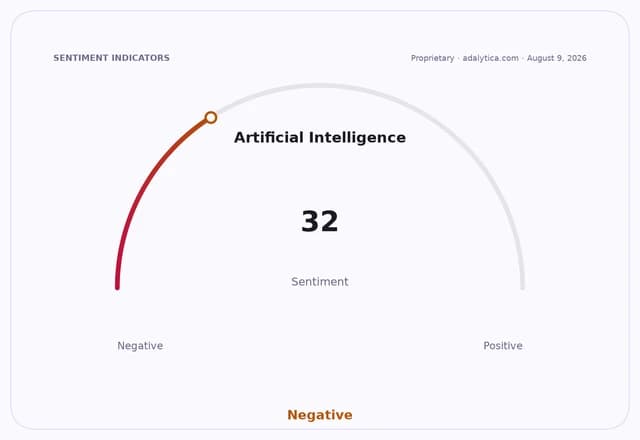
Microsoft’s shares have recovered to about $500 after plunging below $360 in June, while Nvidia has rebounded to about $224 and Alphabet is holding near $354. The moves show that markets still reward the AI trade, but they also underscore how violently sentiment can reset when investors start to question spending discipline, monetization timing or margin pressure. Adalytica’s Microsoft earnings sentiment remains neutral, while its AI gauge shows neutral sentiment but extreme awareness, suggesting the market is still intensely focused on the theme rather than convinced on valuation.
The bull case is that these companies still have extraordinary cash flow, fortress-like balance sheets and strategic reasons to spend aggressively to defend search, cloud and advertising franchises. Microsoft’s latest filing showed financing cash use jumped to $52.5 billion for fiscal 2026, while Alphabet said it issued $51.8 billion of notes in the first half of 2026 for general corporate purposes. Meta has also told investors it expects capital expenditures of $130 billion to $145 billion this year.
The bear case is that the AI buildout is beginning to look like a capital-intensive land grab, with debt funding increasingly used to bridge the gap between demand today and monetization later. If revenue growth or productivity gains lag, investors may start to treat the borrowing as a drag on free cash flow rather than a strategic advantage.
The next test is whether AI spending keeps translating into cloud growth, ad efficiency and enterprise adoption at a pace that can absorb the leverage now building across the sector. If it does, the debt boom will look like an efficient financing of a once-in-a-generation platform shift. If it does not, the market may decide that big tech borrowed too much, too soon, for an AI cycle that is still proving its economics.
| Entity | Gains | Losses |
|---|---|---|
| Big tech borrowers | ▲Funds AI capex | ▼Higher leverage |
| Bond investors | ▲New supply, yield pickup | ▼Credit risk |
| Equities holders | ▲Faster AI buildout | ▼Margin pressure |
| Cloud rivals | ▲Industry spending tailwind | ▼Weaker discipline narrative |