Bitcoin’s drop below $70,000 has put Strategy’s six-year accumulation campaign and average purchase price under sharper scrutiny, giving critics like Peter Schiff fresh ammunition as the market questions whether corporate treasury bets on the token can withstand a prolonged risk-off phase.
Bitcoin Falls Below $70,000 Pressures Strategy
Bitcoin
The economic significance is not just that Bitcoin is weaker; it is that one of the market’s most visible leveraged corporate proxies is now sitting on a cost basis of about $75,500, above the current spot price and well above where the market has traded for most of the past six months. That gap matters because it can influence equity valuation, financing conditions and investor confidence in a company whose identity has become tightly bound to Bitcoin’s direction.
Sentiment Indicators
Bitcoin fell to about $68,369 on Friday, its lowest level since August and nearly half off the recent peak in the mid-$80,000s. The selloff has been driven by renewed inflation worries, the prospect of further rate increases and a broader retreat from risk assets. That backdrop has also hurt crypto-linked equities: Coinbase has fallen to $127.64, while Strategy closed at $111.62, both far below their recent trading ranges.
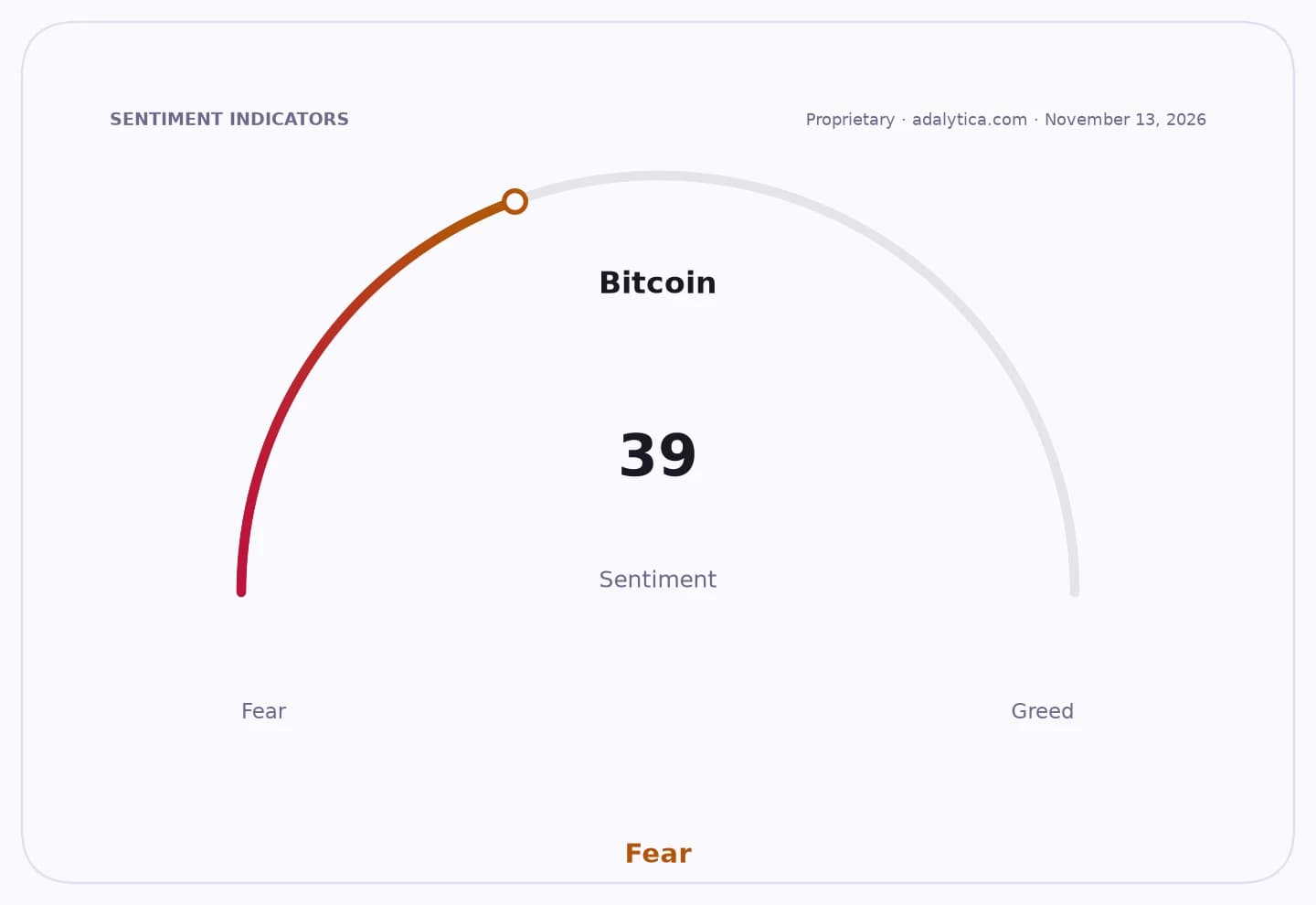
For Strategy, the debate goes beyond mark-to-market losses. The company has long argued that holding Bitcoin is a superior store of value over time, but Schiff’s criticism strikes at the heart of the bull case: if the asset continues to trade below the company’s average cost, investors may begin to focus less on long-term conviction and more on balance-sheet risk, dilution potential and the sustainability of its accumulation model. That is especially relevant when Bitcoin sentiment, according to Adalytica’s Fear & Greed gauge, sits at 39 — neutral, but still fragile after a 7-point drop on the day.
The technical picture reinforces the strain. Bitcoin is trading below its 50-day and 200-day moving averages, with RSI near 28, a level that points to a deeply oversold market but not yet a clean reversal. Strategy’s own shares show similar damage, with RSI around 28.5 and the stock well below both its 50-day and 200-day moving averages. Coinbase is also trading beneath its 50-day and 200-day averages, underscoring how the weakness is being transmitted through the broader crypto equity complex.
Investors now face two competing narratives. The bullish case is that extreme pessimism often precedes a rebound, especially if inflation data eases and central banks soften their tone. Bitcoin’s long-term supporters will also argue that treasury buyers with multi-year horizons can absorb short-term volatility and ultimately benefit if the asset recovers. The bearish case is that higher-for-longer rates, tighter liquidity and repeated drawdowns erode the appeal of Bitcoin as a corporate reserve asset, especially for shareholders who did not sign up for the volatility.
For now, Schiff’s attack matters because it crystallizes a broader market question: whether Strategy is a visionary balance-sheet trade or an increasingly costly bet on a rebound that has yet to arrive. If Bitcoin stabilizes, the criticism will fade quickly. If it keeps slipping, the company’s average entry price could become a more important reference point for investors than any long-term thesis.
| Entity | Gains | Losses |
|---|---|---|
| Peter Schiff | ▲Stronger criticism of Bitcoin treasury bets | ▼Less credibility if BTC rebounds |
| Strategy bulls | ▲Potential long-term upside if Bitcoin recovers | ▼Near-term valuation pressure |
| Strategy bears | ▲Fresher case against accumulation at high cost | ▼Risk of missing a sharp Bitcoin reversal |
| Coinbase shareholders | ▲Possible trading bounce if crypto sentiment stabilizes | ▼Revenue and sentiment hit from weaker BTC |