Bitcoin’s exchange-traded funds are facing their sharpest withdrawal wave since launch, and the damage is worsening as investors abandon risk assets even after a blockbuster AI listing and another strong Nvidia quarter failed to revive market appetite.
Bitcoin ETFs See $6.4B in Outflows
US spot Bitcoin ETFs have seen more than $6.4 billion in redemptions over the past 30 days, with another $306.5 million pulled on the latest session and $1.4 billion withdrawn across seven finalized trading days, according to the data provided. The exodus matters because these funds were the main conduit for institutional money into Bitcoin this year; when they bleed, the marginal buyer disappears and price support weakens quickly.
Sentiment Indicators
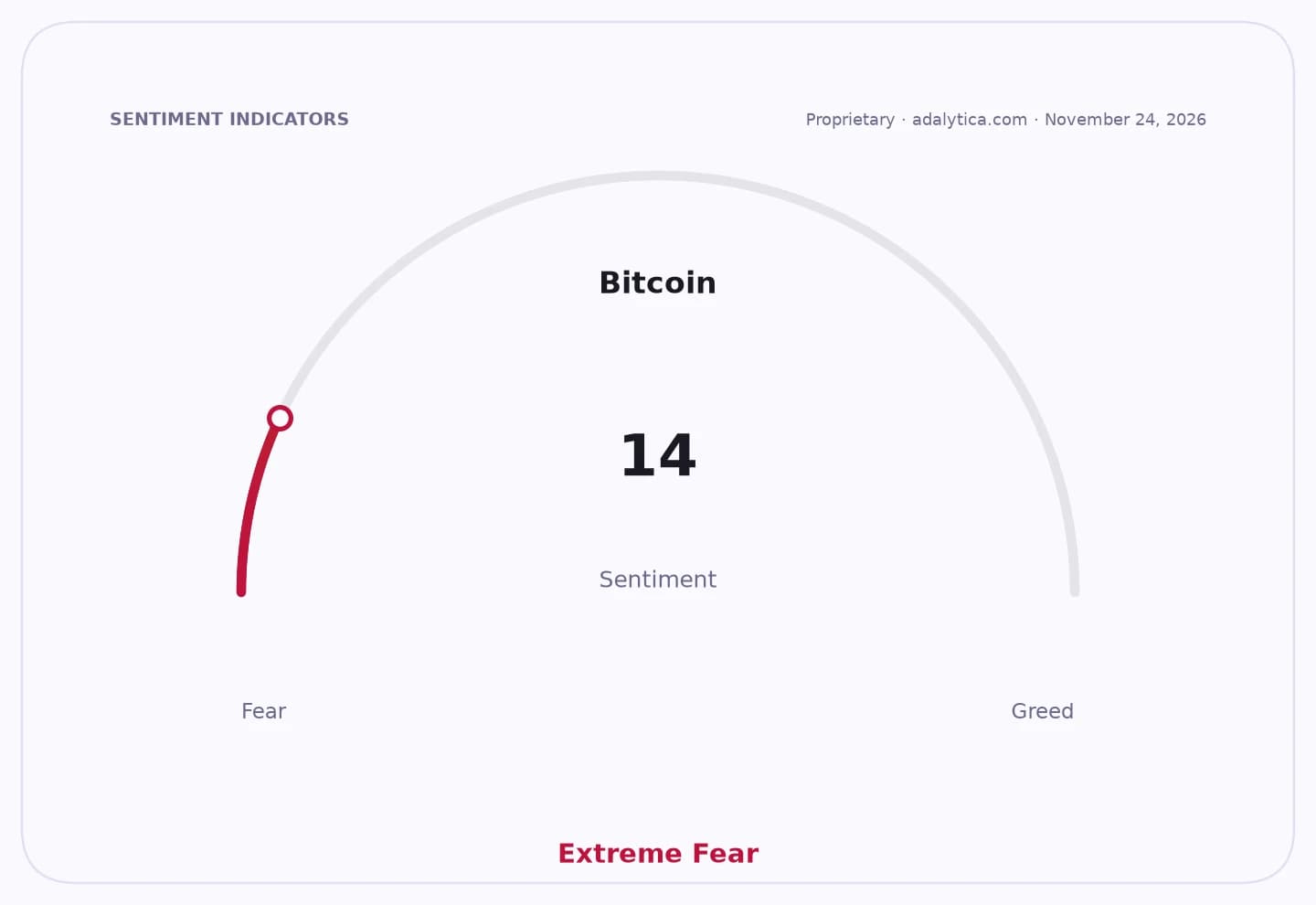
Bitcoin has fallen more than 17% over the past month to its lowest level in nearly five months, while Adalytica’s Bitcoin Fear & Greed Index sits at 9, or “Extreme Fear.” That is a stark signal that the market is not just correcting, but de-risking. In that environment, even a marquee IPO like Anthropic’s $81 billion debut could not steady broader growth trades, which suggests the selloff is being driven less by single-name news than by a shift in how investors are pricing the entire AI-and-tech complex.
The pressure is not confined to crypto. Wall Street extended a six-session losing streak, with the S&P 500 down 2.02% and more than 90% of its constituents lower, while Nvidia dropped another 3.3% despite revenue of $115.8 billion for the quarter and a $130 billion sales forecast for the next one. In Asia, semiconductor-heavy markets were hit especially hard, with Taiwan’s benchmark down 17.5% for the week and South Korea and Japan also slumping. That matters for Bitcoin because the asset has increasingly traded as part of the same liquidity-sensitive, high-beta cohort as growth equities and AI beneficiaries.
The technical picture on the major Bitcoin proxies reinforces the stress. IBIT has fallen to 32.87 from above 55 earlier in the year, with its RSI at 14.9 and price well below both the 50-day and 200-day moving averages. FBTC and GBTC show similar damage, with their respective RSI readings near 15 and 14, suggesting selling has become extended but not yet reversed. For investors, that means the debate is no longer about whether Bitcoin can attract flows in a risk-on tape; it is about how much more selling the market can absorb before ETF redemptions start to feed on themselves.
The bull case is that this is a macro-driven flush rather than a structural break: Nvidia’s numbers still point to extraordinary AI demand, and Bitcoin’s scarcity narrative remains intact. The bear case is that institutions are reassessing expensive growth assets at the same time, leaving Bitcoin without the fresh ETF inflows that supported its prior rally. Until risk appetite returns, the path of least resistance for Bitcoin and its ETFs remains lower, and every fresh bout of volatility in tech is likely to keep crypto under pressure.
| Entity | Gains | Losses |
|---|---|---|
| Cash and defensive assets | ▲Capital preservation bid | ▼Lower return potential |
| Short-term bears | ▲Momentum in downside trades | ▼Risk of sharp squeeze |
| Bitcoin ETF issuers | ▲Higher trading volumes | ▼Asset outflows, fee pressure |
| Bitcoin holders | ▲Potential oversold rebound | ▼Mark-to-market losses |