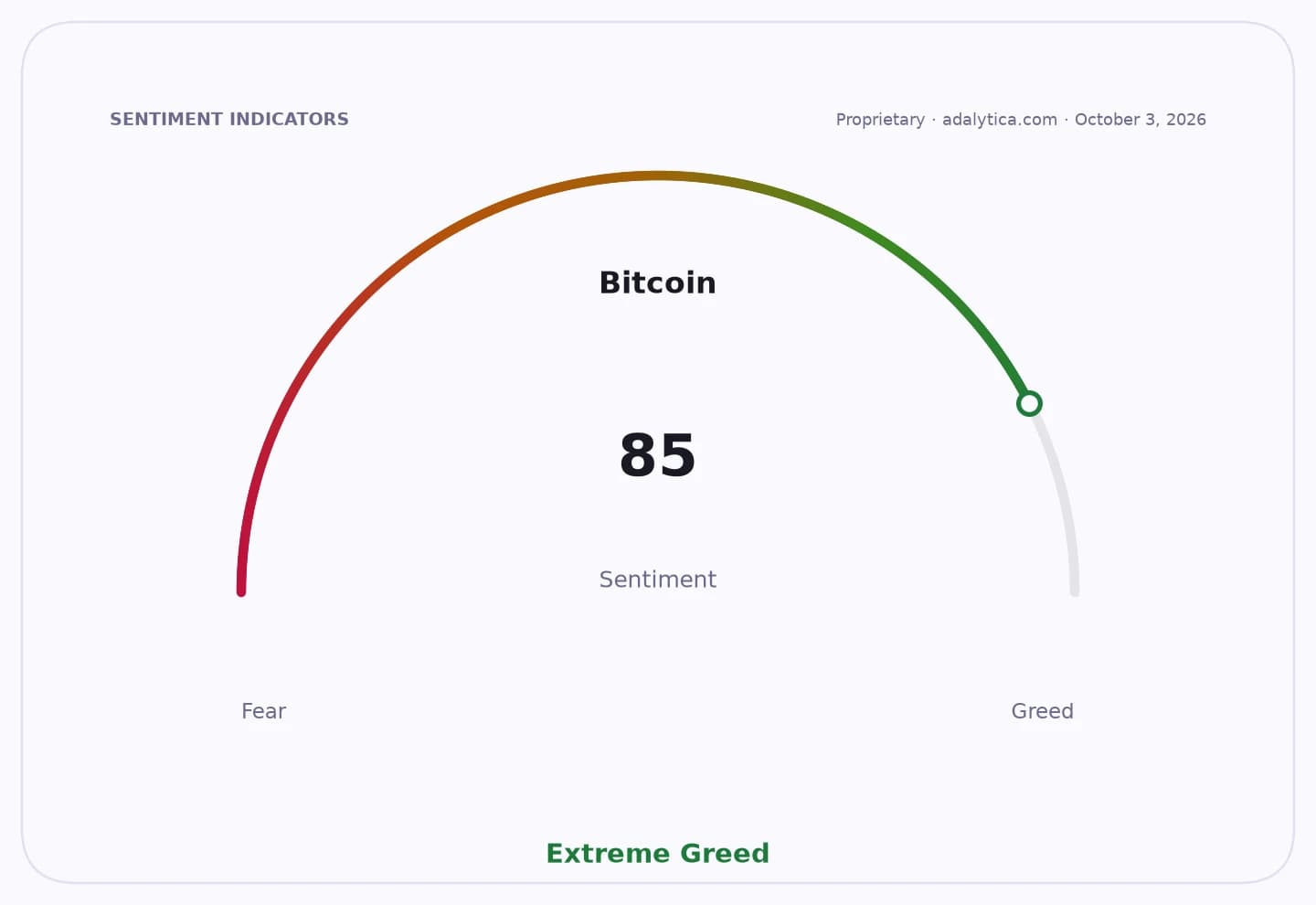
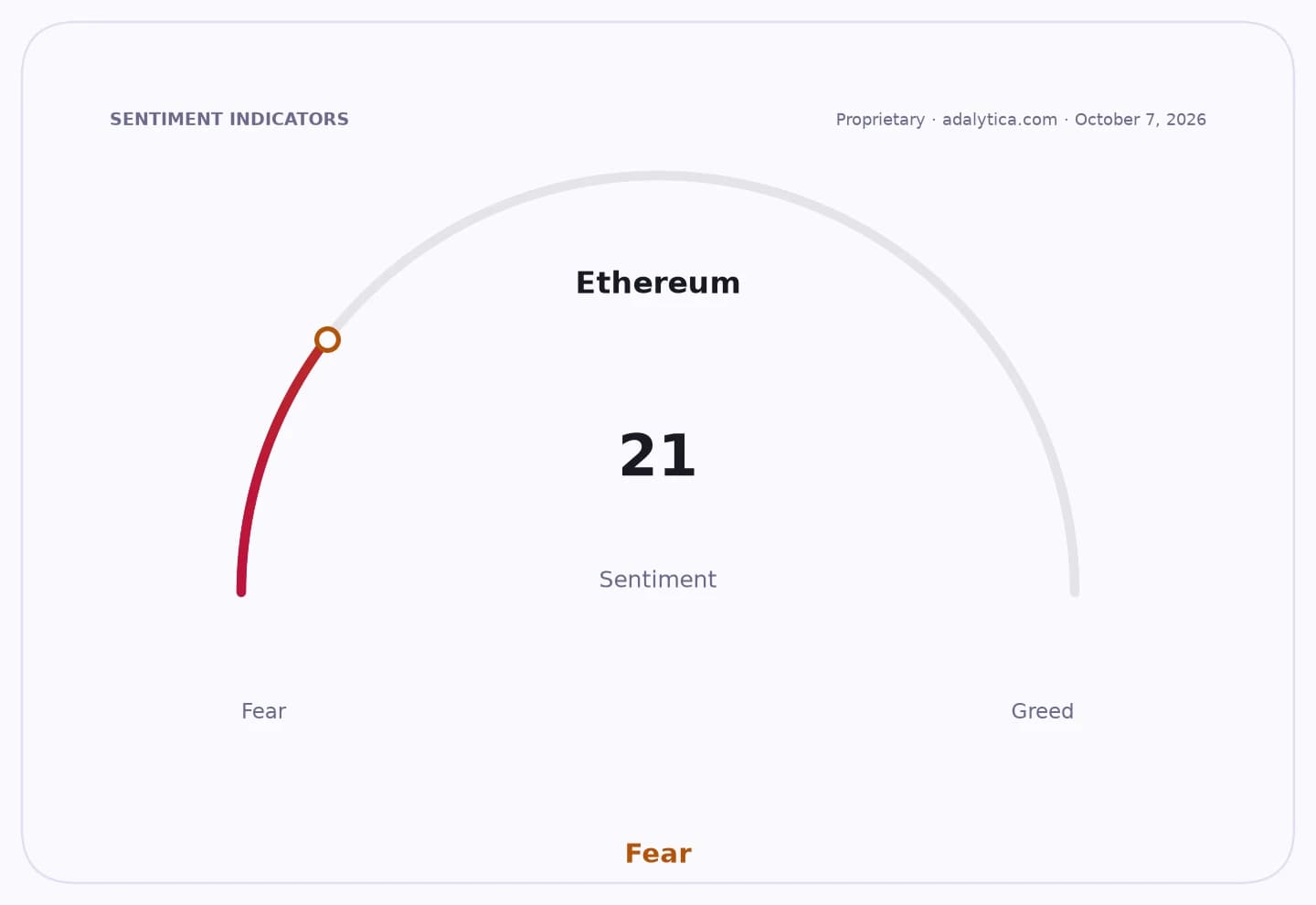
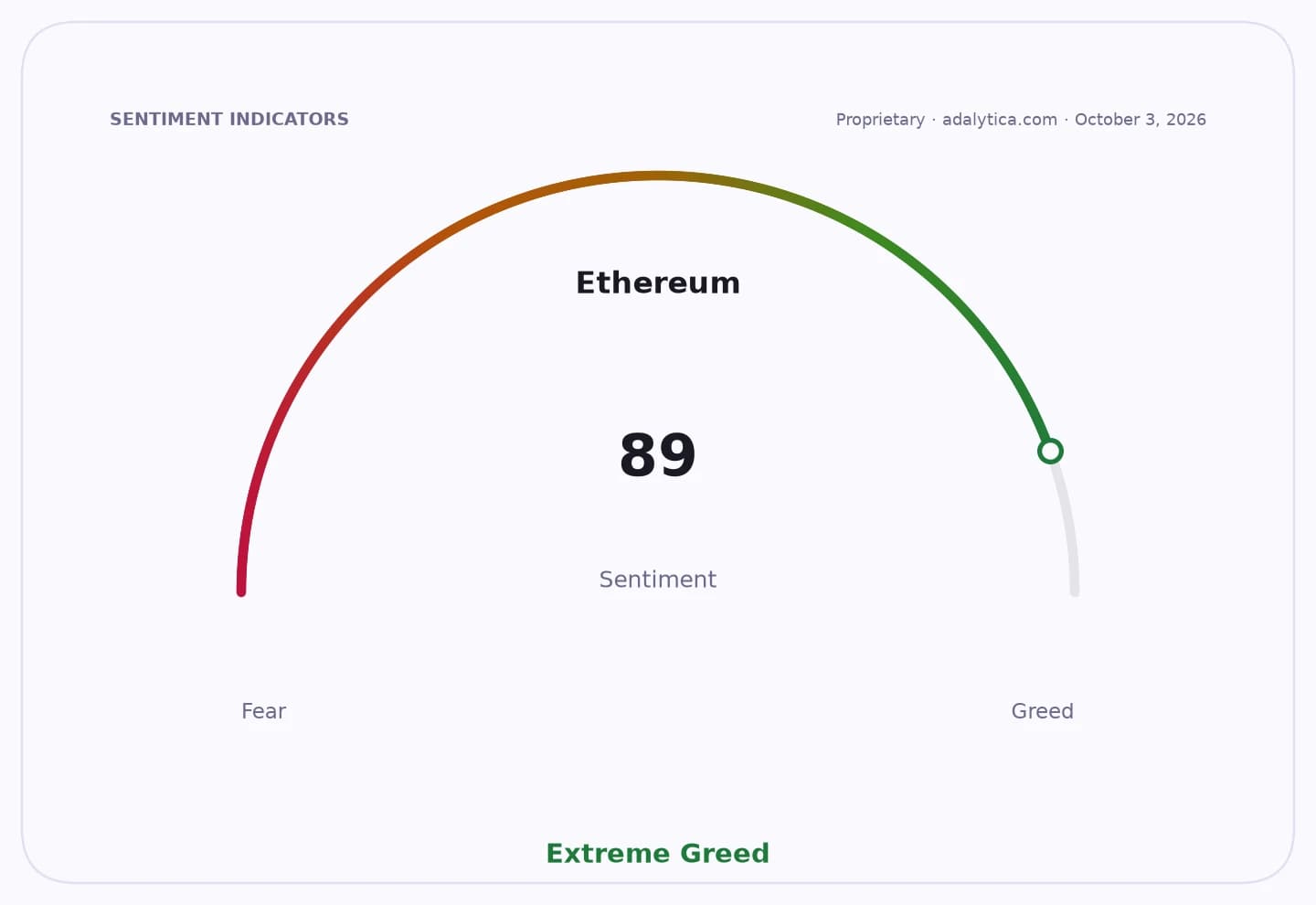
Bitcoin is losing momentum just as investors brace for the Federal Reserve’s next rate decision, while Ethereum is getting the stronger bid because lower inflation keeps alive the hope that easier financial conditions are coming later this year.
Bitcoin, Ethereum Track Fed Policy and ETF Flows

That matters because crypto is behaving less like a pure inflation hedge and more like a high-beta wager on liquidity. When bond yields and policy expectations shift, Bitcoin and Ethereum tend to react faster than most assets, and this week’s setup shows the market still anchoring on rates, not ideology. A softer-than-feared U.S. inflation report last week helped Ethereum briefly climb above $2,600 for the first time since January, while Bitcoin drifted lower even before Wednesday’s Fed announcement and a Senate vote on the Clarity Act.
Sentiment IndicatorsⓘProprietary · adalytica.com · October 7, 2026
This is a snapshot — live sentiment, awareness and momentum for 130+ markets update continuously in the dashboard.Open AlphaPulse
The contrast between the two leaders in digital assets is telling. Bitcoin spot ETFs in the U.S. saw $463 million of net outflows last week, a sharp reversal from earlier inflows, and the coin slipped to about $77,060, down 1.55% from the previous day. Ethereum, by contrast, jumped from roughly $2,433 to $2,665 after August inflation came in at 3.4%, close to expectations and enough to trigger a broad risk rally. Around $665 million in crypto positions were unwound in that move, including about $400 million in shorts, while U.S. Ethereum ETFs pulled in $216.4 million in net inflows, the best day in weeks.
For investors, that ETF split matters more than the one-day price pop. It shows where institutional money is willing to lean ahead of a policy event. BlackRock’s ETHA alone accounted for $148.8 million of those Ethereum inflows, extending its daily inflow streak to 20 trading days. That kind of consistency suggests Ethereum is benefiting from a cleaner demand story right now, while Bitcoin is being treated more like a macro asset that needs a friendlier Fed to re-accelerate.
The broader backdrop is still supportive for long-term crypto investors, but not without caveats. The Fed funds rate is around 3.75%, inflation remains above target, and the 10-year Treasury yield is above 5%, all of which keep real financing conditions tight. That is usually a headwind for speculative assets. On the flip side, a move toward easier policy would tend to help crypto-native exchanges, brokers and ETF issuers, while miners and leveraged holders remain more exposed to downside if Bitcoin keeps lagging.
There are also policy catalysts in play. The Senate vote on whether to advance the Clarity Act could shape the regulatory path for digital assets, and that matters for capital allocation over the next several years. A more predictable framework would be a net positive for institutions deciding whether to hold, trade, custody or build around crypto infrastructure. For now, though, the market is still letting rates set the tone.
Long term, that reinforces a simple lesson for investors: the big crypto names are not just stories about adoption, but about balance sheets, liquidity and rule-making. If the Fed turns less restrictive and regulators create a clearer framework, Bitcoin and Ethereum both have room to recover. Until then, Ethereum’s ETF traction and Bitcoin’s ETF outflows show why patience and diversification still matter.
| Entity | Gains | Losses |
|---|---|---|
| Ethereum investors | ▲Stronger ETF demand | ▼Short-term volatility |
| Bitcoin holders | ▲Potential Fed easing later | ▼ETF outflows and price weakness |
| BlackRock’s ETHA | ▲Heavy inflows | ▼Competitors with weaker flows |
| Crypto exchanges and infrastructure firms | ▲More activity on policy clarity | ▼Uncertainty from rate decisions |