JPMorgan Asset Management’s first long-term Bitcoin forecast gives the token a higher modeled return than U.S. large-cap stocks, a striking sign that digital assets are moving deeper into mainstream portfolio thinking even as their volatility keeps them outside standard allocation models.
Bitcoin in JPMorgan long-term return forecast
The firm’s 2027 Long-Term Capital Market Assumptions, released Oct. 19, assign Bitcoin an annual compounded return of 10% over the next 10 to 15 years, versus 7.5% for U.S. large-cap equities, 8.2% for U.S. REITs and 5.5% for gold. That makes Bitcoin the highest-returning asset in the comparison highlighted by Bitwise CIO Matt Hougan, who drew attention to the figures.
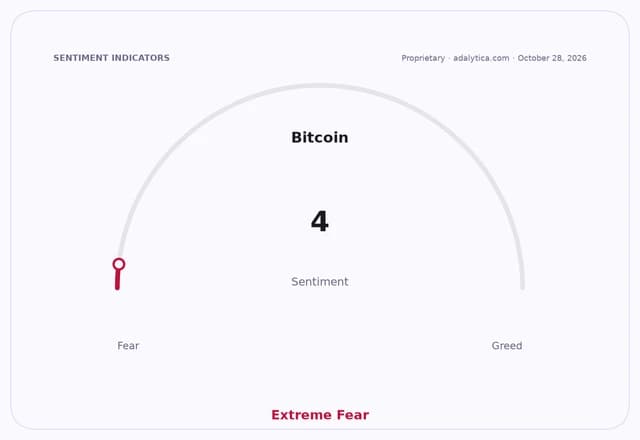
Sentiment IndicatorsⓘProprietary · adalytica.com · October 28, 2026
This is a snapshot — live sentiment, awareness and momentum for 130+ markets update continuously in the dashboard.Open AlphaPulse

For investors, the significance is less about a near-term price call than about how a major Wall Street manager now quantifies Bitcoin in the same long-horizon framework used for stocks, bonds and real assets. A modeled 10% compounded return is not a guarantee, but it does imply that JPMorgan sees enough structural demand, adoption and scarcity value to justify a premium over traditional public markets.
The forecast also lands at a time when Bitcoin’s market backdrop is far less benign. BTC has been one of the worst-performing major assets in 2026, slipping back below $81,000 in recent sessions and failing to clear resistance near $82,000. On the latest data, Bitcoin traded around $81,270, just above its 50-day moving average but still below a recent run that had briefly pushed it toward $87,000.
That weakness matters because the JPMorgan outlook assumes a much longer horizon than the current tape. Bitcoin’s 55% annualized volatility, roughly three times the firm’s assumption for U.S. large-cap equities, is the central reason the bank has not added it to its main covariance matrices for portfolio construction. In other words, JPMorgan is willing to award Bitcoin the highest return assumption, but not yet the clean statistical behavior that would make it easy to embed in a strategic multi-asset portfolio.
That tension is exactly where the story for investors sits. Higher expected return can be compelling, but only if an asset can be sized through a risk framework that survives drawdowns, correlation shifts and liquidity stress. JPMorgan’s own outlook underscores that point by separating Bitcoin from its core portfolio matrix rather than folding it into standard allocations alongside stocks and bonds.
The bank’s broader assumptions also suggest why Bitcoin can still earn a premium in a world of elevated yields and shifting macro regimes. JPMorgan’s baseline outlook incorporates higher bond yields, corporate profitability and AI-driven productivity gains. Against that backdrop, Bitcoin’s appeal likely rests on its scarcity characteristics and its role as a differentiated store of value, even if that role remains unstable from quarter to quarter.
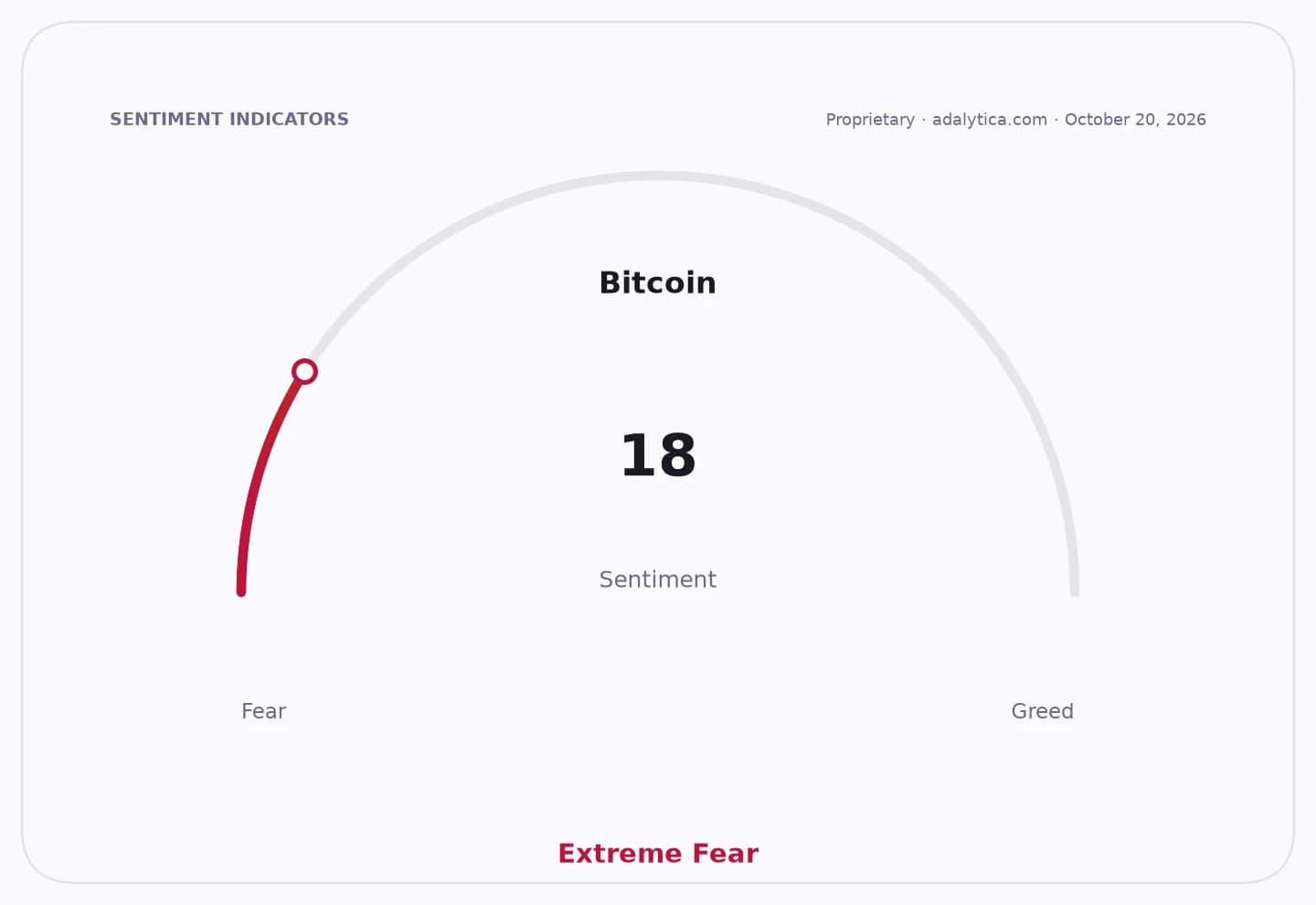
But the near-term market does not yet validate the long-term enthusiasm. Adalytica’s Bitcoin Fear & Greed Index is at 4, or “Extreme Fear,” while the S&P 500 gauge shows “Extreme Fear” on sentiment but “Extreme Greed” on awareness, suggesting investors remain highly alert to macro risks even as they continue to track equities closely. For Bitcoin, the extreme fear reading reinforces a market where positioning is fragile and conviction is thin.
Traditional finance’s growing willingness to model Bitcoin alongside large-cap stocks is still meaningful, though, because it narrows the distance between crypto and conventional capital allocation. JPMorgan’s forecast does not tell investors to buy Bitcoin outright. It does tell them that one of Wall Street’s biggest asset managers now sees enough long-run return potential to place BTC above U.S. equities in its expected-return hierarchy — a notable shift in how the market establishment prices digital assets.
For holders, the takeaway is that Bitcoin’s long-term case is increasingly being framed in institutional terms: return, volatility and portfolio fit. For skeptics, the counterargument remains equally strong: an asset with 55% volatility and unstable correlations can look attractive on paper yet remain difficult to own through the cycle. The next test will be whether Bitcoin can translate that modeled edge into a more durable market structure, especially if real rates, ETF flows and risk appetite continue to swing.
| Entity | Gains | Losses |
|---|---|---|
| Bitcoin holders | ▲Higher long-run return case | ▼Near-term volatility |
| JPMorgan Asset Management | ▲Credibility in digital-asset research | ▼No clear allocation model |
| U.S. large-cap stocks | ▲Relative benchmark status | ▼Return ranking vs BTC |
| Conservative portfolio managers | ▲Clearer risk framing | ▼Pressure to revisit crypto exposure |