Bitcoin hovered near $83,000 on Wednesday as stronger-than-expected technology earnings reignited the artificial intelligence trade, lifting Asian chip stocks and helping stabilize risk appetite across markets. The move matters because bitcoin has been under pressure for most of the past year, and a renewed bid in tech is one of the few catalysts capable of improving liquidity and sentiment in crypto without a fresh policy shift from the Federal Reserve.
Bitcoin Near $83,000 as Tech Earnings Lift Risk

The largest cryptocurrency rose 1.3% to just above $82,700 in Asian trading, while Zcash surged 11% after developers set the activation height for NU7, its next network upgrade. The upgrade is designed to cut block times to 25 seconds from 75 seconds, making payments confirm three times faster and changing the economics of transaction fees by directing 60% into a reserve paid out over time.
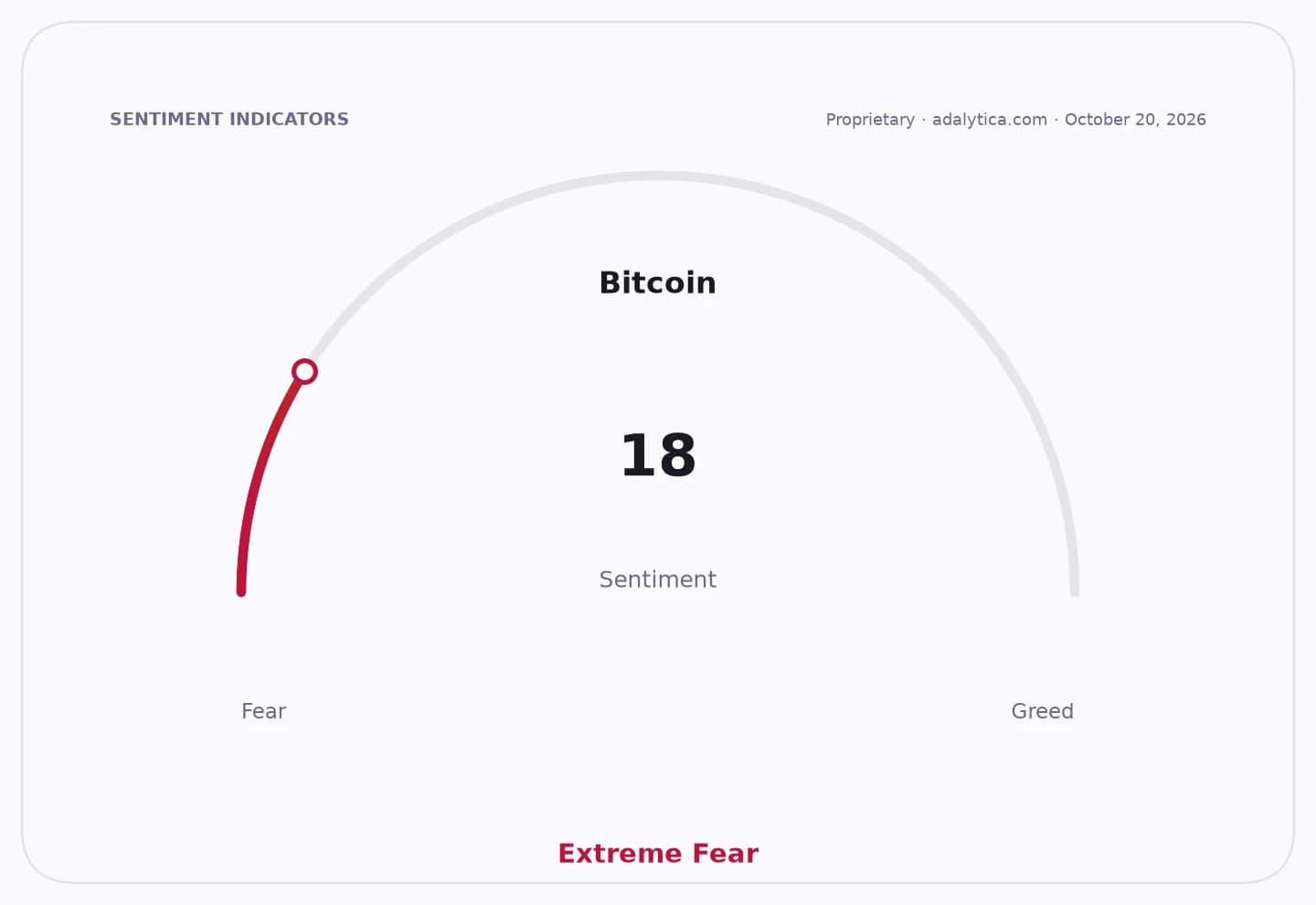
Sentiment IndicatorsⓘProprietary · adalytica.com · October 26, 2026
This is a snapshot — live sentiment, awareness and momentum for 130+ markets update continuously in the dashboard.Open AlphaPulse
For bitcoin, the bigger story is not the day’s modest gain but the way it is trading in the middle of a broader cross-asset rotation. Strong results from SpaceX and Super Micro Computer sent Nasdaq 100 futures up about 1% and pushed South Korea’s Kospi 3.7% higher and Taiwan’s Taiex 1.4% higher, reinforcing the view that the AI buildout remains the dominant equity theme. Crypto has increasingly moved with that trade, particularly when investors are willing to add beta and look through macro noise.
That matters economically because bitcoin is still functioning as a high-volatility proxy for liquidity and risk appetite. When technology earnings are strong and speculative sentiment improves, capital tends to flow back into digital assets, especially after extended drawdowns. The reverse has also been true: bitcoin’s recent slide has reflected not only Fed uncertainty but a lack of conviction from shorter-term holders, who now own just 16% of supply, according to Hashdex — the lowest share since January 2023.
Technical indicators point to a market that is trying to stabilize but has not yet confirmed a decisive reversal. Bitcoin’s price remains below its 50-day moving average, and its relative strength index has fallen to 35.6, a level that suggests momentum is weak but not yet fully washed out. The token also remains below the $84,000 threshold analysts say would be needed to show strength ahead of the Fed’s Oct. 27-28 meeting.
Zcash’s move highlights a different part of the crypto market: idiosyncratic catalysts can still dominate smaller tokens even when bitcoin is mostly waiting for macro cues. The upgrade has been running on the test network since early October, and the price reaction shows traders continue to reward protocol changes that improve speed or scarcity mechanics. HYPE, DOGE and XRP also gained, while ether rose about 2%, suggesting the broader market was participating rather than reacting to a single coin-specific event.
The backdrop is still mixed. Brent crude climbed above $110 a barrel as attacks near the Strait of Hormuz threatened shipments, while the dollar firmed and Treasuries gave back some of Tuesday’s gains. That combination is not ideal for risk assets, but the market appears willing to look past it for now as long as tech earnings keep beating expectations.
For investors, the immediate question is whether the AI-led rebound in equities can translate into a more durable bid for bitcoin, or whether the rally fades once the earnings impulse passes. If bitcoin can reclaim $84,000 before the Fed meeting, it would strengthen the case that the worst of the bear phase is ending. If it cannot, the market may continue to treat crypto as a tactical trade rather than the start of a broader uptrend.
| Entity | Gains | Losses |
|---|---|---|
| Bitcoin bulls | ▲Improved risk appetite | ▼Need $84,000 reclaim |
| AI tech stocks | ▲Earnings momentum | ▼Australian data-center names |
| Zcash holders | ▲NU7 upgrade catalyst | ▼Short-term profit takers |
| Risk assets broadly | ▲Better liquidity tone | ▼Rate and oil volatility |