Bitcoin’s sluggish rebound is being held back less by crypto-specific weakness than by a simple math problem: U.S. Treasury yields are once again offering investors a compelling alternative to a volatile asset that pays nothing.
Bitcoin Rebound Delayed by Higher Treasury Yields
That is the core of Strategy executive chairman Michael Saylor’s argument, and the market data backs him up. Bitcoin was trading near $76,700 on Nov. 2, still about 39% below its October 2025 peak even after recovering roughly 22% since late July. The 10-year Treasury yield has climbed to about 5%, up from roughly 4% a year earlier, while inflation expectations have barely budged. That means investors can now earn a real return of about 2.6% on government paper with no credit risk, a far more attractive proposition than parking money in bitcoin while the Federal Reserve is expected to keep policy tight and possibly hike again in December.
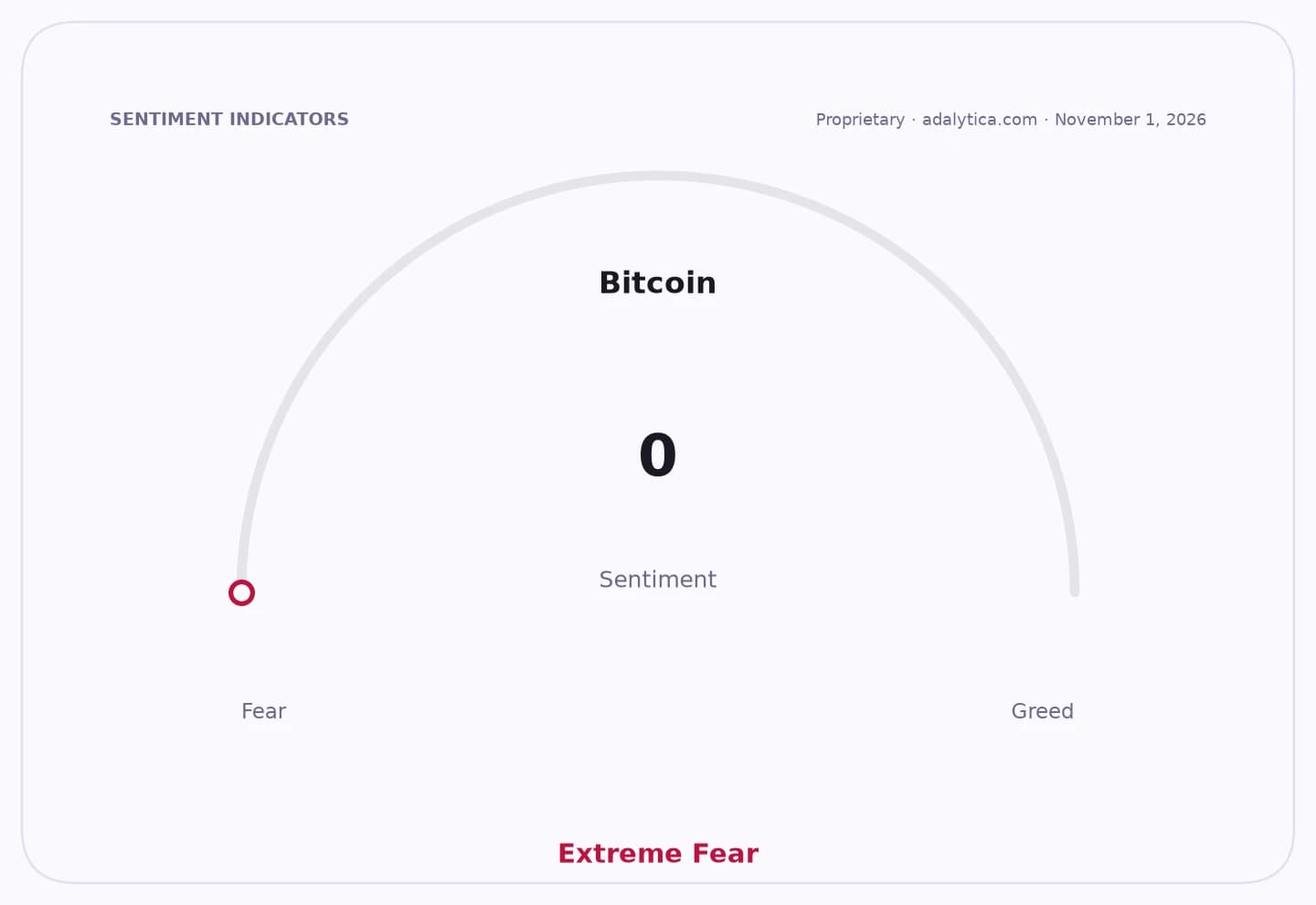
Sentiment Indicators
That matters because bitcoin’s bull case has always depended on liquidity, not just scarcity. When capital is abundant and rates are low, investors are willing to pay up for an asset with no yield and no backing. When safe income rises, that calculus changes fast. Saylor has pointed to three forces slowing bitcoin’s recovery — trade tension, the AI infrastructure boom and higher yields — but the yield channel is the cleanest and most immediate. Tariff noise can soften growth expectations, and AI spending can pull capital into data centers and semiconductor names. Yet those are competing narratives. Treasury yields are a direct discount-rate pressure on all non-income assets, and bitcoin is near the top of that list.
The bond market is reinforcing the message. The 10-year Treasury yield has been hovering around 5%, while the 10-year breakeven inflation rate has been steady near 2.3%, suggesting the recent rise in yields is not simply inflation fear. Strategy’s own behavior reflects the strain: the company paused bitcoin purchases between Oct. 19 and Oct. 28, even as it remained the largest corporate holder with 848,517 coins. For a company built around leveraged bitcoin accumulation, that pause is notable.
DGS10 vs T10Y2Y — macro contextadalytica.com
Explore this data interactively — full history, time series and cross-market comparisons.
US Treasury
For investors, the implication is not that bitcoin’s long-term thesis is broken. It is that the next meaningful leg higher is likely to be delayed until yields stop rising or start falling in a durable way. If the Fed eases, real yields retreat and risk appetite broadens, bitcoin can recover much more forcefully. But if the 10-year stays near 5% and policy remains restrictive into year-end, the market is likely to keep favoring cash flow, bond income and AI infrastructure over a non-yielding digital asset.
In other words, the trade is not dead — it is waiting on rates. Investors who want exposure to bitcoin should recognize that the most important catalyst is no longer the halving, the ETF flow narrative or even corporate treasury buying. It is the bond market. A turn lower in yields would be the cleanest signal to re-engage aggressively; until then, bitcoin remains a high-beta asset competing with some of the best risk-free returns in years.
| Entity | Gains | Losses |
|---|---|---|
| U.S. Treasuries | ▲Higher real yields | ▼Bitcoin demand |
| Bitcoin bulls | ▲Long-term scarcity thesis | ▼Near-term upside |
| Strategy (MSTR) | ▲Potential future rebound | ▼Current treasury-value trade |
| Cash-rich investors | ▲Attractive safe income | ▼Need to chase risk assets |