The Canadian dollar’s jump to a four-week high after the Bank of Canada decision suggests the market is starting to price in a more balanced policy backdrop for Canada — and that matters because positioning still says most traders are betting against the loonie.
BoC Surprise Fuels Canadian Dollar Short Covering
That mismatch is the story. Speculators have lifted bearish bets on the Canadian dollar to the highest level in 18 months, even as the currency has started to rebound. When positioning is this one-sided, even a modest policy surprise can force a sharp unwind. For investors, that creates an asymmetric setup: the loonie does not need a full-blown bull case to extend higher, only enough conviction that the Bank of Canada is not about to fall behind the Federal Reserve.
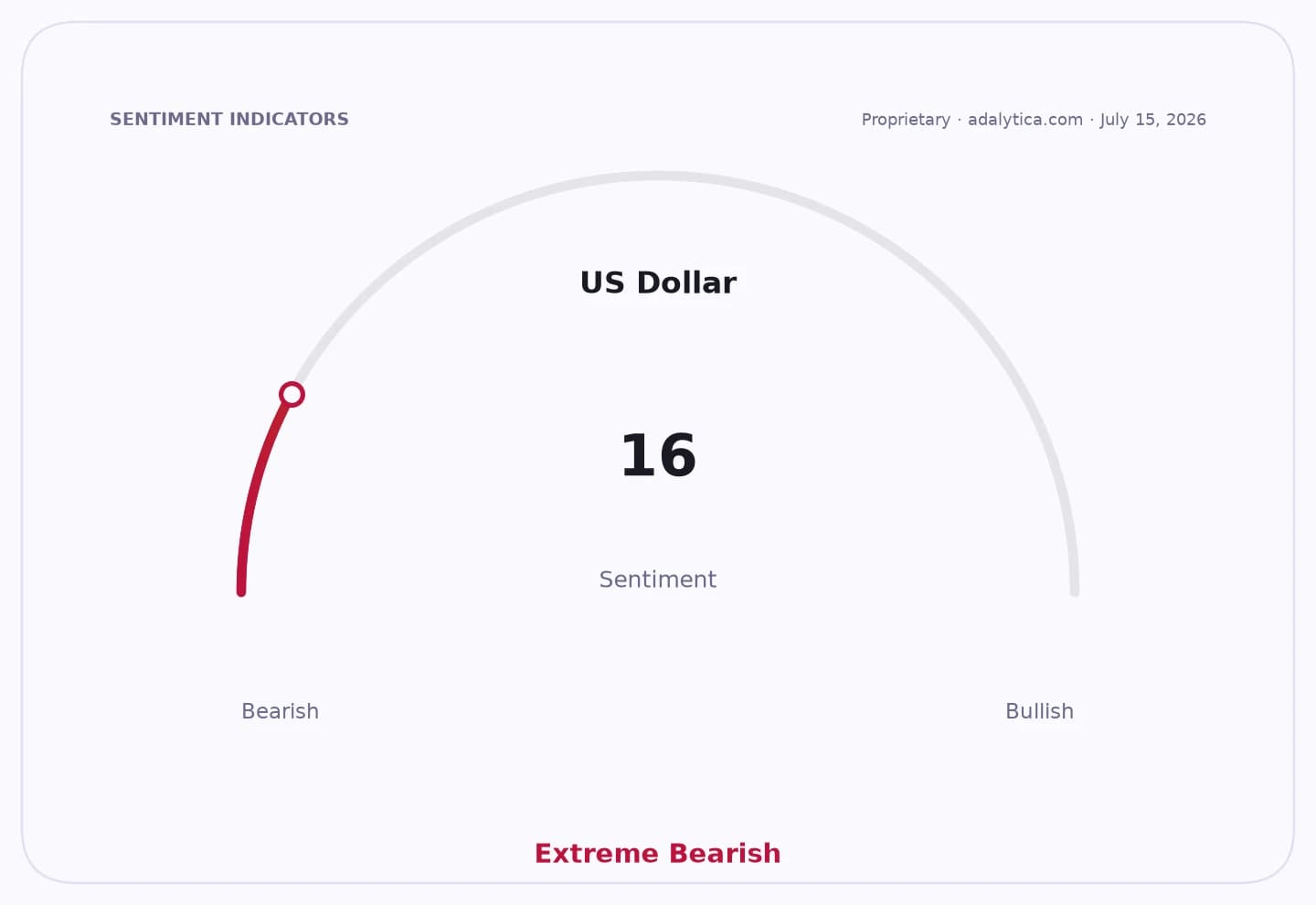
Sentiment IndicatorsⓘProprietary · adalytica.com · July 15, 2026
This is a snapshot — live sentiment, awareness and momentum for 130+ markets update continuously in the dashboard.Open AlphaPulse
The macro backdrop helps explain why. U.S. policy remains restrictive, with the fed funds rate still around 3.6% and the 10-year Treasury yield near 4.6%, but the direction of travel in Canada matters more for the next leg of the currency. If the BoC’s stance signals patience rather than renewed easing, the rate gap with the U.S. stops widening and could even start to narrow in market pricing. That is a real tailwind for CAD, especially after a period when the greenback had been propped up by higher U.S. yields and risk-off flows.
The move also comes against a backdrop of softer dollar sentiment more broadly. Adalytica’s U.S. Dollar Trade Signals show sentiment in fear territory, and the recent pullback in the dollar has given cyclical currencies room to breathe. The Canadian dollar has lagged many of its peers because it is tightly linked to growth, commodities and rate expectations — which is exactly why a policy inflection can hit it harder in both directions.
The price action in the currency market reinforces that thesis. The broader Canadian-dollar proxy, FXC, has climbed back above its recent lows, while the spot CADUSD pair has pushed to its strongest level in four weeks. The technical picture is improving as well, with the exchange rate reclaiming its 50-day and 200-day moving averages and momentum indicators turning higher. That does not guarantee a straight-line advance, but it does tell us the market is no longer treating the loonie as a dead money trade.
For investors, the implication is straightforward: this is not just a forex story, it is a positioning story. A crowded short can become a fuel source when the central bank stops validating the bearish consensus. Canadian banks and domestically focused equities can also benefit if currency stability reduces imported inflation pressure and improves confidence in the policy path. Royal Bank of Canada is already trading near record levels, but the bigger opportunity may lie in currency-sensitive vehicles like FXC for those looking for direct exposure to a loonie rebound.
The market underestimates how quickly expectations can change when a central bank stops surprising dovishly. If the BoC holds firm while U.S. policy stays restrictive, the Canadian dollar has room to extend beyond a short-covering bounce. This is the kind of inflection point that can turn a disliked currency into a trade with real upside. For now, the best way to play it is to stay long Canadian dollar exposure, while the consensus is still leaning the other way.
| Entity | Gains | Losses |
|---|---|---|
| Canadian dollar | ▲Short-covering rally | ▼Bearish speculators |
| FXC ETF | ▲Higher CAD exposure | ▼Currency bears |
| Royal Bank of Canada | ▲Stronger home-currency backdrop | ▼Import-cost pressure |
| U.S. dollar | ▲Softer policy premium fades | ▼Rate-sensitive long positions |