Delivered at market open — research, news and trade ideas in one email, weekdays.
Jair Bolsonaro, former President of Brazil, smiling at an event.
Jair Bolsonaro’s hospitalization with a near-total intestinal obstruction adds a new layer of uncertainty to Brazil’s already fragile political backdrop, with the former president in intensive care and doctors warning he may need surgery.
The medical update matters because Bolsonaro remains one of Brazil’s most powerful political actors even while under house arrest, and any deterioration in his condition could ripple through the country’s polarized politics, legal strategy and market expectations for policy risk. A more serious health setback would not just interrupt his public presence; it could also reshape the balance of pressure on Brazil’s institutions at a moment when investors are already skittish on domestic volatility.
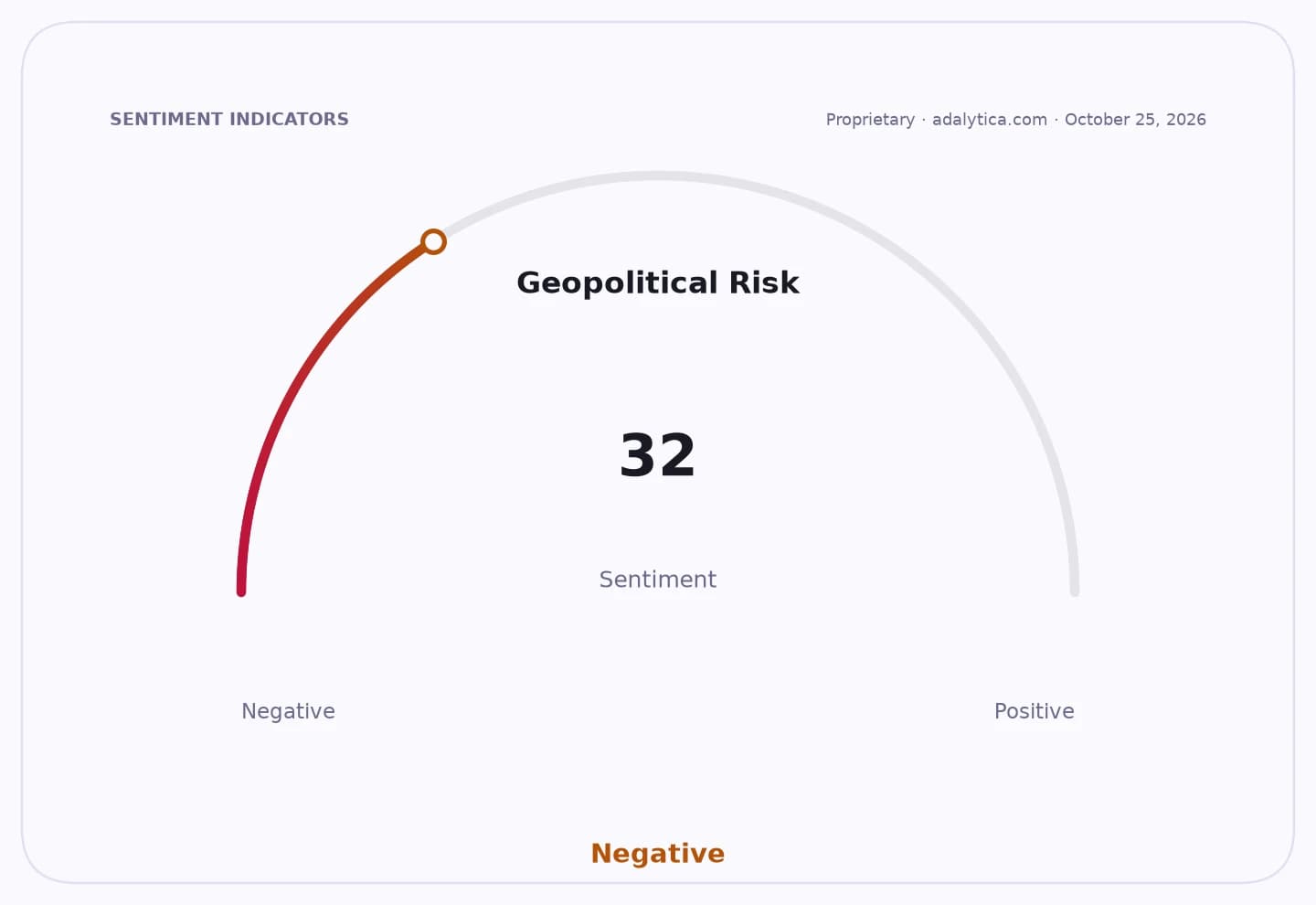
Geopolitical Risk sentiment sits at 4, indicating a deeply negative outlook.
The hospital said Bolsonaro was stable, conscious and breathing on his own, but had been admitted to DF Star in Brasília after suffering severe abdominal pain. His physician said scans showed a “almost total” obstruction in the small intestine and that surgery was possible. Bolsonaro has already undergone procedures for intestinal blockage, including one in April, underscoring the recurring nature of the problem and the likelihood that his recovery could be prolonged.
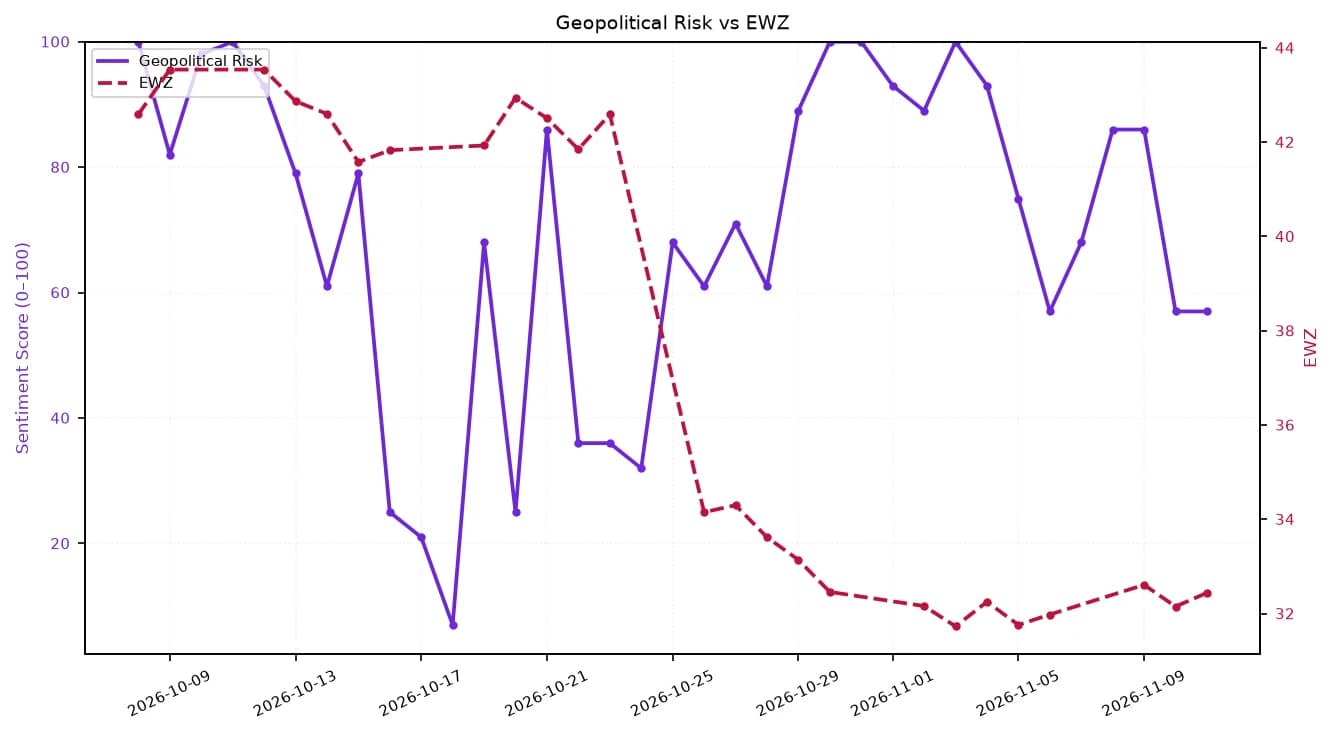
For investors, the immediate read-through is not about direct economic damage from a single hospitalization. It is about risk premium. Brazilian assets are sensitive to political headlines because leadership uncertainty can quickly translate into volatility in the real, local rates and equities tied to domestic sentiment. That is especially relevant now, when markets are already punishing Brazilian risk: EWZ, the iShares MSCI Brazil ETF, has fallen to $28.54 from $42.59 in late October, while Petrobras ADRs have dropped to $16.01 from $26.16 over the same stretch. Both are trading well below recent levels, and the broad selloff shows how quickly investors have shifted toward caution on Brazil.
Geopolitical Risk Awareness sits at 57, indicating a medium level.
Technically, the damage is clear. EWZ is trading far below both its 50-day and 200-day moving averages, with its RSI deep in oversold territory and MACD negative, while Petrobras ADRs have also collapsed beneath both key moving averages with an RSI around 10, signaling extreme weakness. Those are conventional technical indicators, not a fundamental thesis by themselves, but they reinforce the broader message: the market is already pricing in a great deal of bad news, and political shocks can keep the discount in place.
That is where the asymmetric setup begins to matter. If Bolsonaro’s condition stabilizes quickly and the legal-political noise fades, Brazil’s beaten-down assets could see sharp relief rallies simply because positioning is so defensive. If the situation worsens, the market may extend the risk-off move, pressuring domestic equities and keeping foreign capital on the sidelines. In either case, the headline reminds investors that Brazil’s next big move may come less from earnings than from politics.
My view is that the market underestimates how much of Brazil’s valuation gap is tied to headline risk rather than economics alone. The country still offers long-term exposure to commodities, energy and financials, but near-term traders should respect the volatility. For now, Bolsonaro’s hospitalization is another reason to stay selective, favor exporters and cash-generative names over domestic beta, and watch for any sign that political uncertainty is spilling further into asset prices.
Entity
Gains
Losses
Defensive exporters
▲Relief from weaker domestic sentiment
▼Less immediate upside if politics stabilizes
Domestic Brazilian equities
▲Potential rebound on stability
▼Higher volatility and risk premium
Bolsonaro allies/market bulls
▲Sympathy and short-covering if condition improves