Brazil’s election result has turned into a market event: investors are treating the anti-Lula vote as a pivot toward fiscal restraint, friendlier capital flows and a stronger hand against policy drift.
Brazil election lifts EWZ, Petrobras, and real

That matters because Brazil has spent years pricing a tug-of-war between state intervention and market credibility. A clearer rejection of President Luiz Inácio Lula da Silva’s political project would, in theory, reduce the odds of looser spending, heavier regulation and fresh pressure on the central bank. For global investors, that is the difference between a market that stays trapped in “cheap for a reason” territory and one that can re-rate on reform expectations, yield support and a more disciplined macro mix.
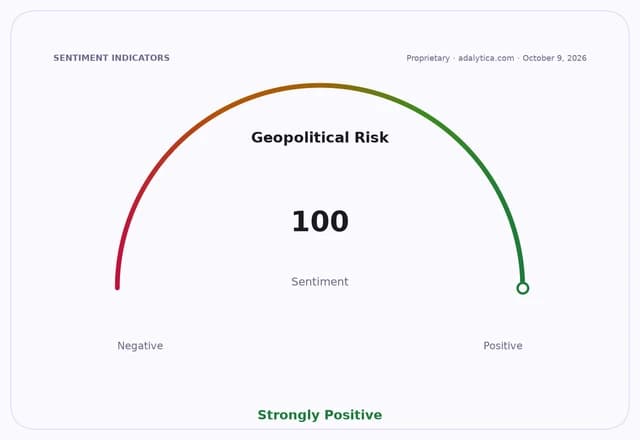
Sentiment IndicatorsⓘProprietary · adalytica.com · October 9, 2026
This is a snapshot — live sentiment, awareness and momentum for 130+ markets update continuously in the dashboard.Open AlphaPulse
The market is already voting with its feet. The iShares MSCI Brazil ETF, EWZ, has surged to $42.59, up sharply from $35.47 on July 29, and is now trading well above both its 50-day and 200-day moving averages. Petrobras ADRs have moved even harder, with PBR closing at $24.69 on Oct. 8 after sitting at $17.45 on Aug. 7 and $20.86 on Sept. 2. Those are not sleepy moves; they are the kind of price action that typically reflects a new political discount being applied to Brazilian assets.
The real story is not just the vote itself. It is the reset in expectations around the state, the judiciary and Brazil’s ability to restore policy credibility. The Spanish-language commentary framing the election as a rejection of Lula captures that mood: fatigue with spending, frustration over inflation and interest rates, and a sense that institutions have become too politicized. Whether or not every claim survives closer scrutiny, the investment implication is clear. When political risk shifts from “more intervention” to “less certainty about intervention,” Brazilian equities and the real can rerate fast.
That is already showing up in the currency. The real was around 5.02 per dollar on Oct. 9, after trading near 5.28 in early March and 5.59 late last year. On the surface that is still weak, but the direction matters: a steadier real would ease imported inflation pressure, help the central bank keep policy tighter for longer and support local fixed income. For investors, that combination is powerful because Brazil offers one of the highest carry trades in emerging markets when inflation expectations are anchored.
Petrobras remains the most obvious high-beta beneficiary. The stock’s breakout suggests investors are pricing a more market-oriented approach to capital allocation, dividends and fuel pricing. Even without any formal policy change, the equity story improves if Brasília looks less likely to lean on the company as a political tool. That makes Petrobras a classic election leverage trade: if fiscal discipline improves, the company’s cash generation and distributions matter more; if politics backslides, the rerating can unwind just as quickly.
The broader macro backdrop makes this even more investable. U.S. 10-year yields are around 5.3%, keeping global capital selective and forcing emerging markets to earn foreign inflows with credibility, not just valuation. Brazil can do that if it convinces investors that fiscal risk is easing rather than deepening. In that sense, the election is less about one leader and more about whether Brazil can reclaim the premium it once had as a high-yield, reform-capable market.
My view is that the market is still underpricing the second-order winners. Beyond Petrobras, investors should watch Brazil banks, local consumer names and the broader EWZ complex, which still has room to run if policy risk keeps easing. If the political message hardens into governing reality, the next leg higher could come from lower risk premiums rather than earnings upgrades alone.
For now, the trade is straightforward: stay long Brazil where balance sheets are strong and policy sensitivity is low, and keep a close eye on Petrobras and EWZ as the cleanest ways to express a potential post-election repricing.
| Entity | Gains | Losses |
|---|---|---|
| EWZ | ▲Lower Brazil risk premium | ▼Lula-aligned policy risk |
| Petrobras (PBR) | ▲Higher rerating, dividend appeal | ▼State interference fears |
| Brazilian real | ▲Capital inflows, tighter inflation outlook | ▼Fiscal slippage, political uncertainty |
| Lula/PT bloc | ▲None | ▼Electoral rejection, weaker mandate |