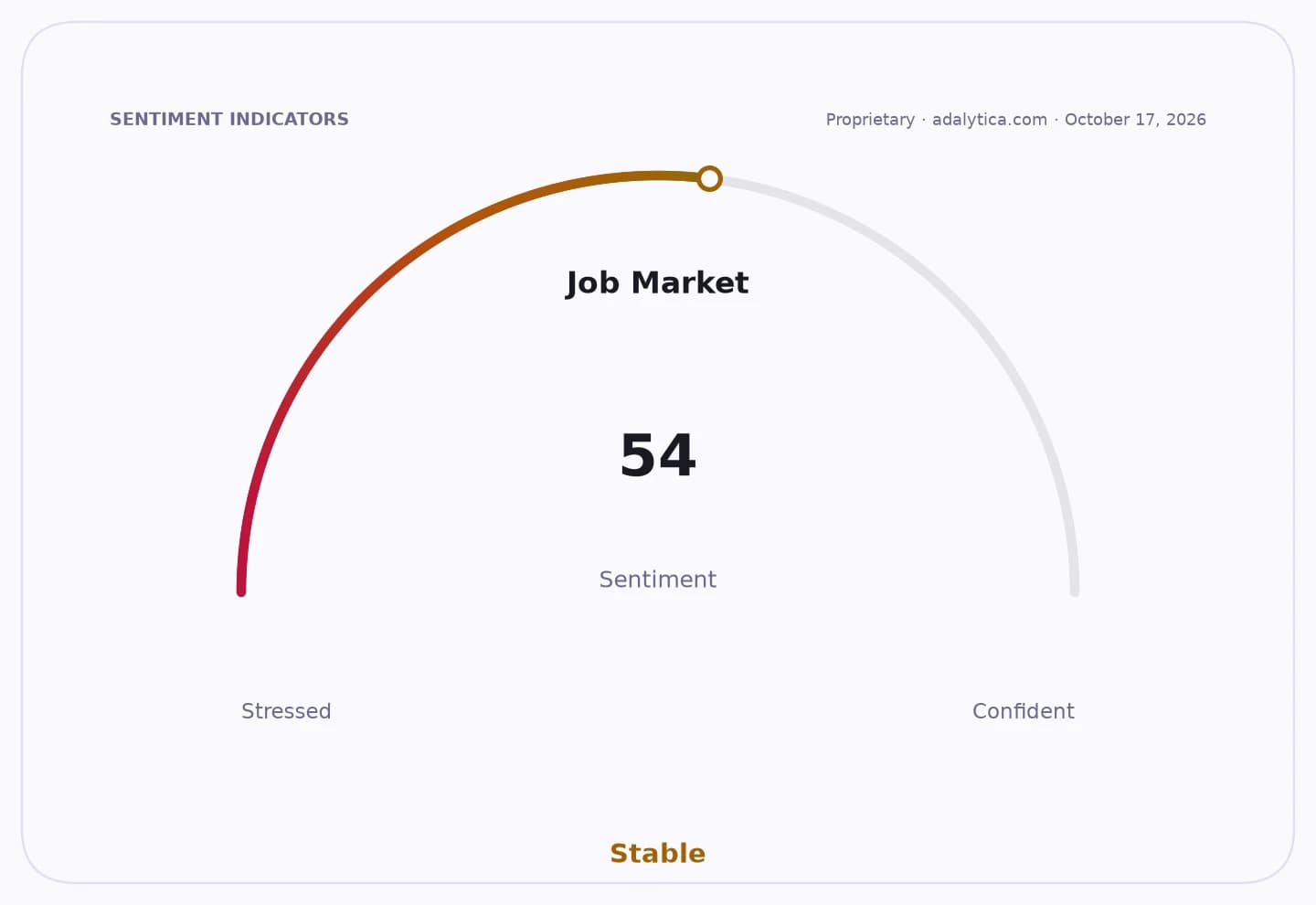
Brazil’s move to phase out the six-days-on, one-day-off work pattern for formal employees is set to reshape staffing costs, payrolls and operating schedules across the country’s biggest occupations, with 22 million workers eventually gaining two weekly days off without a cut in salary.
Brazil labor reform raises staffing costs
The constitutional change matters because it alters the price of labor at scale in an economy where retail, logistics, food service, cleaning, construction and health care rely heavily on long, rotating shifts. Employers will have to absorb the same monthly pay against fewer hours, while overtime, Sunday work and holiday premiums become more expensive just as many sectors are already short of labor and under pressure to maintain service levels.
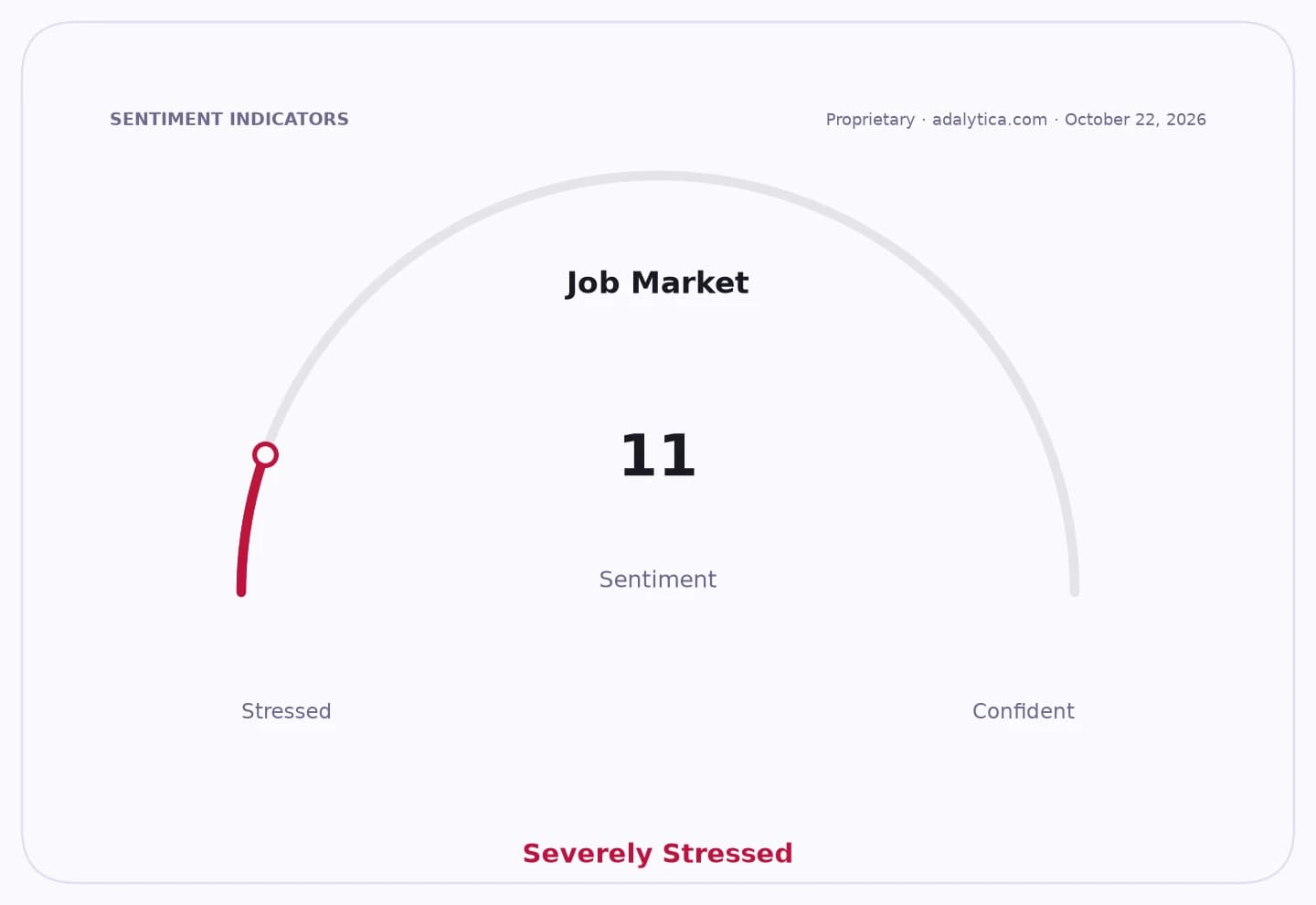
Sentiment IndicatorsⓘProprietary · adalytica.com · October 22, 2026
This is a snapshot — live sentiment, awareness and momentum for 130+ markets update continuously in the dashboard.Open AlphaPulse

The transition starts in December, when the standard workweek falls to 42 hours and two weekly rest days become mandatory, one preferably on Sunday. By the end of 2027, the ceiling drops to 40 hours. That is likely to lift the effective hourly wage even before any salary negotiations. Using the minimum wage of 1,621 reais as a benchmark, the hourly rate rises to 8.11 reais from 7.37 reais, while overtime climbs to 12.16 reais, a 50% premium, and work on Sundays and holidays to 16.21 reais, or double the base hour.
That arithmetic will ripple through the 30 occupations that employ the most Brazilians, especially roles that depend on six-day rosters. For supermarket cashiers, store attendants, receptionists, kitchen workers, delivery assistants, cleaning staff and warehouse workers, the immediate change is less about headline job titles than about redesigning shifts so businesses can preserve weekend trading while honoring two rest days. In many cases, the 12x36 arrangement used in security, nursing and fuel retail may survive, but only if it is adapted to the new weekly limits and collective agreements.
The biggest pressure point is staffing efficiency. A retailer, restaurant or logistics company that keeps operating seven days a week will need more people on the roster or tighter shift rotations to cover the same hours. That raises wage bills and may limit margin recovery in labor-intensive businesses. The effect is even more pronounced in construction, where the text notes that overtime is common when projects fall behind schedule, and in trucking, where longer hauls will have to be recast around compulsory rest periods and delivery deadlines.
Investors should see the reform as a broad re-rating of labor costs rather than a simple workers’ rights story. Companies with strong pricing power or automation capacity should cope better than small employers that depend on thin margins and manual labor. Public-facing sectors such as food service, supermarkets, janitorial services and transport are most exposed, while businesses with already standardized five-day schedules face less disruption. The reform also adds another layer of complexity to public contracts and outsourced work, where transitions may be delayed by amendments and union negotiations.
The market backdrop underscores why the policy matters beyond the labor file. Brazil’s labor market has been tight enough to keep wage bargaining relevant, while political support for shorter hours is broad, according to recent polling cited in the report. The government’s approval of a string of labor agreements and its wider push to formalize working conditions suggest the reform is part of a broader shift toward stronger worker protections. For investors in Brazil assets, that means watching for second-round effects on company earnings, inflation pass-through and consumer spending, since a shorter workweek could support household income while raising the cost of services.
For now, the key variable is implementation. Some professions, including those covered by special statutes or collective bargaining, may preserve differentiated shifts. But the direction is clear: Brazil is moving away from the 6x1 model that has defined much of its formal labor market, and employers will have to decide whether to hire more staff, pay more overtime or accept lower utilization.
| Entity | Gains | Losses |
|---|---|---|
| Formal workers | ▲More rest days; higher hourly pay | ▼Less flexibility in schedules |
| Labor unions | ▲Stronger bargaining leverage | ▼Harder implementation in some sectors |
| Labor-intensive employers | ▲Predictable transition rules | ▼Higher payroll and staffing costs |
| Brazil consumer-facing sectors | ▲Potentially higher demand from wage gains | ▼Margin pressure from cost inflation |