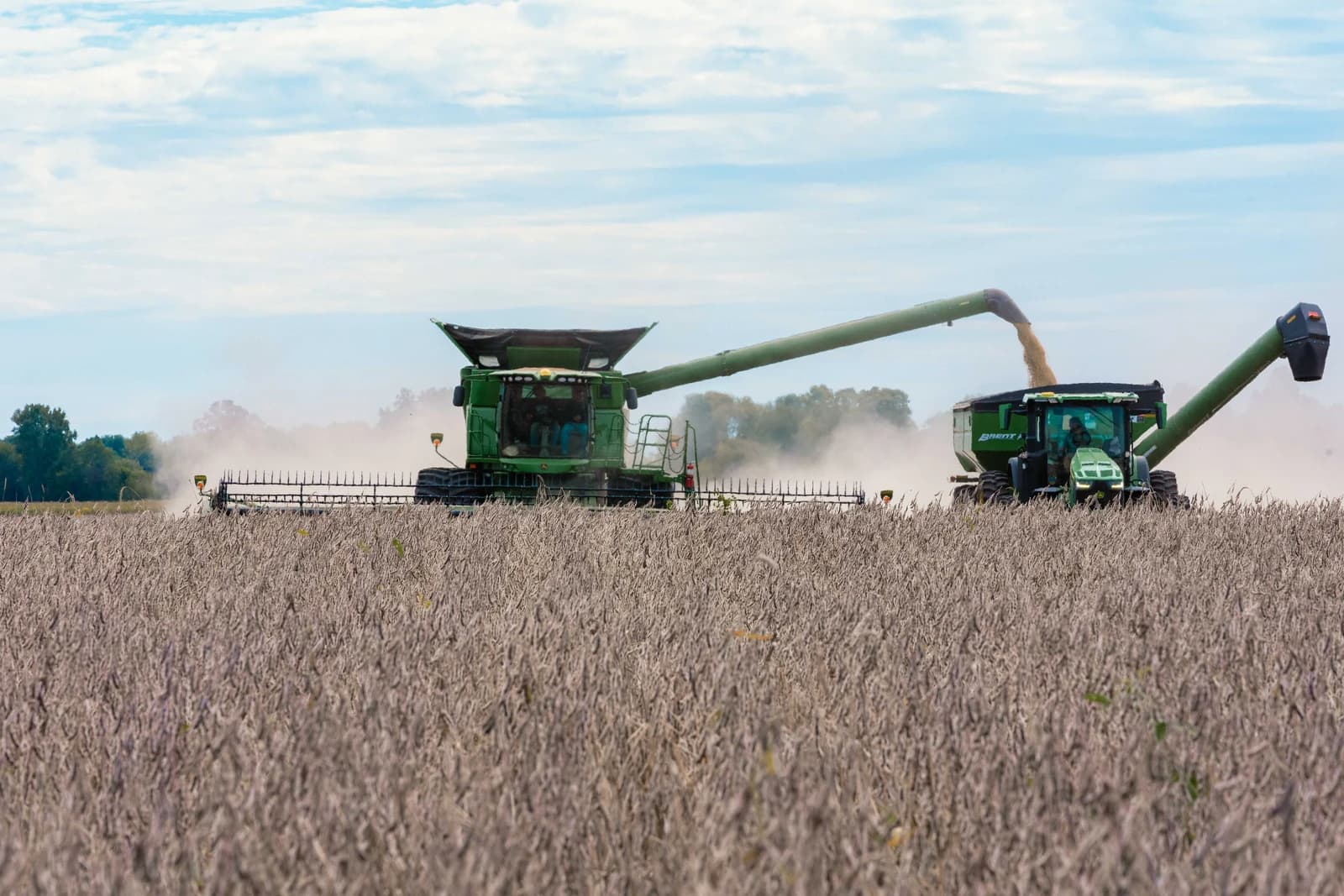
Brazil’s position as China’s dominant soybean supplier is under pressure from a three-sided shift: Beijing is reopening the door to more U.S. cargoes, pushing for greater food self-sufficiency and preparing for slower long-term demand growth as its population ages. That combination matters because China is the anchor market for Brazil’s oilseed exports, and any sustained slowdown would hit farm incomes, land values, logistics investment and export revenues across Latin America’s largest agricultural economy.
Brazil Soybean Exports Face China Demand Risk

The immediate commercial risk comes from trade normalization between Washington and Beijing. China has committed to buying 25 million tonnes of U.S. soybeans a year from 2026 through 2028 and at least $17 billion in annual U.S. agricultural goods, reviving competition for a market Brazil has dominated since 2017. While the volume is not unprecedented for U.S. exporters, it narrows the room for Brazil at a time when Chinese buyers are already sourcing some soybeans from the United States to meet the pact.
Sentiment Indicators

For Brazil, the tariff structure still offers a short-term buffer. U.S. soybeans face a 13% Chinese tariff, compared with 3% on Brazilian cargoes, which helps preserve Brazil’s price advantage. But that edge may be less decisive if Beijing decides to buy beyond the 25 million-tonne commitment, or if the two countries move further toward a broader trade thaw. Reuters and industry sources have long noted that Chinese buying patterns can shift quickly when Washington and Beijing are aligned politically.
The bigger structural threat is not trade diplomacy but Chinese policy. Soybean imports are a function of feed demand, protein consumption and livestock production, and China’s new five-year plan calls for less reliance on imported food and more domestic output of strategic commodities including soybeans, corn and meat. A Systemiq report cited in the context projects China’s soybean imports could fall about 25% by 2030, equivalent to roughly 23.5 million tonnes — nearly all of what the U.S. sold to China in 2024 or about a third of Brazil’s shipments that year.
That would ripple well beyond port terminals. Lower Chinese demand would likely pressure global soybean prices, cut export receipts and squeeze margins for Brazilian farmers. It would also weigh on the value of farmland in producing regions, slow investment in storage and processing, and reduce activity in the transport and services networks that have grown around the export boom. The same report warns of knock-on effects on rural income and employment if producers keep expanding acreage into a market that is no longer absorbing the extra supply.
Investors should also read the story through the lens of substitution and adaptation. Brazil’s soybean complex has benefited from a decade of geopolitical distortion, but that advantage can be cyclical rather than permanent. If China successfully raises feed efficiency, boosts domestic soybean yields, expands use of alternative grains such as sorghum and increases synthetic amino acids in animal rations, import growth could flatten even if meat demand holds up.
For commodity markets, the implication is that soybean prices may stay volatile rather than structurally higher. The recent technical backdrop for soybean-linked products reflects that uncertainty: the SOYB ETF has slipped below its 50-day moving average, while its relative strength index has cooled from overbought levels, suggesting momentum has faded even as China-related headlines remain supportive. Corn and broad agricultural benchmarks have also weakened, underscoring that the market is already discounting a less tight grain demand picture.
The bull case for Brazil is that trust, logistics and established supply chains still matter. Brazilian exporters can scale quickly, and China has repeatedly relied on Brazil when relations with Washington deteriorate. The bear case is more sobering: Beijing is trying to diversify suppliers, manage food security more efficiently and reduce import dependence over time. If that transition accelerates, Brazil’s soybean windfall could prove less durable than many producers have assumed.
For now, Brazil remains China’s most important soybean source. But the real question for investors is whether that is a temporary market share lead or the peak of a cycle that Beijing is already intent on unwinding.
| Entity | Gains | Losses |
|---|---|---|
| Brazil soybean exporters | ▲Near-term tariff advantage | ▼Risk of lost market share |
| China importers | ▲More supply options | ▼Higher trade-management complexity |
| U.S. soybean farmers | ▲Larger guaranteed sales | ▼Dependence on China policy |
| Brazilian rural economy | ▲Export-driven income | ▼Lower prices if demand falls |