Brazil is headed for its highest turnout failure in more than two decades, according to political scientist Jairo Nicolau, who says frustration with a stale, polarizing presidential race could push abstentions, blank ballots and null votes to record levels this year.
Brazil turnout risk rises in 2026 election
That matters because in a tight election, even a modest shift in who stays home can reshape the result as much as a late swing in preference. Nicolau, author of a recent book on Brazil’s elections, argues the country is entering what is effectively a “quiet” campaign, with fewer public debates, late-starting advertising and a debate over the Supreme Court dominating attention just as voters should be choosing among candidates.
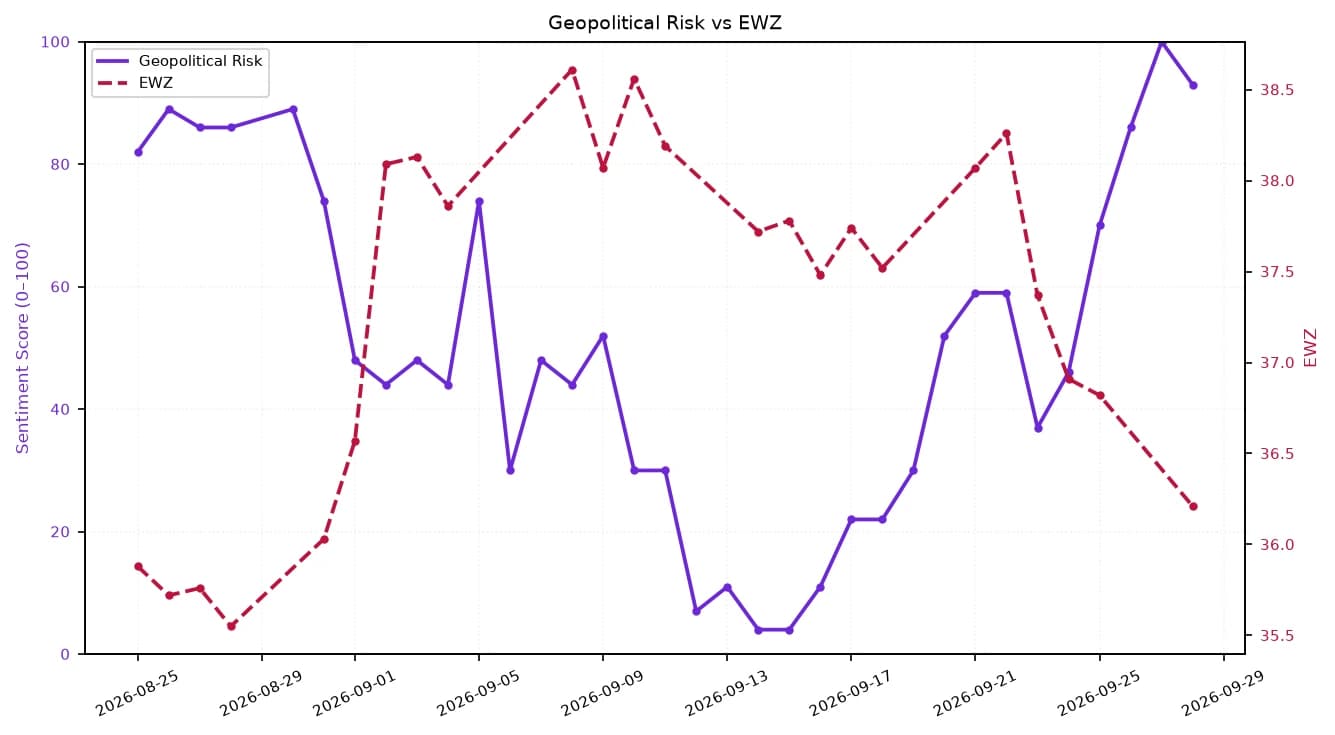
Sentiment IndicatorsⓘProprietary · adalytica.com · September 29, 2026
This is a snapshot — live sentiment, awareness and momentum for 130+ markets update continuously in the dashboard.Open AlphaPulse
He said the combination of repeated polarization between the Lula camp and the Bolsonaro bloc, weak enthusiasm for the field and lower friction around skipping the vote is making abstention easier and more politically acceptable. Brazil’s electronic voting system and the e-Título app have reduced the practical cost of not voting, while the fine for failing to appear is still low enough to be dismissed by many voters. In Nicolau’s view, the country is drifting toward “de facto” optional voting.
The macro implication is more than symbolic. Brazil remains one of the world’s largest democracies and a key emerging-market benchmark, so a broad decline in civic participation can be read as a signal of political fatigue and institutional disconnection. Nicolau said the record abstention seen in 2022 could be broken, with the possibility of the highest rate since the 2002 general election cycle.
For investors, the more important question is not only how many people skip voting, but who skips it. Nicolau said turnout patterns are uneven: women tend to vote more than men, which can help Luiz Inácio Lula da Silva, while lower-schooling voters are less likely to show up, which can work against him. That means a rise in abstention is not automatically a net benefit for either side; the geographic and demographic concentration will matter more than the headline total.
That uncertainty feeds directly into market pricing around Brazil risk. The iShares MSCI Brazil ETF, EWZ, has been volatile in recent months and was still trading just above its 50-day and 200-day moving averages late on Sept. 28, suggesting investors remain alert to election risk even as technical momentum weakened from earlier overbought levels. Petrobras, the state oil group, and BRF, the food processor, have also seen mixed trading patterns, reflecting how political outcomes can alter expectations for regulation, domestic demand and state influence across sectors.
Nicolau also pointed to the collapse of campaign intensity as a further sign that the election is underperforming as a democratic mobilization event. He described the race as unusually poor in policy debate and said the STF crisis consumed a large share of the campaign calendar, crowding out discussion of economic priorities. If that dynamic persists into election day, the biggest takeaway may not be just who wins, but how little conviction the winner inherits.
For markets, that is a warning that Brazil’s political mandate could be thinner than usual, with more room for post-election contestation and policy uncertainty. For voters, it is a sign of exhaustion. And for investors watching Latin America’s biggest economy, it raises the possibility that the real headline in 2026 is not the margin of victory, but the number of Brazilians who choose none of the above.
| Entity | Gains | Losses |
|---|---|---|
| Lula camp | ▲Women turnout edge | ▼Low-schooling abstention |
| Bolsonaro bloc | ▲Disaffected anti-PT voters | ▼Broad voter apathy |
| Political moderates | ▲Protest option via blank/null votes | ▼Polarized major parties |
| Brazil equities | ▲Lower near-term surprise risk | ▼Higher legitimacy uncertainty |