China is now examining Broadcom’s data-center hardware for state-linked use, a reminder that the next phase of the US-China tech fight is shifting from chips alone to the networking gear that ties AI clusters together.
Broadcom China Data Center Hardware Review
That matters because the market has treated Broadcom as a quieter beneficiary of the AI buildout than Nvidia, even though its switches and custom chips sit at the center of modern hyperscale infrastructure. If Beijing decides state enterprises should rely less on Broadcom, the move would not just hit one vendor. It would deepen the pressure on US AI infrastructure suppliers that depend on China as both a sales channel and a strategic growth market.
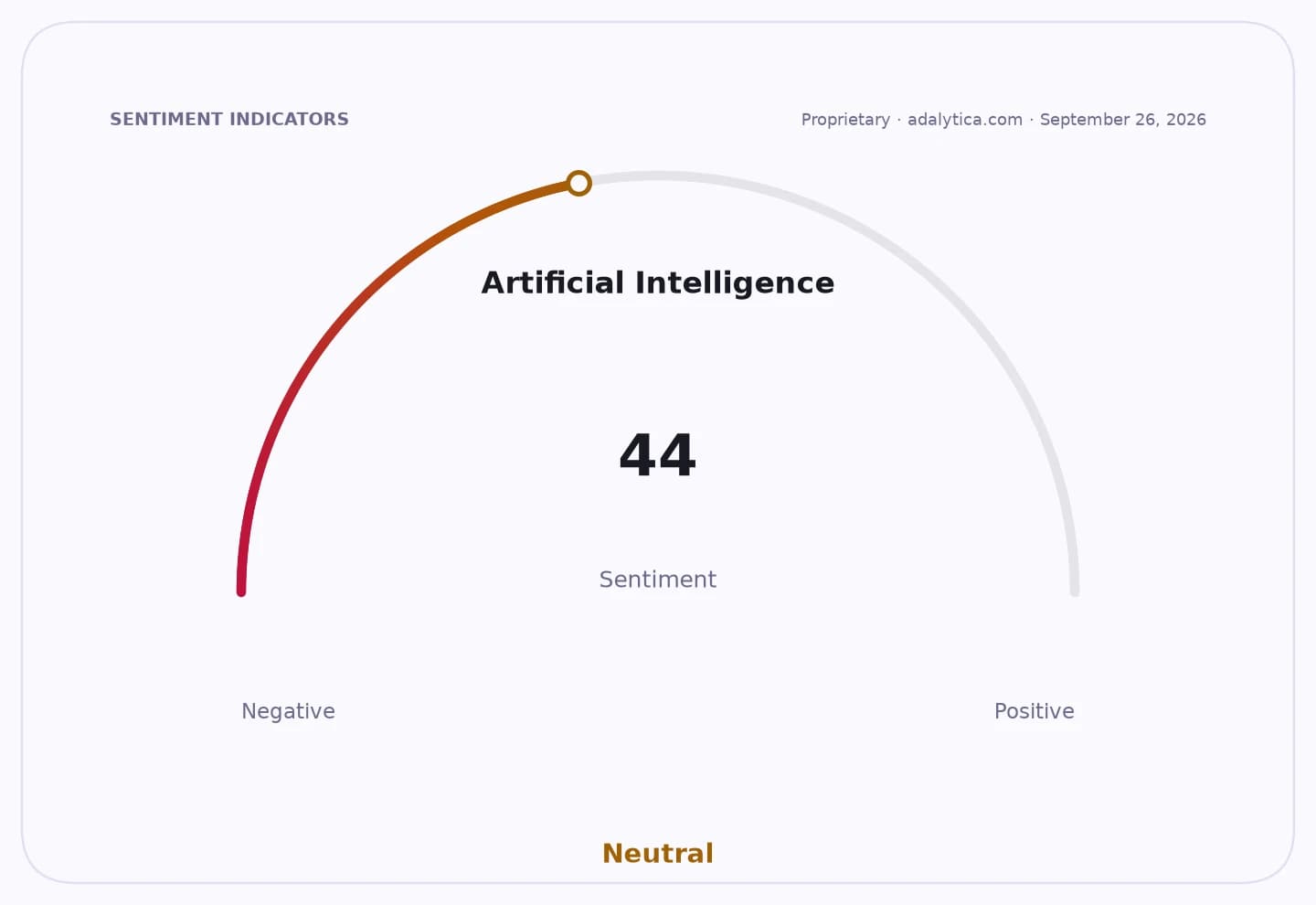
Sentiment IndicatorsⓘProprietary · adalytica.com · September 29, 2026
This is a snapshot — live sentiment, awareness and momentum for 130+ markets update continuously in the dashboard.Open AlphaPulse
According to the Financial Times report cited in the context, China’s State-owned Assets Supervision and Administration Commission is looking into how dependent state-backed organizations are on Broadcom switches. In some cases, as much as 90% of the switches used by those entities reportedly come from Broadcom, underscoring how embedded foreign hardware remains in Chinese data centers even as officials push domestic names such as H3C and Ruijie.
For investors, the message is bigger than a single probe. Broadcom is one of the most important toll roads in the AI economy because it sells the networking fabric and custom silicon that allow vast numbers of accelerators to work as a system. That makes it a high-conviction AI winner, but also a geopolitical target. China has already shown it is willing to restrict Nvidia products in state-linked settings, and now it is testing whether the same playbook can be applied one layer lower in the stack.
The stock’s recent price action suggests the market is still balancing AI enthusiasm against policy risk. Broadcom closed at $349.57 on Sept. 28, below its 50-day moving average of $375.59 and just under the lower end of its recent Bollinger range, with the RSI at 38.2, a level that reflects weakened momentum rather than panic. Nvidia, meanwhile, finished at $228.86, above its 50-day average of $216.32, showing the market is still willing to pay for AI exposure even as China headlines accumulate. The SOXX semiconductor ETF has also held up far better than it did in mid-summer, suggesting investors have not yet priced in a full-scale escalation in China’s procurement push.
Our thesis is simple: the market is underestimating how much of the AI boom is exposed to sovereign buying decisions, not just end-customer demand. If China accelerates its “buy local” campaign in state-run data centers, the beneficiaries are likely to be domestic networking vendors, systems integrators and Chinese chip designers that can substitute for US suppliers. The losers are the US firms that built the backbone of AI infrastructure with the assumption that networking silicon would remain a relatively safe, apolitical layer.
This is why Broadcom deserves attention now, not fear. The company is not on a ban list, and an investigation is not a prohibition. But in this market, the first sign of procurement scrutiny often becomes the first step toward policy, and policy is where revenue risk starts to compound. The right response is not to abandon the name, but to recognize that Broadcom’s AI premium now comes with a larger geopolitical discount than the market may be admitting.
For investors looking for the next leg of this trade, the real opportunity may be in the domestic China hardware stack, the broader AI infrastructure ecosystem outside direct US export channels, and the semiconductor ETFs that can absorb idiosyncratic shocks better than single names. Broadcom remains a core AI compounder, but the catalyst ahead is no longer just capex growth. It is whether Beijing turns procurement into another front in the race for technological independence.
| Entity | Gains | Losses |
|---|---|---|
| Chinese hardware vendors | ▲More state procurement | ▼Less foreign competition |
| Broadcom | ▲AI demand outside China | ▼China procurement scrutiny |
| Nvidia | ▲Still AI exposure demand | ▼Another China-policy template |
| SOXX ETF | ▲Sector resilience | ▼Event risk from China probes |