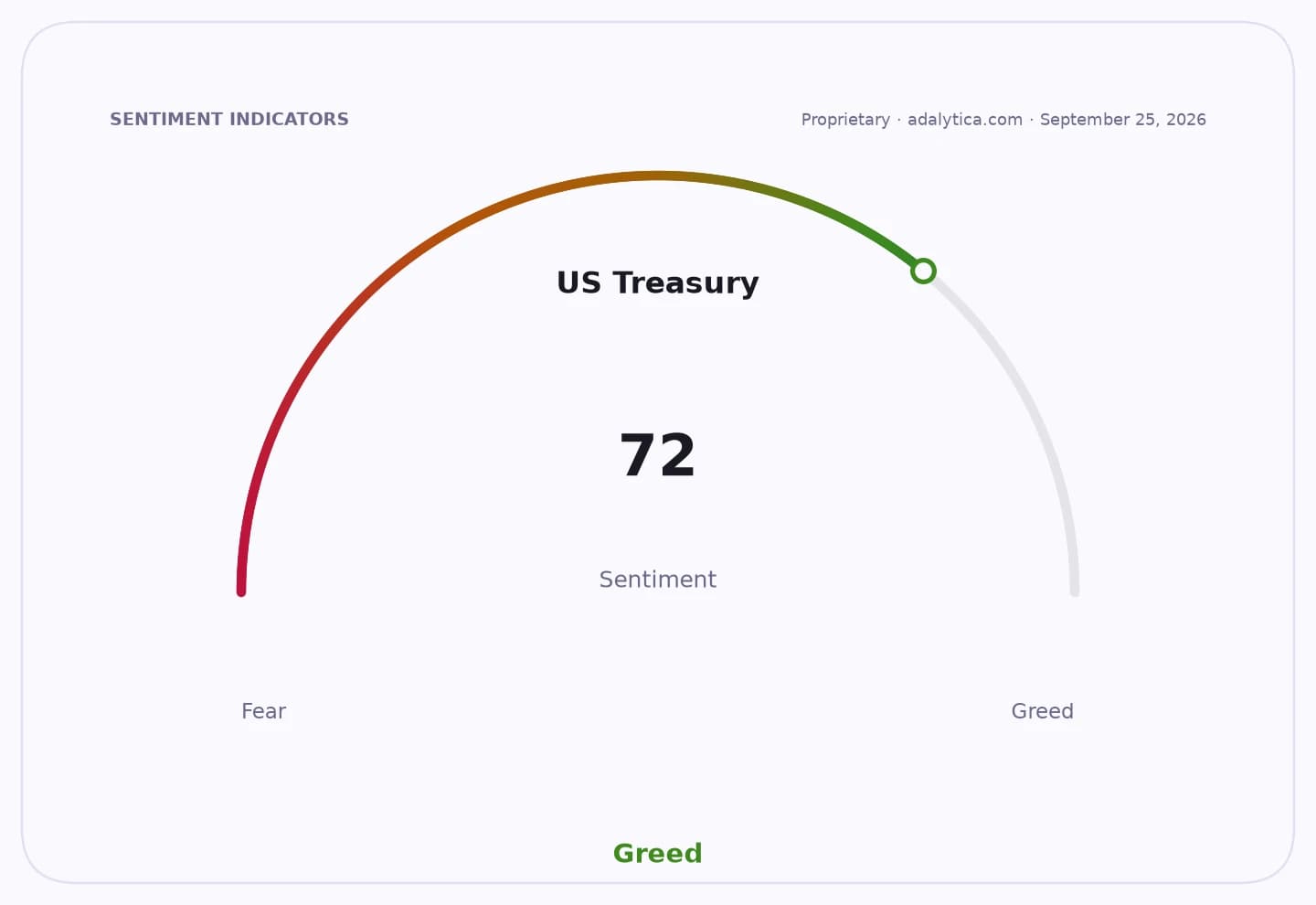
One company’s debt sale may look like smart capital management, but in this market, the real risk is paying up for growth while the cost of money still sits near a structural ceiling.
Brown-Forman and CoreWeave debt deals draw focus

That is the message hidden inside a wave of corporate borrowing that now includes Brown-Forman’s $500 million debt offering and CoreWeave’s $3 billion convertible sale, while sovereign balance sheets from Thailand to the developed world are coming under fresh strain. The common thread is not abundance of cheap capital. It is that borrowers are still reaching for financing even as the Treasury market keeps yields elevated, the Federal Reserve holds rates around 3.63%, and 10-year yields hover near 5%.
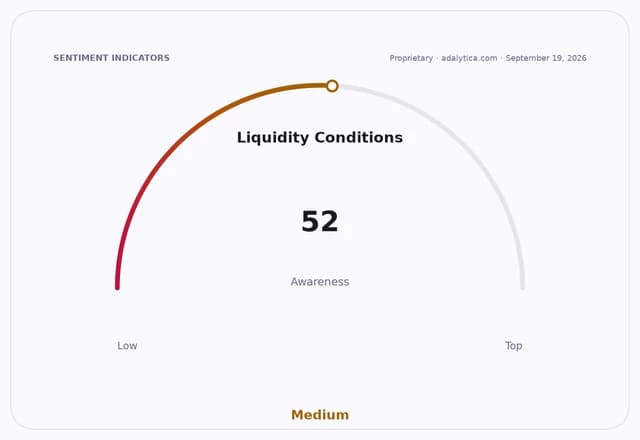
Sentiment IndicatorsⓘProprietary · adalytica.com · September 19, 2026
This is a snapshot — live sentiment, awareness and momentum for 130+ markets update continuously in the dashboard.Open AlphaPulse
For investors, that matters because debt is no longer a free bridge to expansion. It is an explicit claim on future cash flow. When rates are high and growth is uncertain, every incremental dollar of borrowing raises the hurdle for equity holders. The companies that can still borrow aggressively are often the ones markets have already rewarded for scale or optionality — the “treasures” of this cycle — but they are also the names most exposed if refinancing costs remain sticky or if earnings fail to keep pace with the capital they are raising.
That tension is especially relevant in the AI and infrastructure trade. CoreWeave’s convertible deal underscores how capital-intensive the next wave of computing has become. The market wants the upside from AI infrastructure, cloud buildouts and data-center demand, but those businesses require vast upfront spending long before cash generation catches up. In a rising- or merely elevated-rate environment, debt can amplify the winner’s advantage — or punish late buyers who confuse revenue growth with durable equity value.
The macro backdrop is not helping. High-yield spreads remain contained around 2.7%, which says credit investors are still taking risk, but they are doing so against a backdrop of a 10-year yield near 5%, far above the post-crisis norm. That combination is dangerous: it encourages borrowers to lock in financing now while markets are still open, but it also leaves little room for error if growth softens or the Fed stays restrictive. The sharp volatility in bond proxies such as TLT, which is trading below both its 50-day and 200-day moving averages, reinforces that caution. The bond market is not pricing a clean disinflationary glide path; it is signaling a higher-for-longer regime.
Adalytica’s financial system liquidity gauge shows that strain more directly, with liquidity sentiment deep in “Extreme Fear.” At the same time, the U.S. dollar’s trade signal sits at “Extreme Greed,” a reminder that tighter global financial conditions are still being exported through the funding market. That combination usually favors cash-rich companies, short-duration balance sheets and businesses with pricing power. It is much less friendly to leveraged balance sheets that depend on continuous market access.
The lesson for investors is that debt issuance is not automatically bullish. In this tape, it can be a warning flag. The companies best positioned are the ones using capital to build durable moats in AI infrastructure, energy, defense and other secular megatrends, while keeping leverage manageable. The losers are the ones treating the market’s appetite for their paper as proof that the equity is cheap.
That is why the best opportunities may not be the borrowers themselves, but the toll roads around them: exchanges, infrastructure providers, lenders with strong underwriting power, and asset-light platforms that benefit from capex cycles without funding them. If rates stay high and refinancing remains expensive, investors should favor balance-sheet strength over financial engineering.
| Entity | Gains | Losses |
|---|---|---|
| Cash-rich mega-cap platforms | ▲Lower funding risk | ▼Less relative appeal for borrow-and-spend rivals |
| AI infrastructure builders | ▲Access to capital | ▼Higher debt service burden |
| Bondholders/lenders | ▲Higher yields | ▼Interest-rate volatility risk |
| Highly leveraged borrowers | ▲Near-term financing access | ▼Refinancing pressure and margin squeeze |