Canada faces a softer growth path and a stickier inflation outlook after the OECD lowered its GDP forecasts while lifting price projections for this year and 2027, a combination that complicates the Bank of Canada’s easing cycle and keeps pressure on longer-term bond yields.
Canada GDP Forecast Cut as Inflation Outlook Rises

The revision matters because it points to an economy that is losing momentum without delivering the clean disinflation policymakers need to cut rates aggressively. For households and businesses, that means weaker income growth and demand on one side, but still-elevated borrowing costs and pricing pressure on the other — a mix that typically squeezes margins and restrains investment.
Sentiment IndicatorsⓘProprietary · adalytica.com · September 28, 2026
This is a snapshot — live sentiment, awareness and momentum for 130+ markets update continuously in the dashboard.Open AlphaPulse

The OECD’s call lands at a sensitive moment for markets. Canada’s 10-year government bond yield has climbed to about 5.19%, near the highest level in the data set, underscoring how global rates and inflation expectations continue to dominate fixed-income pricing. The Canadian dollar fund FXC has also slipped below both its 50-day and 200-day moving averages, while its relative strength reading has fallen sharply, suggesting investors are leaning cautious on the currency as growth expectations weaken.
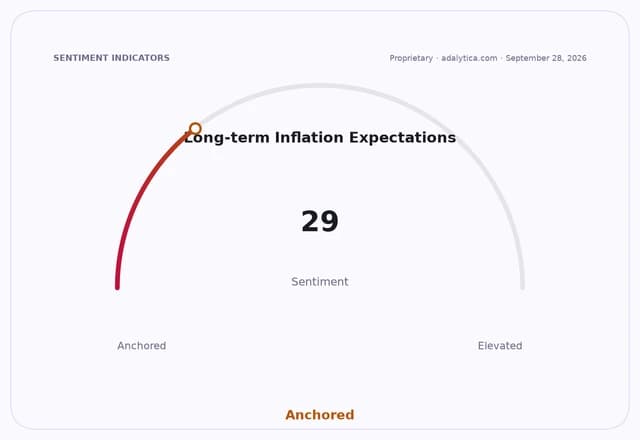
That caution is reinforced by inflation gauges. Adalytica’s long-term inflation expectations snapshot shows sentiment in fear territory, even after a recent rebound, while confidence in the Fed’s 2% target remains only neutral and five-year breakeven sentiment is still subdued. For Canada, the implication is that higher inflation forecasts will make it harder for the central bank to justify faster rate cuts if underlying price pressures prove persistent.
The OECD update also fits a broader pattern of uneven global growth. Oil prices have softened, which should help Canadian consumers and importers, but weaker commodity revenues can weigh on resource-heavy provinces and on the corporate sector’s earnings outlook. That leaves the policy trade-off more awkward: slower growth argues for support, but higher inflation limits how much relief the central bank can provide.
For investors, the message is less about a single forecast revision than about the regime it describes. Lower growth and higher inflation are a poor combination for duration-sensitive assets, rate-sensitive equities and domestically focused cyclicals. Bank stocks and exporters may prove more resilient than consumers and leveraged borrowers, but even those groups will be sensitive to how far the OECD’s inflation call feeds into expectations for Canadian policy.
The next catalyst will be whether incoming inflation and labour data confirm the OECD’s view or allow policymakers to discount it as a temporary bump. If price pressures stay elevated while growth slows further, Canada could find itself stuck with a stagflation-like mix that keeps the bond market defensive and limits the upside for risk assets.
| Entity | Gains | Losses |
|---|---|---|
| Canadian bondholders | ▲Higher yields on new debt | ▼Price risk from inflation |
| Borrowers and consumers | ▲Slightly easier policy if growth weakens | ▼Persistent borrowing costs |
| Exporters and banks | ▲Weaker loonie, steadier margins | ▼Slower domestic demand |
| Rate-sensitive equities | ▲Possible support if cuts come | ▼Higher-for-longer rate outlook |