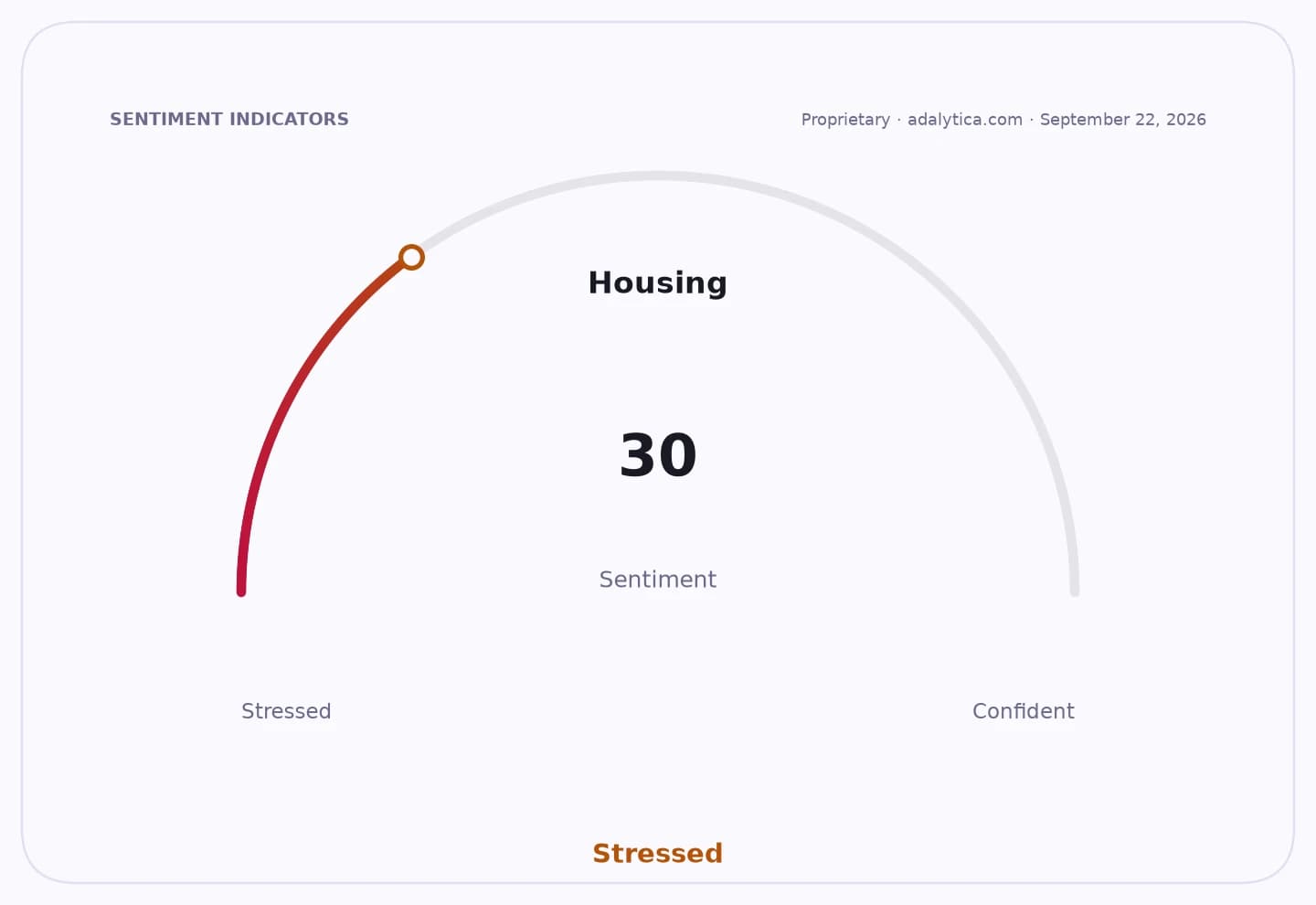
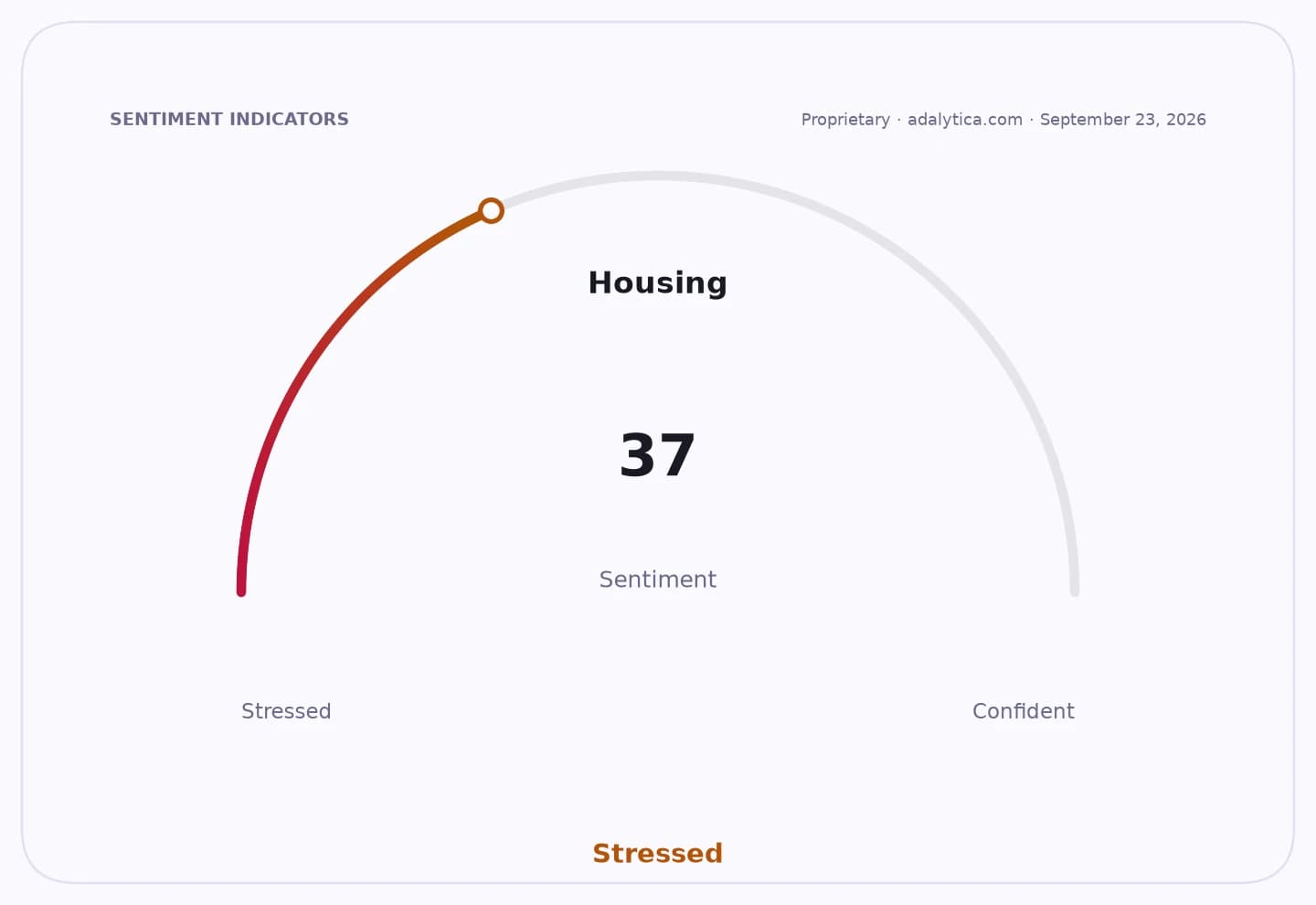
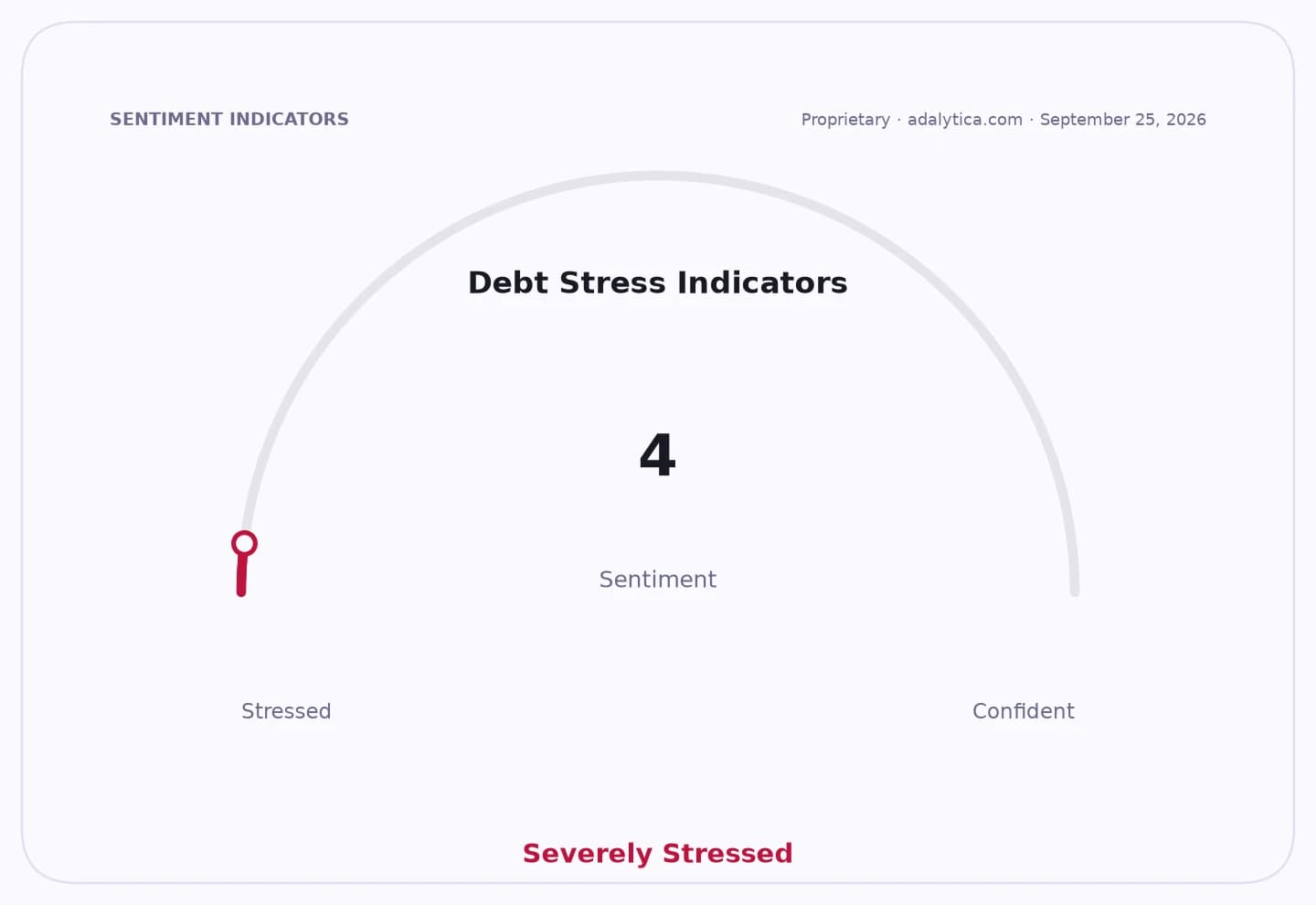
Mortgage stress is deepening in Canada’s biggest housing markets even as the national mortgage book remains relatively stable, with Ontario and British Columbia emerging as the clearest fault lines in a system still coping with the aftershocks of higher rates.
Canada Mortgage Delinquencies Rise in Ontario and B.C.
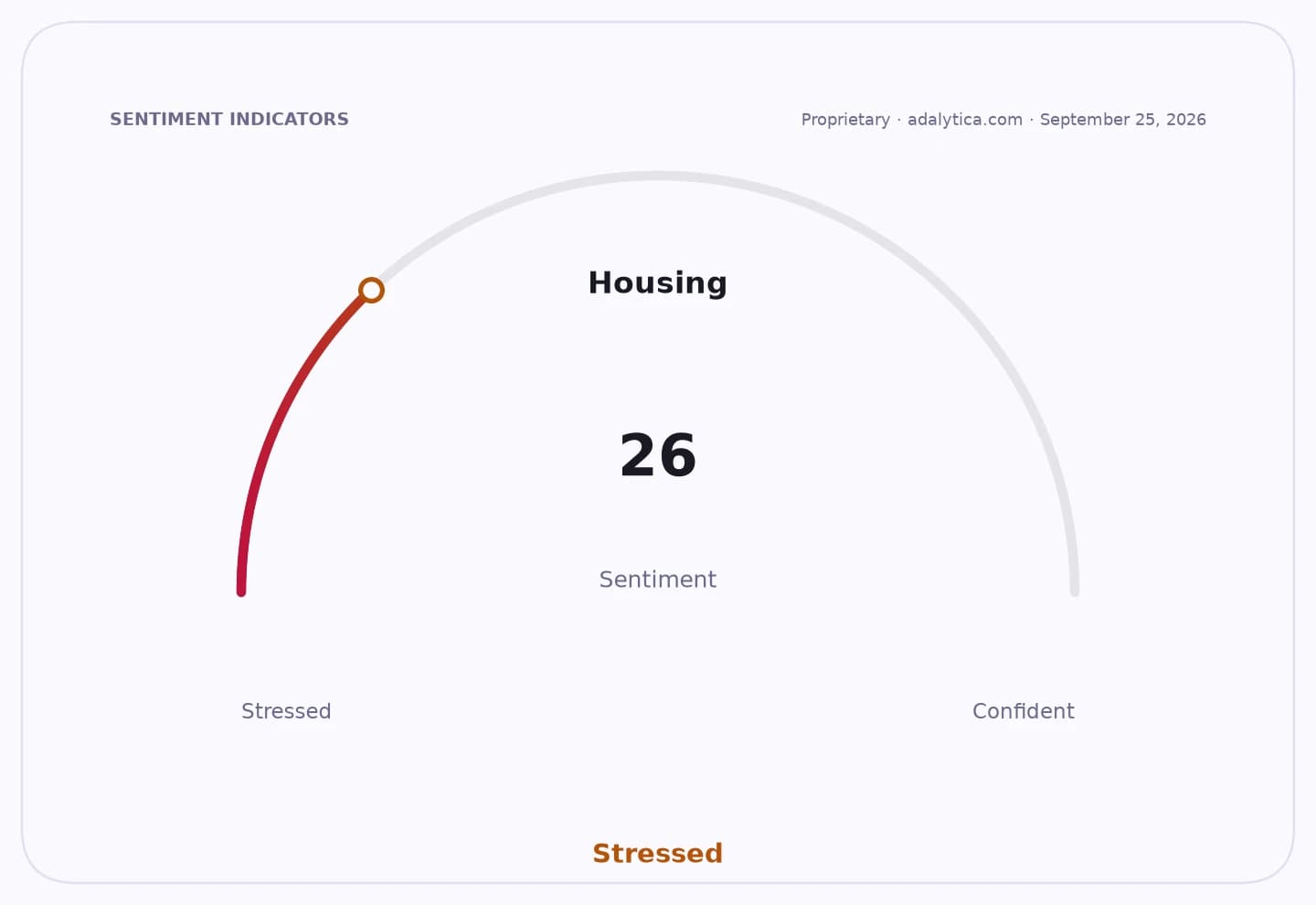
Equifax said severe mortgage delinquencies are rising fastest in those two provinces, while first-time buyers are increasingly leaning on joint borrowing — often with parents or older family members — to qualify in expensive markets. That combination matters because it points to a housing market where affordability is being preserved less by income growth than by family balance sheets, while repayment pressure is already spreading into other consumer debts.
Sentiment IndicatorsⓘProprietary · adalytica.com · September 25, 2026
This is a snapshot — live sentiment, awareness and momentum for 130+ markets update continuously in the dashboard.Open AlphaPulse

The credit bureau’s second-quarter 2026 Market Pulse showed Canadian mortgage balances at C$1.97 trillion, up 4% from a year earlier, with 310,200 new mortgage accounts originated at an average loan size of C$362,300. But the seemingly stable national picture masks growing stress underneath: the 90-plus-day delinquency rate by mortgage balance climbed to 0.30%, up 33.8% year over year, while the rate by account count rose to 0.23%.
The strain is most visible in Ontario and B.C., where Equifax said severe delinquencies continue to stand out after several years of higher borrowing costs, renewal payment shocks and elevated living expenses. Among Ontario mortgage holders, severe 90-plus-day non-mortgage delinquencies rose 27% from a year earlier by balance and 24% by account count, versus increases of just 2% and 3% across the rest of Canada. That split suggests borrowers are protecting their homes first and letting auto loans, credit cards or other consumer obligations slip — a classic sign that household finances are tightening even before mortgages themselves become impaired.

For lenders, that makes the upcoming renewal cycle the critical watchpoint. Many borrowers who locked in lower fixed rates during the ultra-low-rate era are now rolling over at meaningfully higher payments, and Equifax expects that to keep pressure on borrower mobility and lender switching. The impact is likely to be uneven: borrowers with strong credit and sizeable equity should still refinance, while more leveraged households may be forced into restructuring, second liens or other forms of credit management.
The shift in borrower structure is equally important. Equifax said joint mortgages now account for about 68% of first-time-buyer mortgages, up from the pre-COVID period, underscoring how affordability in Toronto and Vancouver increasingly depends on co-borrowers. In Ontario and B.C., 11.4% of first-time-buyer mortgages involved joint borrowers with an age gap of more than 20 years, compared with 8.4% in the rest of Canada, a sign of greater parental or multi-generational support. That may help support transaction volumes, but it also changes underwriting risk: repayment ability is no longer just a function of the primary borrower’s wage income.
The trend also helps explain why mortgage originations remain concentrated in higher-credit borrowers. More than half of new mortgages went to consumers with credit scores above 750, suggesting lenders are still preferring quality over volume at a time when credit conditions remain tight. Quebec led originations with 35%, followed by Ontario at 33% and B.C. at 12%, but the provinces with the most expensive housing are also the ones showing the most visible stress.
For investors, the implications run beyond Canadian banks. Rising mortgage and consumer delinquencies can weigh on credit losses, force more conservative underwriting and curb loan growth at a time when household balance sheets remain stretched. Any evidence that stress is broadening beyond Ontario and B.C. would be especially important for the big lenders, but for now the national picture still looks manageable. The risk is that renewal-driven pain persists longer than expected, especially if labor-market conditions soften or housing prices fail to recover enough to rebuild borrower equity.
Equifax’s message is clear: Canada’s mortgage market is not in crisis, but the stress is becoming more concentrated, more household-specific and more dependent on family support. That is a less visible but more fragile version of stability, and it leaves lenders, borrowers and investors increasingly exposed to the next round of renewals.
| Entity | Gains | Losses |
|---|---|---|
| Joint borrowers / families | ▲Help buyers qualify | ▼Take on shared debt risk |
| Mortgage lenders | ▲Better-quality originations | ▼Higher delinquency pressure |
| Ontario & B.C. buyers | ▲Access to housing credit | ▼Greater payment stress |
| Banks / investors | ▲More rate-sensitive refinancing business | ▼Rising credit-loss risk |