Cardano is trying to turn a week of gains into a push toward $0.20, even after ADA slipped 6.6% in the last 24 hours to about $0.17.
Cardano Holds $0.17 as ADA Eyes $0.20

The move matters because it comes at a point where traders are weighing whether Cardano’s recent rebound is just a short squeeze or the start of a broader recovery in a token that has underperformed much of the market this year. ADA is still up 10.2% over seven days and 12.8% over two weeks, keeping the focus on whether buyers can defend the $0.17 area and then clear the next resistance band at $0.193, before a possible test of $0.20.
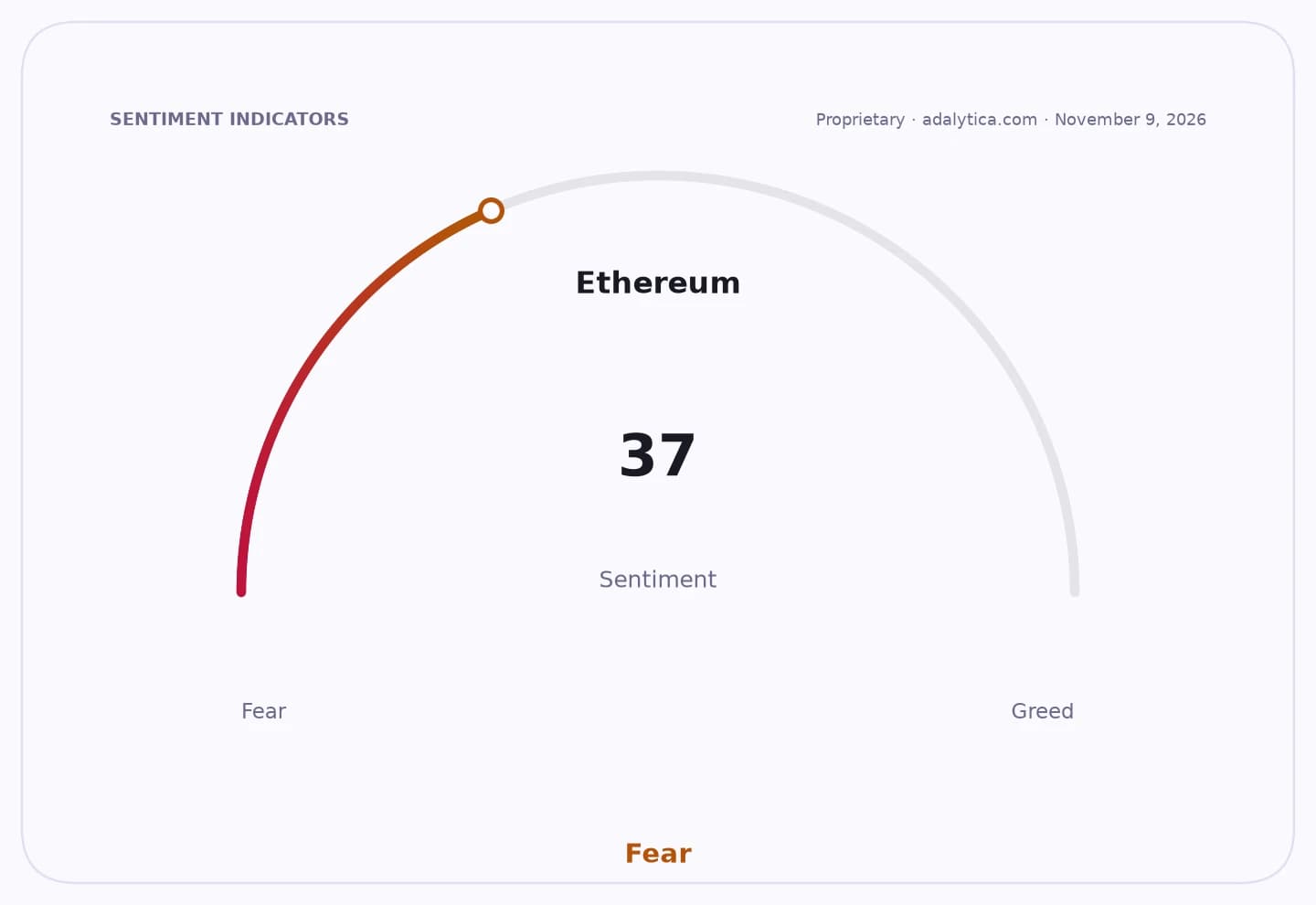
Sentiment Indicators
What has added fuel to the rally is a renewed architectural debate between Cardano and Ethereum. Cardano founder Charles Hoskinson said Ethereum is beginning to adopt ideas similar to Cardano’s eUTXO model after Ethereum researcher Toni Wahrstätter proposed EIP-8141, or Frame Transactions, a design aimed at reducing state growth and improving scalability. The proposal says UTXO-inspired mechanics could cut Ethereum’s permanent state footprint for payment transactions by about 99.8%, underscoring how network design, not just price action, is back in focus for crypto traders.
For Cardano holders, the argument is straightforward: if Ethereum is borrowing from eUTXO-style thinking, that can be framed as validation of Cardano’s design choices and a reminder that the network has long sold itself as a more scalable, academically grounded blockchain. Hoskinson went further, saying Ethereum’s inner circles are reluctant to acknowledge Cardano, a line that may play well with the ADA base even if it does little to change fundamentals on its own.
The more immediate market question is whether the narrative can translate into demand. ADA’s technical setup still looks fragile despite the recent bounce: the token is hovering near the lower end of its recent trading range, with support cited around $0.144 and a key breakout level near $0.193. A move above that could open the way to $0.23, but failure to hold $0.17 would leave the rally vulnerable to profit-taking.
Cardano’s broader development roadmap also gives bulls something to point to. The network recently released Cardano Node 9.0.1, a recommended update for mainnet validators focused on bootstrapping and script execution stability ahead of the next hard fork. That is not a headline-grabbing feature release, but in a market where reliability and upgrade execution matter, it helps reinforce the case that the ecosystem is still building rather than simply trading on speculation.
Ethereum’s own backdrop is less comfortable. ETH has been under pressure alongside wider crypto volatility and remains well below its recent highs, with security incidents around the broader ecosystem and concerns over state growth adding to the sense that the network still has work to do on scalability and resilience. That does not make Cardano a clearer winner by itself, but it does mean Hoskinson’s comparison lands at a sensitive moment for Ethereum and a potentially useful one for ADA.
For investors, the setup is binary. If ADA can hold support and reclaim $0.193, the current debate over Ethereum’s architecture could help extend momentum toward $0.20 and beyond. If not, the latest burst of attention risks fading into another short-lived crypto narrative, with the market once again reminding holders that technical upgrades and founder commentary do not always outweigh broader risk appetite.
| Entity | Gains | Losses |
|---|---|---|
| ADA bulls | ▲Momentum toward $0.20 | ▼Risk of profit-taking |
| Cardano | ▲Validation of eUTXO model | ▼Depends on follow-through demand |
| Ethereum | ▲Scalability debate sharpened | ▼Narrative pressure from rivals |
| Short-term traders | ▲Volatility and range trade | ▼Breakout failure risk |