Ethereum is getting two very different signals at once: a public-relations boost from Vitalik Buterin’s Devcon appearance in Mumbai and a far more consequential accumulation bid from Bitmine Immersion Technologies, which has pushed its ETH stash to 6,060,506 tokens and is closing in on 5% of the network’s supply.
Ethereum Bitmine Holdings Near 5% of Supply
Ethereum
That matters because the real market story is not the costume. It is the tightening supply dynamic around Ethereum as one listed company keeps absorbing coins, staking them and removing them from circulation while broader ETH price momentum remains fragile. Bitmine’s latest purchase of 8,573 ETH brought its holdings to about $13.7 billion at a price of $2,261, making it one of the clearest examples yet of a corporate treasury strategy built around Ethereum itself.
Sentiment Indicators
The company now controls roughly 4.9% of all ETH, which puts it just shy of its stated target of 5%. It has also staked 5.23 million ETH, or 86% of its holdings, a position it says could generate about $358 million in annualized rewards and potentially $415 million if the entire treasury were staked. That is the key investment case: Ethereum is no longer only a speculative token. For large holders, it is becoming a productive balance-sheet asset.
For investors, the implications run in two directions. First, Bitmine’s buying creates a persistent source of demand at a time when spot Ethereum ETFs have seen heavy outflows and the token has struggled to regain traction. Second, staking reduces the amount of ETH available for active trading, which can amplify any upside once sentiment turns. At roughly 4.9% of supply, Bitmine alone now represents nearly one in every 20 ETH in existence.
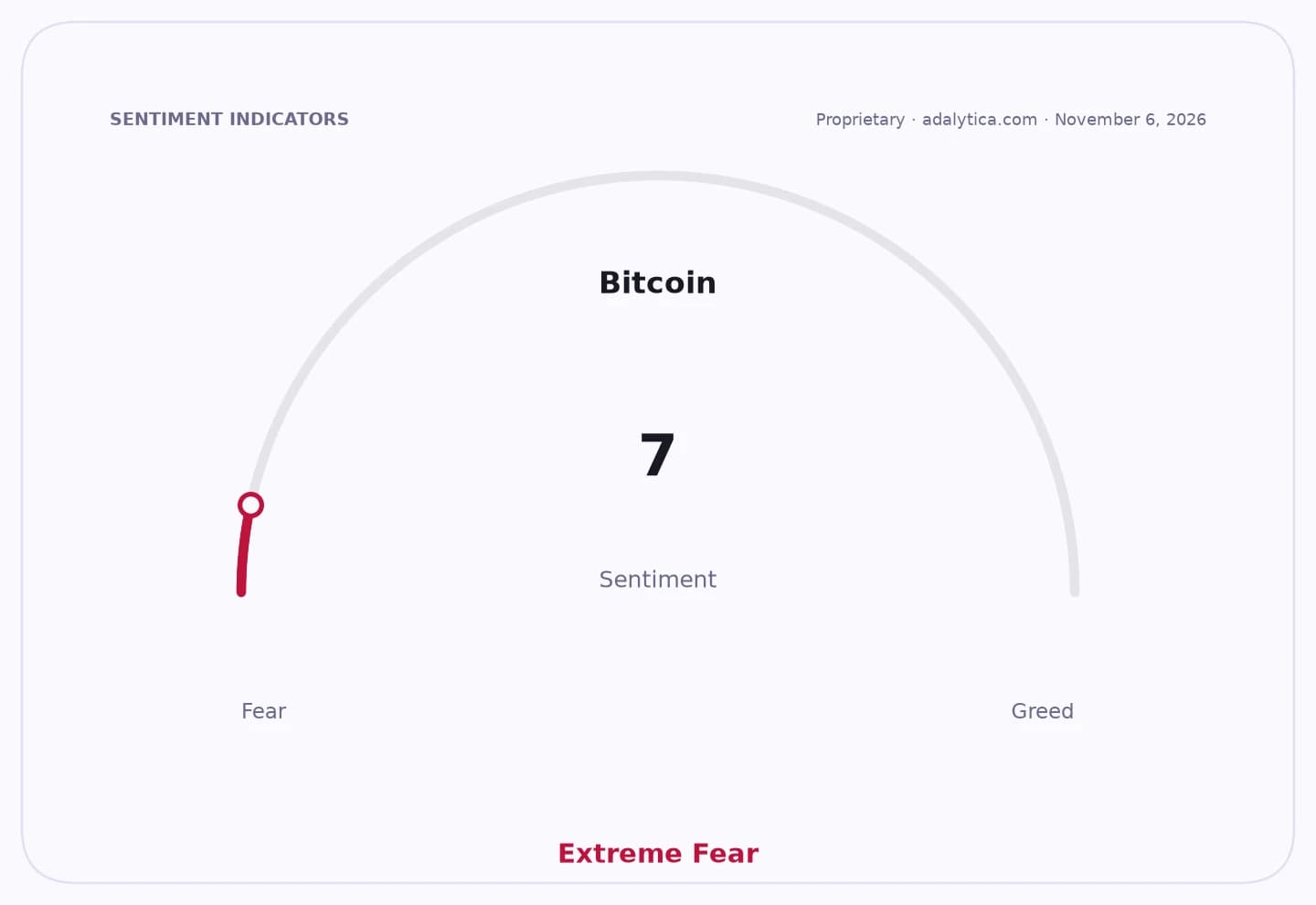
The market still has to prove that institutional accumulation can translate into a sustained price reversal. ETH was last changing hands around $2,101, below its 50-day moving average of $2,470 and only modestly above its 200-day average of $2,153. Relative strength readings around 34.5 and a negative MACD point to a market that is still under pressure. Bitcoin, meanwhile, is trading near $74,025 with sentiment in fear territory, underscoring how cautious crypto positioning remains more broadly.
That is exactly why the setup may be mispriced. When a major treasury buyer is willing to lock up billions of dollars of ETH and harvest staking yield rather than flipping exposure, it strengthens the argument that Ethereum is evolving into a reserve-like asset for the digital economy. If institutional flows return and ETH can reclaim key resistance, the move could be abrupt rather than gradual.
Bitmine chairman Tom Lee has already sketched out the upside case, saying Ethereum could revisit its prior record near $4,954 before the end of 2026, with $6,000 also in play as a year-end target. Whether that happens will depend on a turn in ETF flows, broader risk appetite and ETH’s ability to clear technical resistance. But the message from Bitmine is clear: the smart money thesis on Ethereum is no longer just about upside. It is about scarcity, yield and control of supply.
Vitalik’s cosplay may have won the crowd, but Bitmine’s accumulation is the event traders should watch. If this treasury race continues, Ethereum’s next major rally could be driven less by hype than by balance sheets.
| Entity | Gains | Losses |
|---|---|---|
| Bitmine Immersion Technologies | ▲ETH exposure and staking yield | ▼Cash flexibility |
| Ethereum holders | ▲Tighter supply | ▼Liquid float |
| ETH bulls | ▲Accumulation catalyst | ▼Continued ETF outflows |
| Short-term sellers | ▲Volatility to trade | ▼Scarcity-driven squeeze risk |