A local employment “treasure hunt” returns to Castelnaudary on Thursday, underscoring how French towns are leaning on more direct, low-friction hiring channels as employers struggle to fill roles that never make it to public job boards.
Castelnaudary Markethon Targets Hidden Job Openings
The 12th edition of the Markethon de l’emploi will bring together several dozen jobseekers and local companies in the Aude town, with participants split into small teams that visit partner businesses in search of “hidden” vacancies. The format is designed to surface openings that are often withheld from the general public for 15 days, giving attendees first access before the offers are released more broadly.
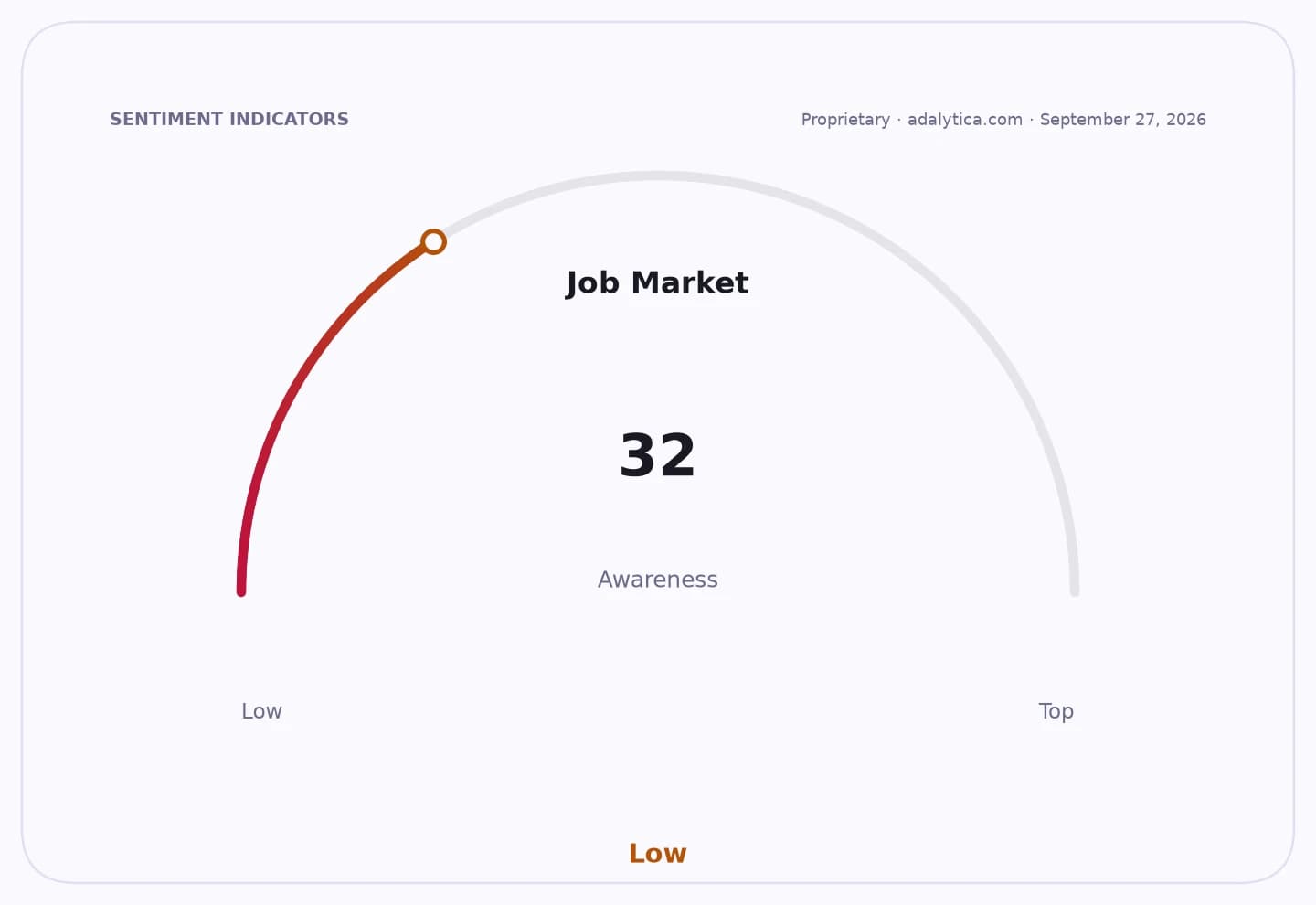
Sentiment IndicatorsⓘProprietary · adalytica.com · September 27, 2026
This is a snapshot — live sentiment, awareness and momentum for 130+ markets update continuously in the dashboard.Open AlphaPulse
That matters because the Markethon is not just a job fair with a gimmick. It reflects a deeper shift in labour-market matching: employers want faster, more qualified candidates, while workers increasingly need access to informal or off-market vacancies to improve their odds. In smaller towns, where recruitment pools are thinner and vacancy lists can be incomplete, those private channels can be more useful than conventional postings.
The event also speaks to a broader tension in the French labour market. Even where official joblessness is not the central issue, many businesses still say recruitment remains difficult, particularly for local services, trades and entry-level roles. For policymakers and employment agencies, that points to a structural mismatch rather than a simple shortage of demand. The question is less whether jobs exist than whether the right candidates can find them quickly enough.
That is why the Markethon model has endured. France Travail, the Mission locale de l’Ouest audois and the Emploi et Partage association are channeling applicants into pre-arranged teams, while the municipality frames the event as a “win-win” for both employers and seekers. For businesses, it is a low-cost way to test interest and meet candidates face to face. For applicants, it offers priority access to vacancies that can otherwise remain invisible.
The economic significance is modest at the national level but meaningful locally. In a labour market increasingly shaped by selective hiring, skills gaps and uneven participation, the real constraint is often information flow. Events like this do not solve unemployment on their own, but they can improve matching efficiency — and in tight local economies, that can be enough to change who gets hired.
For investors, the story is a reminder that labour-market softness or strength cannot be judged only by headline unemployment data. Recruitment frictions, hiring channels and worker mobility all affect wage pressure, household income and consumption. A market with hidden vacancies and direct sourcing tends to favour employers with strong local networks and workers with better access to institutional support, while leaving outsiders at a disadvantage.
The deeper narrative is one of labour markets becoming more granular. As firms and jobseekers look for faster, more personalised matching, local initiatives like Castelnaudary’s Markethon may gain importance even when national indicators remain mixed. The test on Thursday will be whether the hunt uncovers enough real openings to justify the format once again.
| Entity | Gains | Losses |
|---|---|---|
| Jobseekers in Castelnaudary | ▲Priority access to hidden jobs | ▼Those outside the event |
| Local employers | ▲Faster candidate screening | ▼Public vacancy visibility |
| France Travail / local agencies | ▲Stronger placement role | ▼Passive job-board models |
| Informal hiring channels | ▲Greater relevance | ▼Traditional search channels |