The most important development for investors is not another headline about Nagorno-Karabakh itself, but the way the conflict’s aftermath is hardening a new strategic map across Turkey, Azerbaijan, Iran, Georgia and Central Asia — one that is forcing capital to reprice logistics, energy security and defense exposure around the Caspian corridor.
Caucasus tensions boost corridor and infrastructure plays

That matters because the South Caucasus is no longer a backwater geopolitical footnote. It is becoming a toll road for Eurasian trade, a transit lever for hydrocarbons, and a pressure point between NATO-aligned Turkey, sanctions-sensitive Iran, resource-rich Azerbaijan and the Black Sea gateway through Georgia. In a world defined by fractured supply chains and higher geopolitical risk premiums, control of routes matters as much as control of reserves.
The market still underestimates how much this shift changes the investable landscape. Every incremental reduction in dependence on Russian transit increases the value of alternative corridors through Azerbaijan and Georgia, while every escalation in regional friction raises demand for security, border infrastructure, drones, communications and energy redundancy. That creates a classic second-order trade: the obvious beneficiaries are the sovereigns and operators on the route, but the more attractive opportunity may be in the picks-and-shovels providers that gain no matter which side of the border strengthens.
That is why the trading action in Turkey-focused telecom and infrastructure names such as TKC, and the more speculative move in SORA, should be read through a geopolitical lens rather than a purely technical one. TKC has reclaimed ground above its 50-day moving average and its 200-day average, even after a recent pullback, while SORA has remained highly volatile but is still trading well below its 2025 peaks. In a market driven by routes, connectivity and state-backed investment, these are the kinds of names that can re-rate early if capital starts pricing a longer cycle of corridor buildout and regional resilience spending.
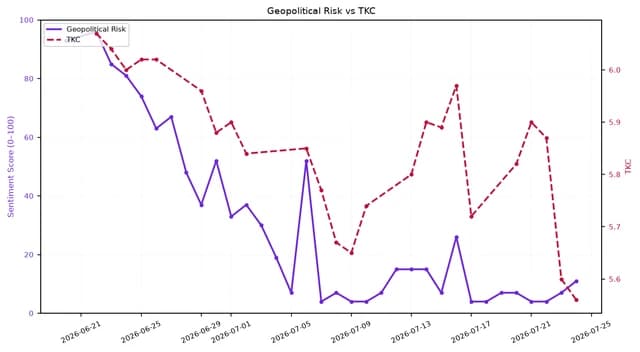
The macro setup is reinforcing the thesis. Adalytica’s Global Stability Sentiment is deep in “Extreme Fear” even as awareness remains elevated, a combination that usually precedes abrupt rerating in security-linked assets. Investors should read that as a warning and an opportunity: fear suppresses valuations in the short run, but it often accelerates spending on defense, surveillance, transport links and energy transit once policymakers move from rhetoric to budgets.
Azerbaijan stands out as the key strategic hinge. Any durable expansion of its role as a transit and energy hub strengthens Turkey’s position and increases the leverage of Georgia as the western outlet to the Black Sea. At the same time, Iran’s proximity ensures the region stays militarized and politically fragile, which supports long-run demand for hard infrastructure and security systems. Central Asia, for its part, gains optionality: more routes mean more negotiating power, but also more competition for influence from Turkey, China, Russia and Europe.
For investors, the lesson is to think beyond the immediate conflict cycle. The trade is not simply “peace good, war bad.” It is that uncertainty in the South Caucasus and the wider Caspian basin is pushing governments to spend on exactly the kinds of assets that tend to compound over years: fiber, towers, transport corridors, border systems, LNG and electricity interconnects, ports, and defense electronics. That is where the asymmetry lives.
I believe the best positioning is to own the enablers, not the headlines. Turkey-linked telecoms, corridor infrastructure, logistics, defense contractors and energy-transit beneficiaries are the most direct ways to express the thesis that Nagorno-Karabakh’s unresolved legacy is not ending the story — it is changing the route map. If the market keeps treating the South Caucasus as a local issue, that mispricing may become the next source of alpha.
| Entity | Gains | Losses |
|---|---|---|
| Turkey and Azerbaijan | ▲Corridor leverage | ▼Transit uncertainty |
| Georgia | ▲Black Sea gateway relevance | ▼Border and security risk |
| Iran | ▲Strategic pressure on rivals | ▼Influence dilution |
| Telecoms/infrastructure names | ▲Capex tailwind | ▼Geopolitical volatility |