China’s artificial intelligence industry has crossed 1.2 trillion yuan in 2025, underscoring that the country’s AI push is no longer a policy slogan but a real economic engine with direct implications for growth, capex and equity winners.
China AI industry tops 1.2 trillion yuan in 2025

That matters because AI is becoming one of China’s few credible avenues for reaccelerating activity at a time when the broader economy remains weighed down by soft domestic demand and a sluggish property backdrop. The scale of the sector — more than 1.2 trillion yuan, or roughly $165 billion — suggests AI is now large enough to influence industrial output, cloud spending, semiconductor demand and local tech hiring, rather than simply sit on the margins of the economy.
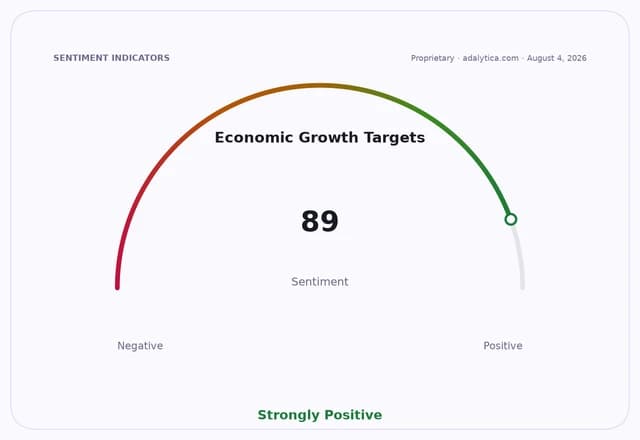
Sentiment IndicatorsⓘProprietary · adalytica.com · August 4, 2026
This is a snapshot — live sentiment, awareness and momentum for 130+ markets update continuously in the dashboard.Open AlphaPulse
For investors, the message is even clearer: capital is starting to flow to the companies that own the infrastructure, models and distribution layers of China’s AI stack. Alibaba and Baidu are among the most obvious beneficiaries. Alibaba’s stock has been one of the stronger AI proxies, while Baidu’s shares have also shown renewed sensitivity to any sign that AI monetization is gaining traction. Tencent is another key barometer, with its gaming, cloud and enterprise software franchises positioned to capture spending as AI workloads expand.
The market often underestimates how quickly a policy-driven technology cycle can become a multi-year earnings cycle in China. Beijing has been pushing AI from the classroom to the corporate boardroom, including efforts to recruit talent earlier and deepen technical training, while domestic model launches such as Alibaba’s Qwen 3.8 Max show the ecosystem is advancing despite U.S. export restrictions. In a country where industrial policy can rapidly redirect investment, AI is emerging as a new channel for stimulus by another name: not blanket credit, but targeted spending on compute, chips, cloud and applications.
That is why the downstream winners may be even more interesting than the headline AI names. Semiconductor suppliers, data-center builders, power equipment firms and network infrastructure providers stand to benefit from the capex wave that AI requires. The AI boom is not just about software margins; it is about the hard assets needed to train and deploy models at scale. In China, where strategic self-sufficiency remains a priority, that means more domestic procurement and more pressure to localize the full stack.
The macro backdrop helps the thesis. Global AI investment is feeding manufacturing and industrial activity far beyond the U.S., and emerging markets are increasingly treating AI as a productivity lever rather than a novelty. China’s 1.2 trillion yuan AI industry tells us the country is trying to buy itself a new growth runway. For investors, the asymmetric opportunity is to own the picks-and-shovels names that sell compute, cloud and infrastructure into that runway before the consensus fully prices the earnings uplift.
The next catalyst is execution: model performance, enterprise adoption and the pace of AI-related capex over the next few quarters. If those keep accelerating, this will stop looking like a theme trade and start looking like a durable earnings cycle. I believe that makes China’s leading AI platforms and infrastructure suppliers a buy on weakness, not a story to fade.
| Entity | Gains | Losses |
|---|---|---|
| Alibaba | ▲AI monetization, cloud demand | ▼Non-AI peers |
| Baidu | ▲Model adoption, investor attention | ▼Slow-growth incumbents |
| Tencent | ▲Enterprise spend, ecosystem traffic | ▼Pure-play laggards |
| Chip and data-center suppliers | ▲Capex surge | ▼Import-dependent rivals |