China is sharpening its climate strategy with a new five-year action plan that puts resilience, grid reliability and cleaner industrial standards at the center of policy, a shift that matters as much for infrastructure investors as for environmental pledges.
China climate plan focuses on grid resilience

The roadmap is economically important because it signals that Beijing is no longer treating climate policy as a narrow emissions exercise. Instead, it is linking decarbonization to physical risk management, industrial upgrading and energy security — three areas that directly affect capital spending, utility regulation and the economics of renewables. With heavy rains increasingly threatening hydroelectric dams and other assets, the plan aims to reduce the chance that climate damage becomes a macro drag on power supply, transport and local government balance sheets.
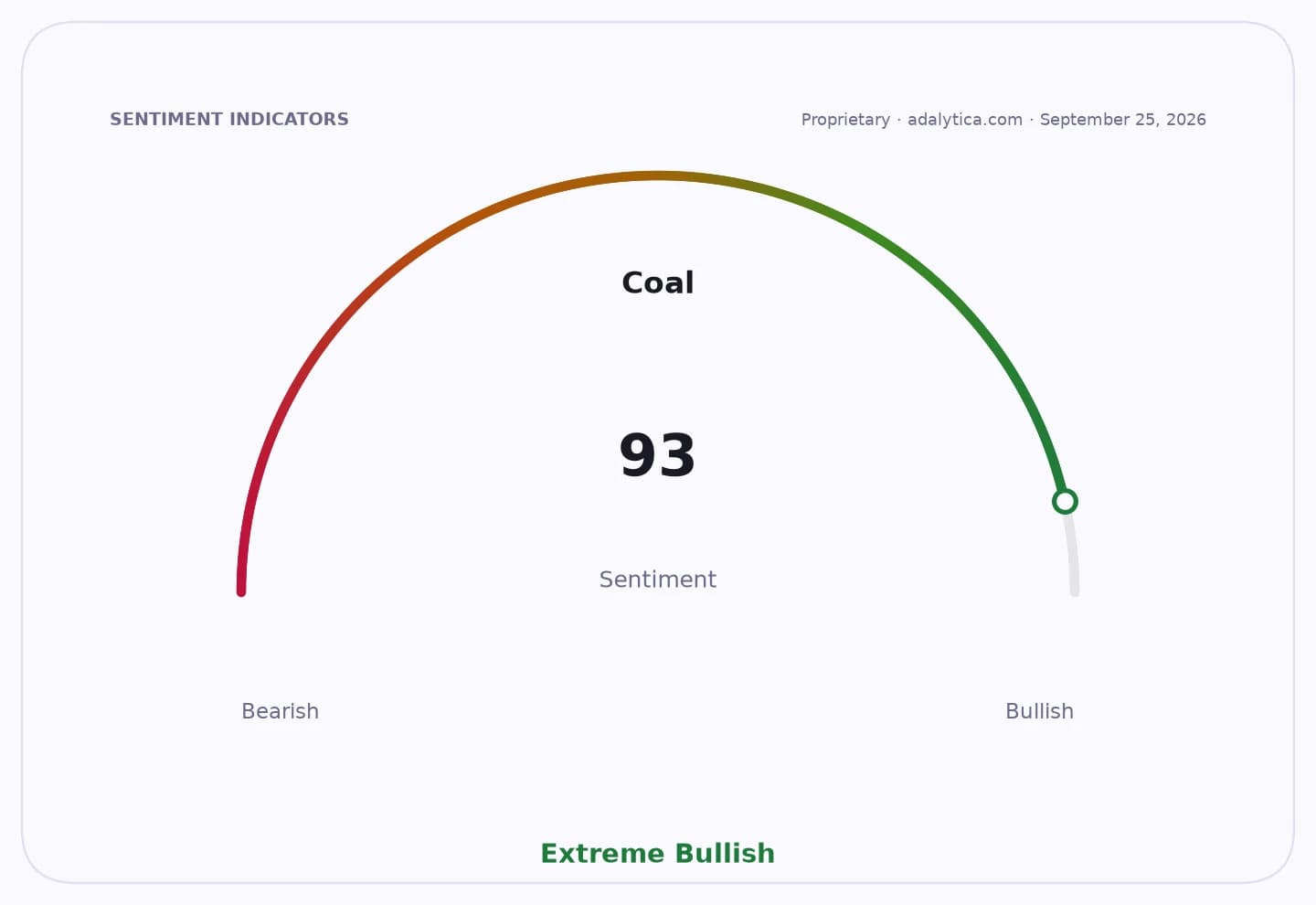
Sentiment IndicatorsⓘProprietary · adalytica.com · August 14, 2026
This is a snapshot — live sentiment, awareness and momentum for 130+ markets update continuously in the dashboard.Open AlphaPulse
The package also includes mandatory solar efficiency standards intended to curb overcapacity and push the sector toward higher-quality output. That matters in a market where China has already created global price pressure by flooding supply chains with low-cost panels, inverters and related equipment. Tighter standards could improve margins for stronger manufacturers over time, even if they slow unit growth in the near term. It also reinforces Beijing’s broader effort to move from volume-led clean-energy expansion to a more disciplined industrial policy.
China’s first selection of carbon-efficiency leaders and its testing of advanced AI models for climate forecasting point to the same theme: technology is becoming central to policy execution. Better prediction of climate events can reduce losses from extreme weather, while carbon-efficiency rankings may give regulators a new lever to reward more productive industrial capacity and penalize laggards. For investors, that means the policy mix is increasingly about winners and losers within clean energy, not just a broad demand tailwind.
The market has already started to price that shift. U.S.-listed renewable-energy funds and solar shares have been volatile, but China’s policy direction can still influence sentiment across the sector because it affects global supply, pricing and the pace of technology adoption. The Invesco Solar ETF, TAN, has rebounded to about $52 after trading as high as $73.93 in late May, while the iShares Global Clean Energy ETF, ICLN, and the First Trust Nasdaq Clean Edge Green Energy Index Fund, QCLN, have also recovered from recent summer lows. Technical readings on all three funds show that momentum has improved, even if the sector is not yet in a clean breakout.
The bull case is that Beijing is signaling a more durable framework for clean-energy investment, one that could support grid upgrades, advanced solar manufacturing, storage and climate-tech beneficiaries. The bear case is that better standards may tighten competition, expose weaker producers and keep pressure on margins in an industry still prone to overcapacity. Either way, China’s new roadmap suggests the next phase of the green transition will be judged less by installed capacity alone and more by resilience, efficiency and the ability to turn climate policy into usable industrial advantage.
| Entity | Gains | Losses |
|---|---|---|
| China clean-tech leaders | ▲Higher-quality demand | ▼Weaker rivals |
| Solar manufacturers with scale | ▲Better standards, stronger pricing | ▼Low-end panel makers |
| Grid and climate-tech providers | ▲More policy support | ▼Commodity suppliers |
| Renewable ETF longs | ▲Policy-driven re-rating | ▼Overcapacity shorts |