Asian equities sold off on Thursday as China’s market extended a punishing slide into bear territory, underscoring how quickly the region’s growth and technology premium has been deflated. The move matters because China is no longer just underperforming — it is now forcing investors to confront a deeper repricing of AI enthusiasm, earnings expectations and risk appetite across Asian markets.
China CSI 300 Falls Into Bear Market
Tokyo’s Nikkei 225 fell about 2%, Hong Kong’s Hang Seng dropped 3% and South Korea’s Kospi lost roughly 3%, with technology and artificial intelligence names among the worst hit. But the more important signal came from China, where the CSI 300 slipped more than 1% and had fallen 20% from its June peak, meeting the standard definition of a bear market. The index has now declined for 10 straight weeks, a streak that suggests this is not a one-day washout but a sustained loss of conviction.
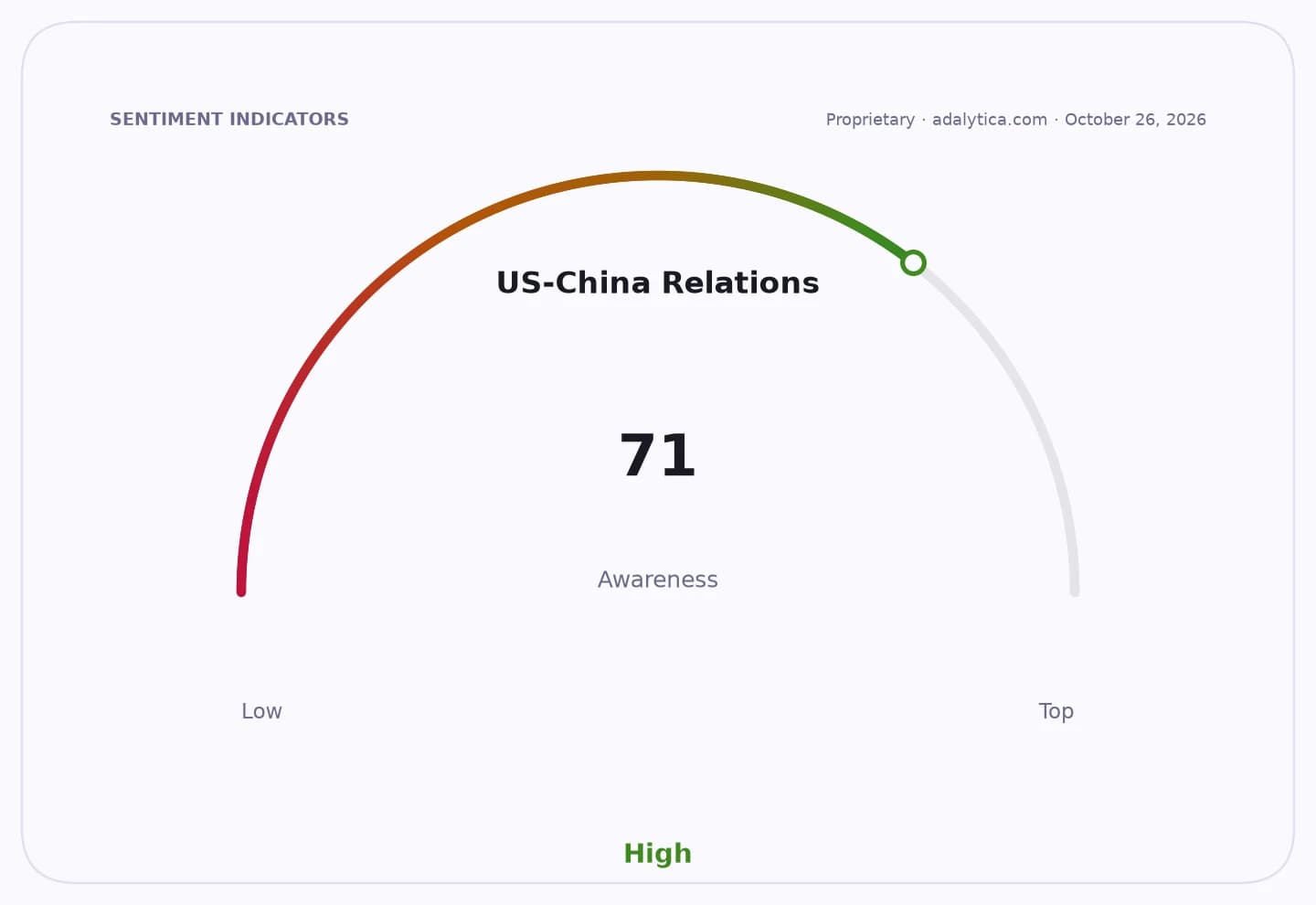
Sentiment IndicatorsⓘProprietary · adalytica.com · October 28, 2026
This is a snapshot — live sentiment, awareness and momentum for 130+ markets update continuously in the dashboard.Open AlphaPulse
For investors, the retreat is a reminder that the AI trade in Asia has become fragile. Chinese technology stocks were among the region’s biggest momentum winners earlier in the year, but weak earnings expectations and fading enthusiasm for growth are now dragging the sector lower. The collapse has wiped out a huge amount of market value in a short period, and that kind of destruction usually forces a broader reset in capital allocation, not just a sector rotation. When the market can no longer justify rich multiples for China’s tech champions, the pain tends to spread to suppliers, hardware names and broader emerging-market sentiment.
The economic backdrop makes the selloff more than a technical correction. China is still struggling with uneven consumer demand, fragile confidence and persistent uncertainty around policy support. That leaves state-backed buying efforts with limited effect: they may slow the decline, but they have not restored the kind of growth narrative needed to sustain higher valuations. In that sense, the bear market is a verdict on the macro story as much as on individual companies.
The pressure is also spilling across regional indexes. Japan, Hong Kong and South Korea are all deeply exposed to semiconductor supply chains, Chinese demand and the global AI investment cycle. As a result, a China-led de-rating can hit everything from chipmakers to exporters and platform companies, especially when investors are already more selective on valuation. The latest move also comes as U.S. market signals remain mixed, leaving global equity buyers less willing to add risk in Asia.
From an investment perspective, the message is clear: the market is still underpricing how long this China reset could last, and that creates both danger and opportunity. The losers are obvious — Chinese internet, AI and high-beta growth names tied to speculative earnings recovery. The winners are more selective: cash-generative regional exporters with non-China revenue, global semiconductor names with pricing power, and defensive strategies that benefit from lower Asian risk appetite. If China cannot regain leadership, capital will keep chasing the cleaner growth stories elsewhere.
The next catalyst will be whether policy support can translate into actual earnings stability, not just short-lived rallies. Until then, the bear market in China is likely to remain a drag on Asian equities and a warning to anyone still betting that the AI trade can power through weak fundamentals alone.
| Entity | Gains | Losses |
|---|---|---|
| China tech stocks | ▲none | ▼valuation reset |
| Asian exporters | ▲selective demand shift | ▼China-linked sales |
| State-backed buyers | ▲short-term support | ▼credibility |
| Global risk assets | ▲defensive rotation | ▼Asia momentum |