China’s top Communist Party diplomatic envoy Liu Haixing’s visit to Dhaka underscores Beijing’s effort to keep Bangladesh firmly within its South Asia orbit at a time when regional alignments are being tested by trade, energy and political uncertainty.
China envoy Liu Haixing visits Dhaka on Bangladesh ties
The immediate significance is less about ceremony than about continuity. Beijing is signaling that its relationship with Dhaka will outlast changes in Bangladesh’s domestic politics and will extend beyond the current government to opposition forces and institutions. That matters because Bangladesh is one of South Asia’s most populous economies, a key manufacturing base and an important node in China’s Belt and Road strategy. For Beijing, maintaining access to Dhaka helps preserve influence on the Bay of Bengal, protect commercial interests and counter rival powers seeking a larger role in the country.
Sentiment Indicators
The talks in Dhaka also fit a broader pattern of Chinese diplomacy that has become more active across Asia as Beijing works to stabilize its regional ties and secure markets for trade and infrastructure. The reported meeting with Tariq Rahman, along with Beijing’s pledge to strengthen cooperation and support a new research center at North South University, suggests China is broadening its engagement beyond state-to-state channels and into political and academic networks. That gives Beijing more optionality if Bangladesh’s political landscape shifts.
For investors, the main implication is that Bangladesh-China relations remain unlikely to deteriorate sharply in the near term, reducing one source of policy risk for Chinese lenders, contractors and exporters with exposure to the country. The message also matters for broader emerging-markets sentiment: stable Chinese engagement can support infrastructure spending, energy cooperation and import demand, even if the pace of project execution remains uneven.
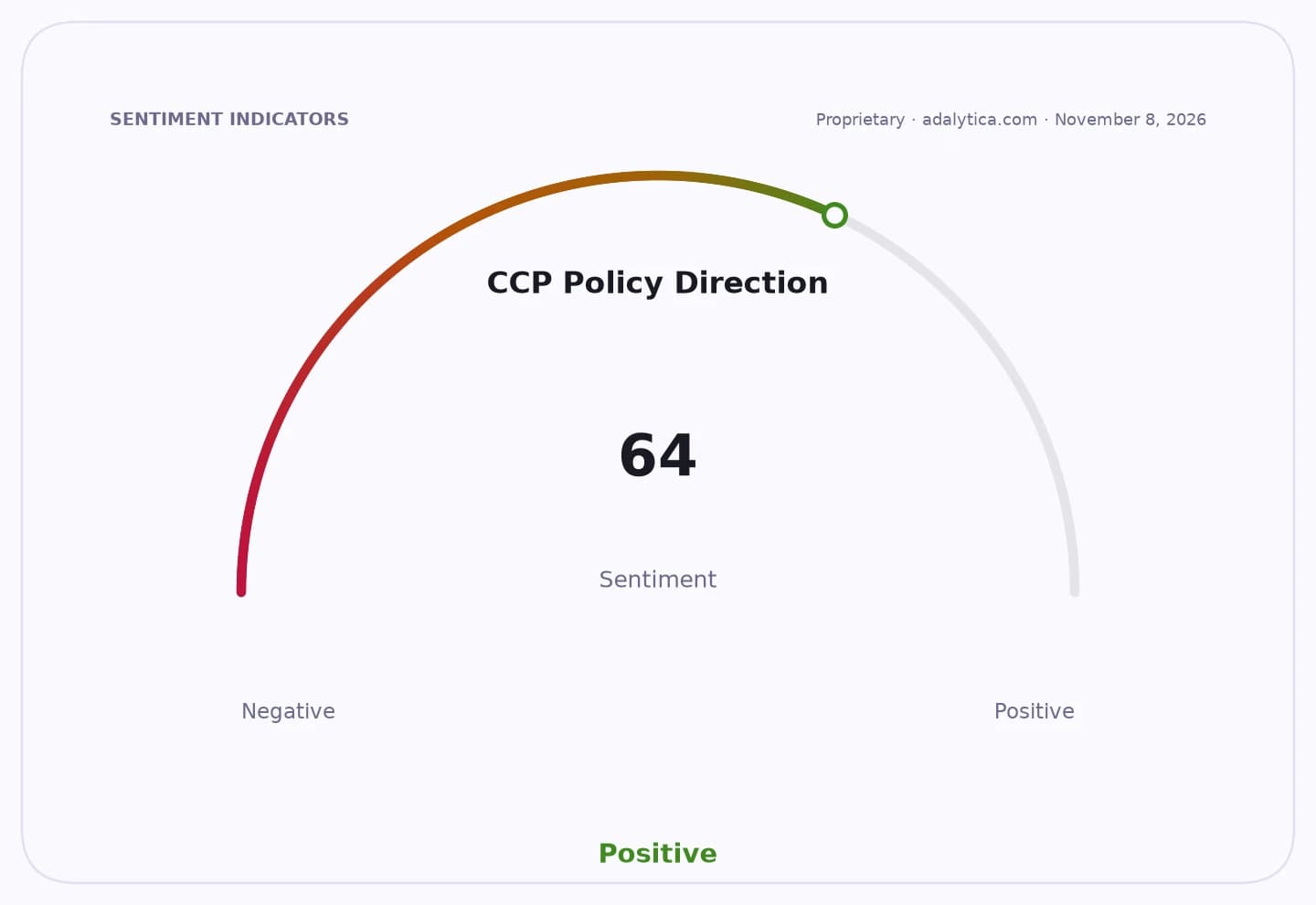
The market backdrop is mixed. FXI, the large-cap China ETF, has been drifting below its 200-day moving average, reflecting skepticism about China’s growth outlook even as short-term momentum has improved. BABA, meanwhile, has rebounded sharply from recent lows, but its shares still sit well below longer-term levels, showing that investors remain selective about China exposure. Adalytica’s China CCP policy-direction gauge has turned more optimistic in recent days, though its yuan-trade signal remains deeply cautious, highlighting the gap between political messaging and currency confidence.
The bull case is that tighter China-Bangladesh ties reinforce a corridor for trade, financing and strategic influence at a moment when Beijing is trying to defend its regional position. The bear case is that diplomatic reassurance does not eliminate Bangladesh’s own political volatility, debt constraints or execution risk on large projects. For now, Liu’s visit points to a steadying of relations rather than a transformational shift — but in South Asia, steadying can itself be economically meaningful.
| Entity | Gains | Losses |
|---|---|---|
| China | ▲Regional influence | ▼Diplomatic uncertainty |
| Bangladesh | ▲Investment access | ▼Bargaining leverage |
| Chinese lenders and contractors | ▲Project pipeline | ▼Financing risk |
| Rival regional powers | ▲— | ▼Strategic space |