Beijing is widening its export-control playbook to cover artificial intelligence, biopharmaceuticals and solar technology, a move that deepens the economic fight with Washington by putting some of China’s most strategically valuable industrial capabilities under tighter state oversight.
China Expands Export Controls on AI, Biopharma, Solar
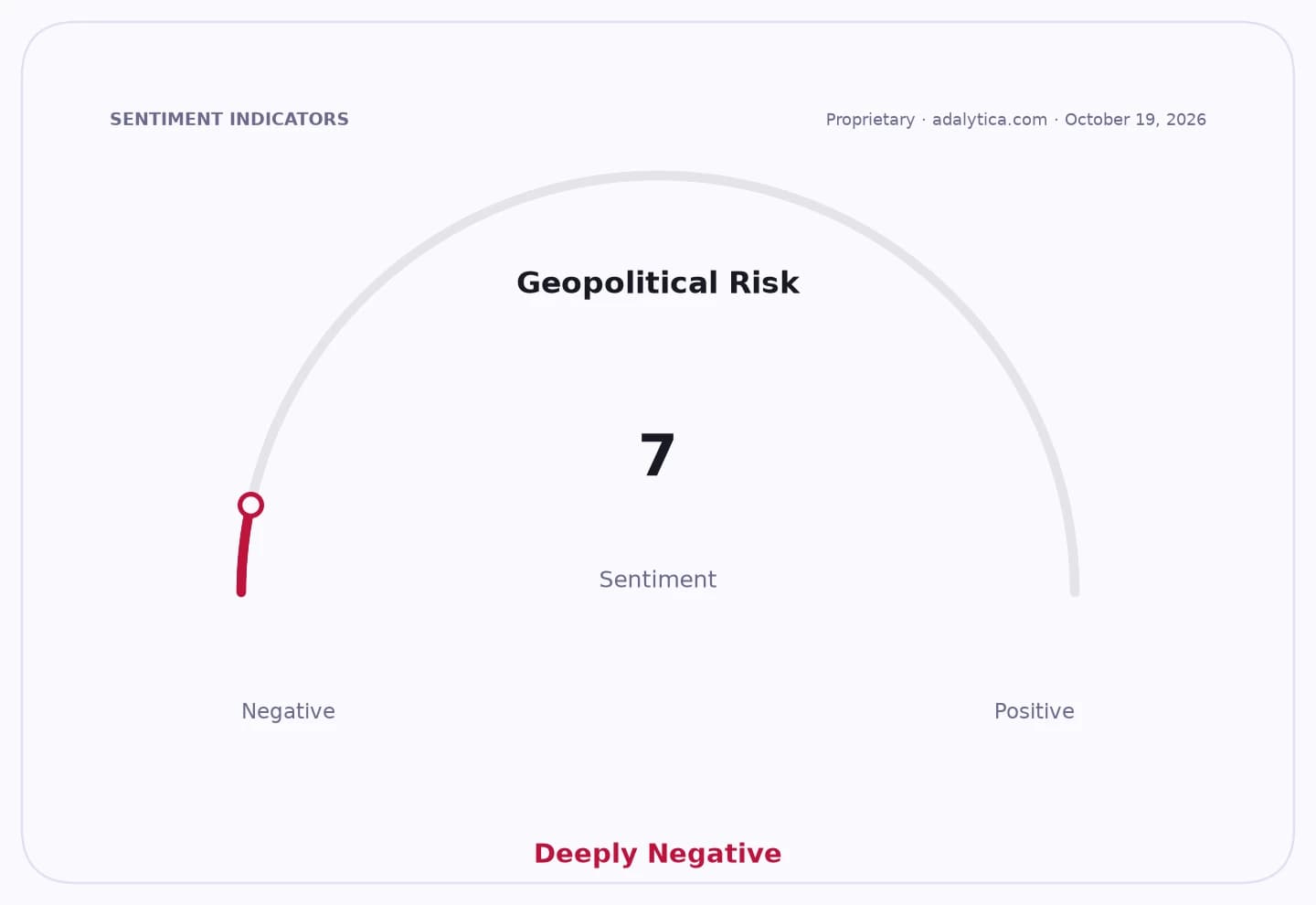
The new restrictions matter because they target sectors at the center of China’s trade surplus, its push up the technology value chain and its leverage over global supply chains. By explicitly seeking to stop certain capabilities from “proliferating inappropriately,” Beijing is signaling that technology flows will be managed not just through tariffs and sanctions, but through licensing and regulatory permission — a tool that can slow competitors, reshape pricing and force multinationals to rethink sourcing and production.
Sentiment IndicatorsⓘProprietary · adalytica.com · October 19, 2026
This is a snapshot — live sentiment, awareness and momentum for 130+ markets update continuously in the dashboard.Open AlphaPulse
For investors, the immediate read-through is mixed. Companies tied to Chinese AI infrastructure, solar manufacturing and drug production face a higher risk of delays, compliance costs and export bottlenecks. U.S. and allied chipmakers, equipment suppliers and biotech firms also face another layer of uncertainty as export rules become a more active instrument of state policy. That helps explain why semiconductor and clean-energy shares have been sensitive to each round of China-U.S. trade escalation: any new restriction can shift demand, reroute orders and compress margins across the supply chain.
The timing is notable. China has been leaning on exports to offset weak domestic demand, and recent trade performance has underscored how central external demand has become to growth. At the same time, the country is moving to preserve control over the technologies most likely to matter in the next phase of strategic competition, particularly where AI development, medical innovation and energy manufacturing intersect.
That creates a broader policy trade-off. Beijing can use export controls to protect national security, curb leakage of sensitive know-how and strengthen bargaining power in negotiations with the United States and its allies. But tighter controls also risk slowing commercial flows, complicating relationships with overseas customers and inviting more retaliation. The more China weaponizes its role in advanced manufacturing, the more global firms will accelerate diversification away from single-country dependence.
For investors, the key question is whether this becomes a narrow licensing regime or the start of a broader effort to place more of China’s high-value industrial base behind strategic gates. If the rules tighten further, the winners are likely to be non-China suppliers and firms with diversified manufacturing footprints. The losers are companies relying on seamless access to Chinese inputs, customers or production capacity.
| Entity | Gains | Losses |
|---|---|---|
| China government | ▲More control over strategic tech | ▼Short-term trade friction |
| U.S. and allied suppliers | ▲Diversification demand | ▼Fewer China-linked sales |
| Chinese AI/solar/biopharma firms | ▲Protected know-how | ▼Export delays and compliance costs |
| Global manufacturers | ▲Incentive to reshore/reshuffle supply chains | ▼Higher sourcing uncertainty |