Xi Jinping’s call for “higher-quality growth” comes as China tries to keep its economy expanding without leaning on the old playbook of debt, property and heavy industry. That matters because the country’s next phase of growth will shape commodity demand, corporate earnings and investor returns far beyond its borders.
China Higher-Quality Growth and Market Impact
The most important part of the story is not the slogan itself, but the policy shift behind it: Beijing wants China to keep growing, but in a way that is more efficient, more innovative and less wasteful. That is a meaningful economic change. It suggests officials are increasingly focused on durable productivity gains, not just headline GDP, and that they are willing to tolerate slower but cleaner expansion if it produces stronger long-term returns.
Sentiment Indicators
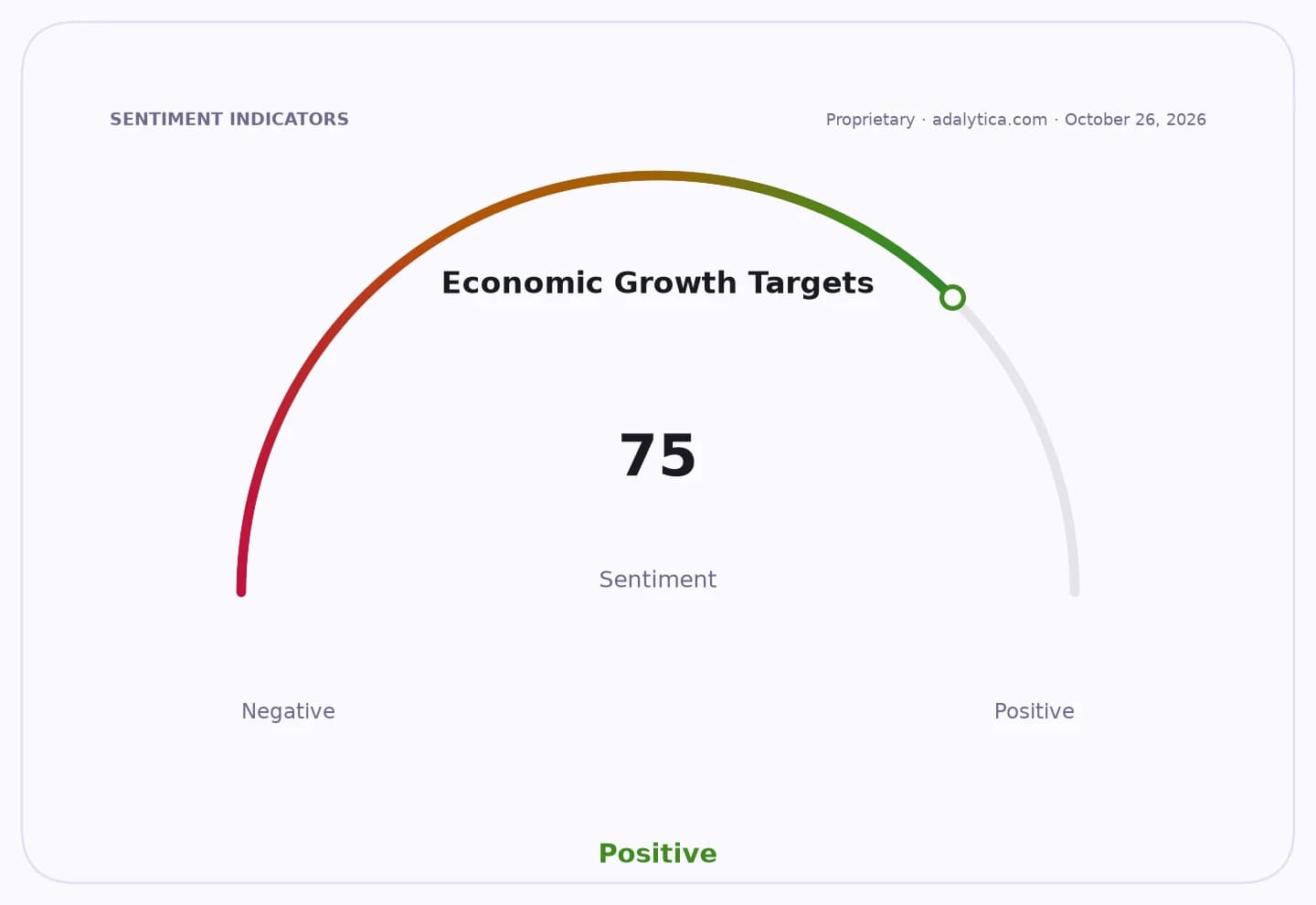
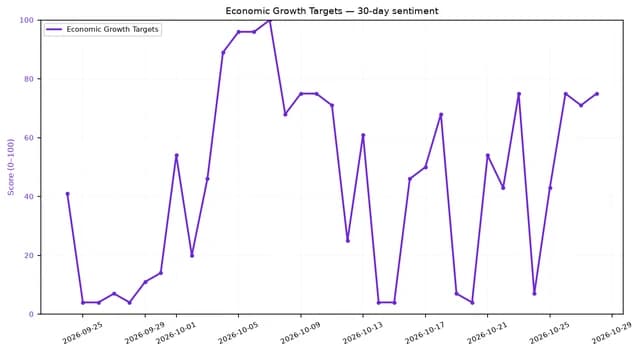
Economic Growth Targets
There is evidence the strategy is already taking hold. China’s industrial profits have jumped at the fastest pace in three months, helped by “new growth drivers” and innovation-heavy sectors. In other words, the parts of the economy Beijing wants to nurture are beginning to contribute more visibly to earnings. For investors, that is important because profits ultimately matter more than policy rhetoric. If companies tied to advanced manufacturing, green technology and other strategic industries can sustain margin gains, they can support a longer-lasting rerating of Chinese equities.
The market is already showing a split view of the opportunity. The iShares China Large-Cap ETF, FXI, has slipped to about 32.50, below its 50-day moving average near 34.35 and its 200-day moving average around 35.63, with the relative strength index near 38. That tells you investors remain cautious despite the policy message. The broader China ETF, MCHI, is weaker still, trading near 49.08, well below its 50-day and 200-day averages, with RSI in the high 20s. By contrast, the mainland-focused ASHR sits near 30.78, also under pressure but closer to its lower Bollinger Band. The technical backdrop says the market wants proof, not promises.
That proof would have to come from earnings growth, not just easier financing or state support. Beijing’s emphasis on “reasonable expansion” suggests it is trying to avoid a sharp slowdown while keeping leverage in check. For long-term investors, that is the key balance: too much stimulus can revive old imbalances, but too little risks leaving private-sector confidence weak. If policy can support the right industries without reigniting excess, China could move into a more sustainable growth model that is better for shareholders over time.
The yuan and sentiment indicators also point to a market still searching for conviction. Adalytica’s China growth target sentiment is elevated, but the yuan trading signals show only neutral sentiment even as awareness remains extremely high. That combination usually means investors are paying close attention, but they are not yet fully committed. In practical terms, global portfolios should treat China less as a momentum trade and more as a selective, multi-year allocation.
For investors, the takeaway is simple: China is still trying to prove that higher-quality growth can translate into better returns. If industrial profits keep improving and policy stays focused on innovation, the winners are likely to be companies with real pricing power, export strength and scalable technology. That makes China worth watching, and in a diversified portfolio, worth considering for the long term rather than chasing in bursts.
| Entity | Gains | Losses |
|---|---|---|
| Innovation-led Chinese companies | ▲Better margins, policy support | ▼Old-economy laggards |
| China policymakers | ▲More durable growth model | ▼Easy headline stimulus |
| Investors in quality China equities | ▲Higher earnings visibility | ▼Broad index holders in weak sectors |
| Commodity exporters and industrial rivals | ▲Steadier demand | ▼Less of a China boom boost |