China has unveiled a 19-measure plan to accelerate its drive for so-called new quality productive forces, sharpening a policy shift toward advanced manufacturing, technological self-reliance and higher-value industrial growth at a time when the economy is still leaning on government support.
China Unveils 19-Measure New Productivity Plan

The move matters because Beijing is trying to change the composition of growth, not just the pace. By targeting scientific innovation, deeper integration between research and industry, new development models, institutional reform and human-capital development, the leadership is signaling that the next phase of expansion will be judged less by heavy investment and more by productivity gains, upgraded supply chains and strategic industries.
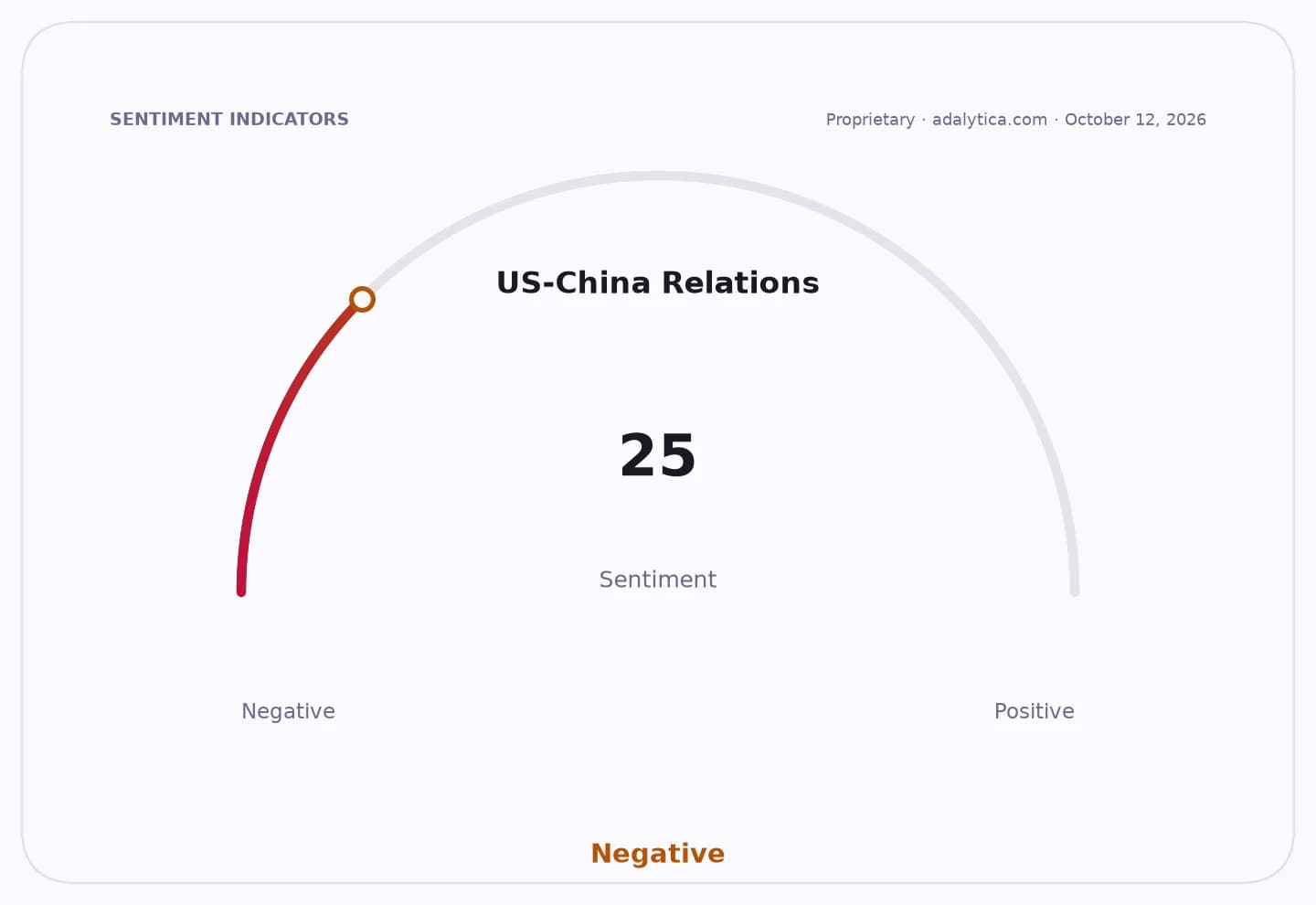
Sentiment IndicatorsⓘProprietary · adalytica.com · October 12, 2026
This is a snapshot — live sentiment, awareness and momentum for 130+ markets update continuously in the dashboard.Open AlphaPulse

That makes the policy economically important on several levels. If successful, it could help lift factory efficiency, support higher-margin sectors such as semiconductors, electric vehicles, industrial automation and green technology, and reduce dependence on low-end manufacturing. It also suggests Beijing is prepared to use policy more aggressively to sustain industrial momentum after signs of recovery in factory output, which recently returned to expansion for the first time since June.
For investors, the implications are broader than a standard stimulus announcement. The plan reinforces the case for selective exposure to Chinese industrial technology, automation and export-oriented manufacturers that can move up the value chain. It may also support sentiment toward China-linked exchange-traded funds such as FXI and MCHI, though the moves in those funds have been volatile and remain below longer-term trend markers, reflecting lingering doubts about earnings quality, property-sector weakness and the durability of the recovery. Leveraged China equity bets such as YINN remain especially sensitive to policy headlines and shifts in risk appetite.

The market backdrop still looks conflicted. FXI closed at $34.24 on Oct. 9, above its recent lows but below its 200-day moving average of 35.96. MCHI ended at $52.55, also under its 200-day average of 56.38. YINN, the leveraged fund, rose to $25.27 but remains far beneath its 200-day average of 32.49, underscoring that traders are still skeptical about a broad, sustained rerating of Chinese assets. Technical readings also point to caution rather than conviction: the two unlevered ETFs are still below their 200-day averages, while momentum indicators have only partially recovered from recent weakness.
The policy push also comes against a tense external backdrop. Adalytica’s US–China relations sentiment gauge remains at 25, labeled fear, even after a small one-day improvement, showing how trade, technology controls and geopolitical friction continue to weigh on investor positioning. That matters because China’s new productivity drive is not just about domestic reform; it is also a response to a more fragmented global technology landscape in which Beijing wants to secure industrial depth and strategic autonomy.
There is a bull case for the policy: it could channel capital into sectors where China still has scale advantages and create a more durable earnings base for listed industrial and technology companies. The bear case is that China has announced many pro-growth initiatives before, but returns have often been uneven, with local-government constraints, weak private confidence and external restrictions limiting execution.
For now, the key question for markets is whether this latest reform package can translate into faster capex, better margins and a broader improvement in corporate profits. If it does, China equities could begin to trade less as a cyclical rebound and more as a structural story around industrial upgrading. If not, the policy may again end up as a headline boost with limited staying power.
| Entity | Gains | Losses |
|---|---|---|
| China’s advanced manufacturers | ▲More policy support | ▼More scrutiny |
| China equity ETFs | ▲Re-rating potential | ▼Continued skepticism |
| Global industrial rivals | ▲Demand spillovers | ▼Chinese competition |
| Leveraged China bulls | ▲Upside from policy headlines | ▼Higher volatility |