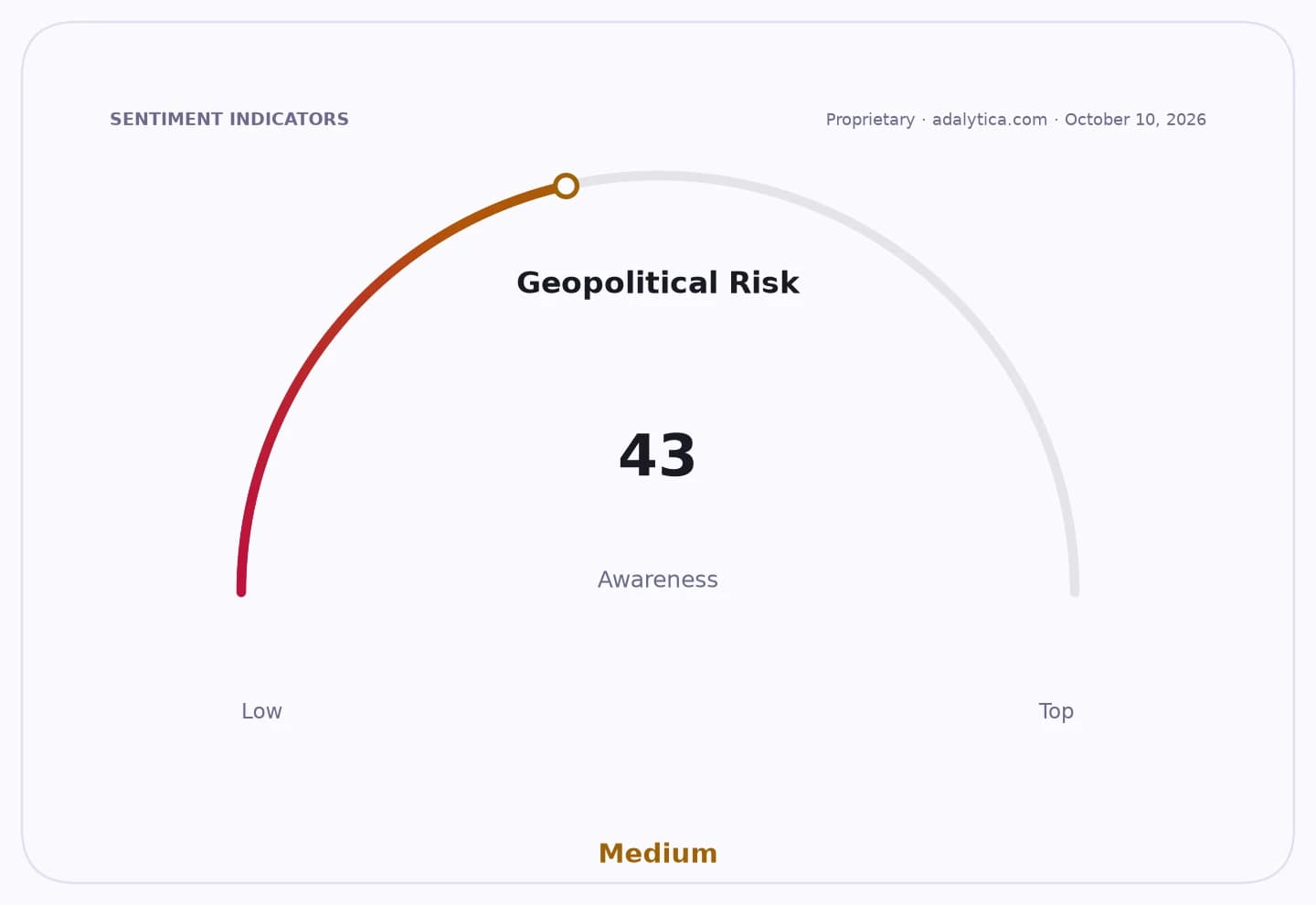
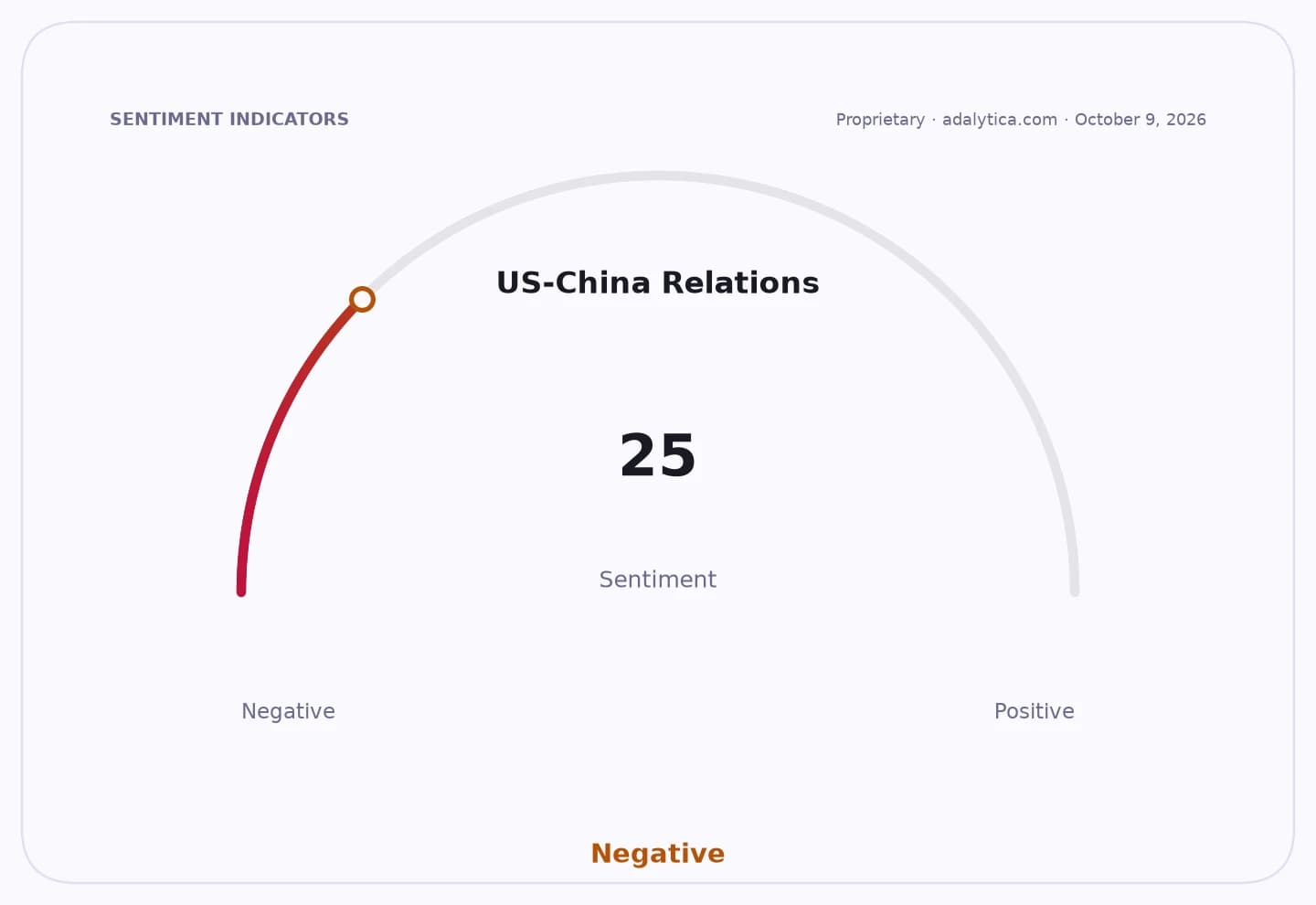
US-China friction is once again the market’s quiet macro tax, and investors are starting to price it into Chinese equities, the dollar and global risk appetite.
FXI Falls as US-China Tensions Keep Pressure
The biggest tell is the iShares China Large-Cap ETF, FXI, which has slipped back to $34.24 after touching $40.34 earlier this year and now sits below both its 50-day and 200-day moving averages. That matters because it shows capital is still demanding a discount for China exposure even as headlines point to diplomatic maneuvering and efforts to cool trade tensions.
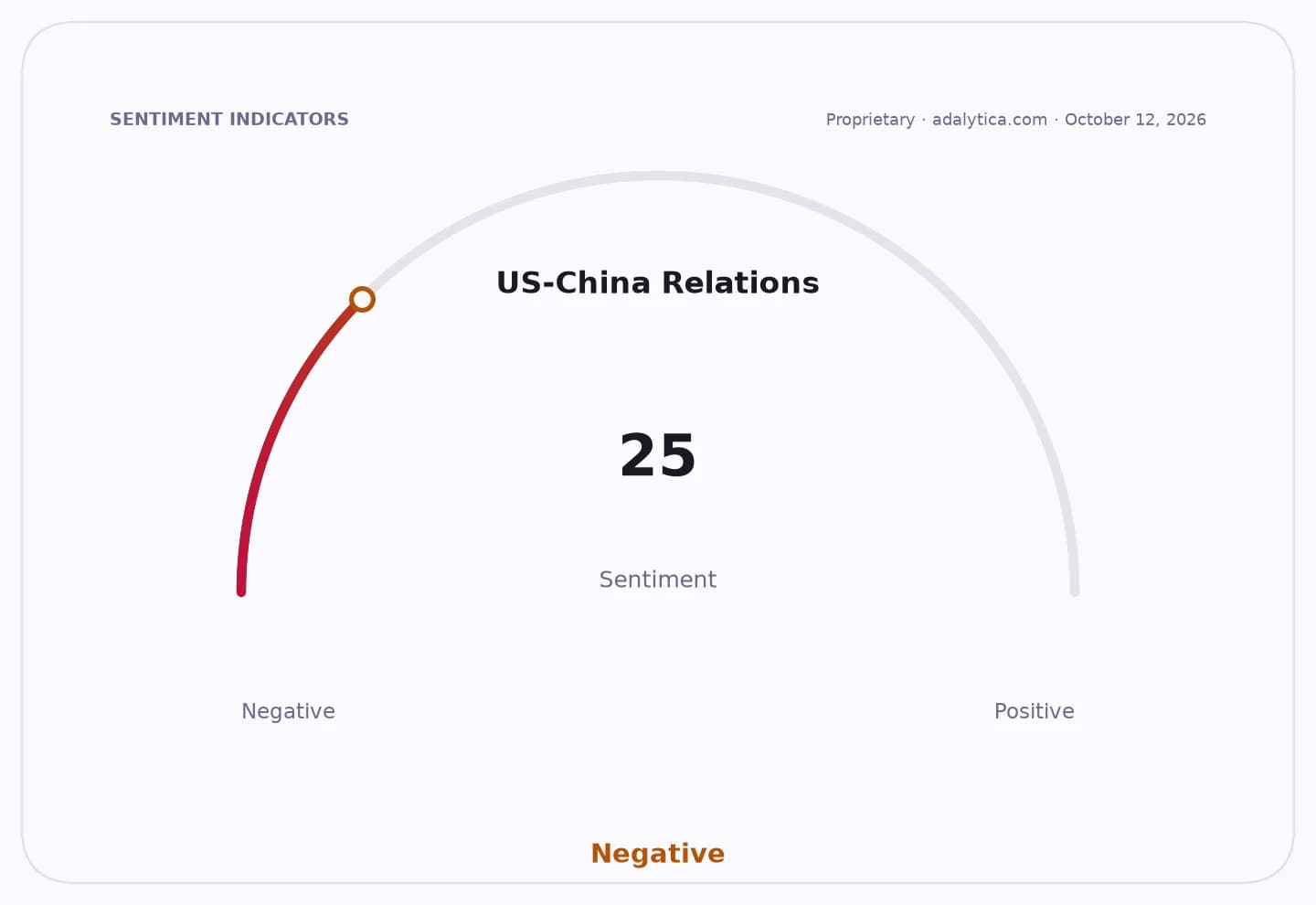
Sentiment IndicatorsⓘProprietary · adalytica.com · October 12, 2026
This is a snapshot — live sentiment, awareness and momentum for 130+ markets update continuously in the dashboard.Open AlphaPulse
The latest backdrop is not a single event but a widening web of pressure. The EU trade chief has arrived in China to try to ease economic strains and avoid a broader trade war, while Beijing continues to criticize unilateral US measures. At the same time, North Korea’s condemnation of US arms sales to Taiwan and ballistic missile launches underline how the Taiwan issue remains a live geopolitical fault line. For markets, that combination is toxic: it lifts policy risk, complicates supply chains and keeps a ceiling on cross-border capital flows.
You can see the risk premium elsewhere. The dollar ETF UUP has climbed to 29.02 and is trading above both its 50-day and 200-day averages, a sign that investors still want the safety of US assets when geopolitics gets louder. SPY, meanwhile, remains near record territory at 778.57, showing that global investors are still comfortable owning US equities even as they hedge uncertainty through the currency market rather than abandoning risk entirely.
US-China Relations — 30-day sentimentadalytica.com
Explore this data interactively — full history, time series and cross-market comparisons.Open AlphaPulse
That split is important. The market is not saying the confrontation will become a crisis tomorrow. It is saying the cost of doing business across the US-China divide is rising, and that cost is showing up in valuations, in capital allocation and in the names most exposed to mainland demand. FXI’s weak relative trend suggests investors are still reluctant to pay up for China rerating without a clearer thaw in trade, technology and security relations.
Our thesis is that this remains an underappreciated setup for selective positioning rather than blanket risk-taking. If tensions stay elevated, the beneficiaries are not the obvious China beta trades but the companies and sectors that sit further up the value chain: US industrials tied to reshoring, defense names tied to Indo-Pacific security, and dollar-linked assets that gain when uncertainty persists. If talks eventually improve, the rebound could be sharp — but the market is not there yet.
For now, the trade is simple: respect the geopolitical premium, stay selective on China exposure, and treat any durable easing in US-China tensions as a catalyst, not a baseline.
| Entity | Gains | Losses |
|---|---|---|
| UUP / US dollar | ▲Safe-haven demand | ▼Currency bears |
| SPY / US equities | ▲Relative capital inflows | ▼Global asset allocators hedging risk |
| FXI / China equities | ▲Potential rebound if tensions ease | ▼Investors priced for discount |
| Defense and reshoring plays | ▲Policy and security tailwind | ▼China-sensitive cyclicals |