Fresh concerns over President Xi Jinping’s health are mattering less as gossip than as a reminder of China’s biggest political risk: a succession system that remains opaque, personalized and potentially market-moving if the leader’s condition weakens.
China Xi health concerns and succession risk
The immediate catalyst was reported unusual protocol during Xi’s U.S. trip, when Chinese officials reportedly asked for extra rest time and a private room between meetings. There is no confirmed illness, but even the suggestion of a reduced travel load is enough to sharpen attention in a system where top-level medical information is treated as state secret and where investor confidence depends heavily on continuity at the apex of power.
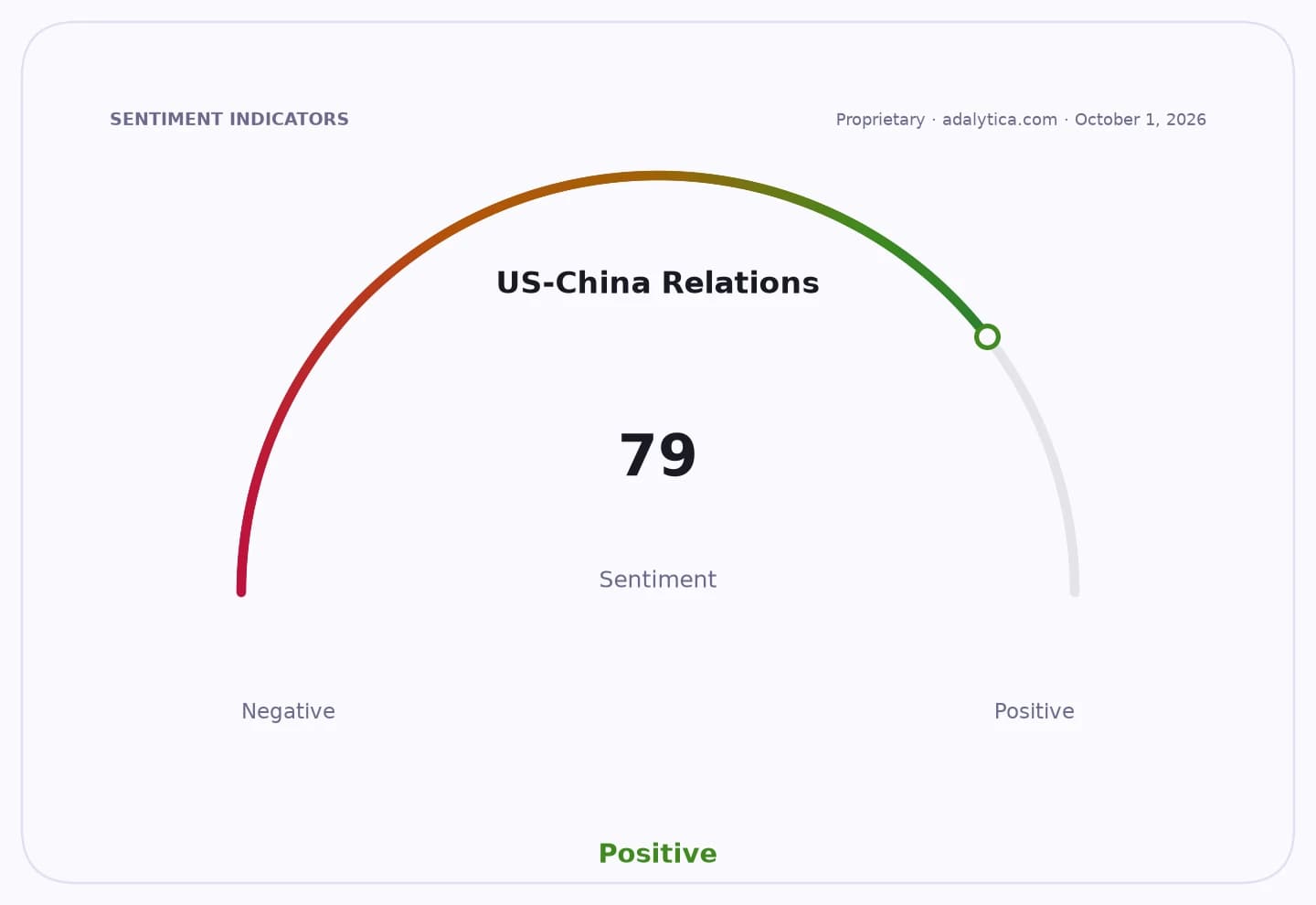
Sentiment IndicatorsⓘProprietary · adalytica.com · October 6, 2026
This is a snapshot — live sentiment, awareness and momentum for 130+ markets update continuously in the dashboard.Open AlphaPulse
That matters economically because Xi’s centralization of authority has made policy direction, business confidence and diplomatic posture increasingly tied to one man. In a country that is still the world’s second-largest economy and a core node in global supply chains, any perception of leadership vulnerability can quickly bleed into risk premiums on Chinese assets, trade assumptions and corporate planning. The absence of a clearly designated successor only heightens the danger: the market is not pricing a clean handoff, but the possibility of a messy intra-party transition.
The investor implication is straightforward. Uncertainty at the top usually means wider valuation discounts for China exposure, especially for funds and multinationals that rely on policy predictability. The mainland’s benchmark and Hong Kong-listed China proxies have already been trading with caution, and the technical picture reflects that hesitation. FXI, the iShares China Large-Cap ETF, recently slipped to $33.85, below its 50-day moving average near $35.12 and its 200-day average around $36.05, while its RSI reading of 44.2 suggests neither capitulation nor conviction. MCHI has also been weak, last at $52.28 versus a 50-day average near $54.27 and a 200-day around $56.53. Hong Kong-focused EWH is faring slightly better, but at $21.77 it too sits below both key moving averages.
The bigger narrative is not simply whether Xi is unwell. It is that the market underestimates how much China’s stability depends on a highly concentrated political structure with limited transparency and no obvious succession roadmap. That is why health rumors repeatedly ricochet beyond Beijing and into currency, equity and geopolitical positioning: they reopen a question investors would rather not have to price, namely what happens if the person anchoring the system suddenly cannot.
Adalytica’s US-China Relations Sentiment gauge is already flashing deep caution, with sentiment at 25 and awareness in “Extreme Fear,” underscoring how quickly fragility in leadership perception can sour cross-border risk appetite. For investors, the actionable takeaway is to treat any escalation in succession speculation as a volatility event for China exposure, while favoring the beneficiaries of uncertainty—defense, alternatives to China manufacturing and non-China Asia supply-chain winners—over broad, undifferentiated mainland beta.
| Entity | Gains | Losses |
|---|---|---|
| Non-China Asia supply chains | ▲More diversification demand | ▼China-centric manufacturers |
| U.S. defense and security names | ▲Higher geopolitical hedging | ▼Risk-tolerant China bulls |
| FXI / MCHI holders | ▲Short-term trading volatility | ▼Long-only China allocation |
| Hong Kong market exposure | ▲Relative safe-haven interest | ▼Mainland policy-linked assets |