Secrecy is becoming a more powerful feature of China’s policy mix just as the economy and markets are being forced to price a heavier national-security overlay. That matters because the same impulse that shields the Communist Party’s history and internal debates also makes it harder for researchers, companies and investors to assess where policy is headed, how far controls will go and what they will mean for trade, technology and growth.
China opacity keeps pressure on equities
Global Stability
The most important development is not a single speech or rule, but the broadening reach of information control and export restrictions as Beijing leans harder into political discipline and strategic self-reliance. Recent curbs on sensitive technologies, including the addition of Japanese entities to China’s export-control list, underline how national security is increasingly taking priority over economic efficiency. For investors, that raises the premium on opacity: policy can shift quickly, enforcement can be uneven and the scope for external scrutiny is narrowing.
Sentiment Indicators
That matters economically because China’s growth model is already under pressure from weak domestic demand, a fragile property sector and hesitant private-sector confidence. A more closed political and information environment can reinforce those headwinds by discouraging investment, slowing due diligence and making it harder for businesses to forecast regulatory risk. The restrictions also feed a wider decoupling dynamic, in which trade, supply chains and technology transfer become more politicized and less predictable.
The market is responding through a familiar China trade: selective buying of equities when stimulus hopes rise, followed by sharp reversals when policy or geopolitical risks reassert themselves. The iShares China Large-Cap ETF, FXI, recently slid to $33.48 from $40.87 in mid-September, while the MSCI China ETF, MCHI, fell to $53.13 from $64.58 over the same broad stretch. Both funds remain below their 200-day moving averages, a sign that longer-term momentum is still weak despite short-term rebounds. Meanwhile, the leveraged inverse China ETF YANG has rallied to $34.18 from $23.90 in mid-May, reflecting renewed demand for downside protection against Chinese equities.
Technical indicators reinforce that uneasy backdrop. FXI’s 50-day moving average sits above its latest close, but momentum has only recently improved from oversold levels, while MCHI’s RSI has recovered from near-oversold territory after a steep June-July decline. YANG’s strength suggests some investors are still positioning for volatility rather than a clean rebound. In market terms, the message is less about a collapse than about a structurally lower confidence premium.
The Reuters-style reading of the policy shift is that Beijing is trying to manage three goals at once: maintain domestic control, defend strategic sectors and keep enough external commerce alive to support growth. The bull case is that tighter discipline can improve state coordination and reduce vulnerability in critical technologies, while targeted industrial policy could still support earnings in selected areas. The bear case is that secrecy and control degrade the flow of information needed for capital allocation, raise the cost of doing business and prompt foreign investors to demand a larger discount for China exposure.
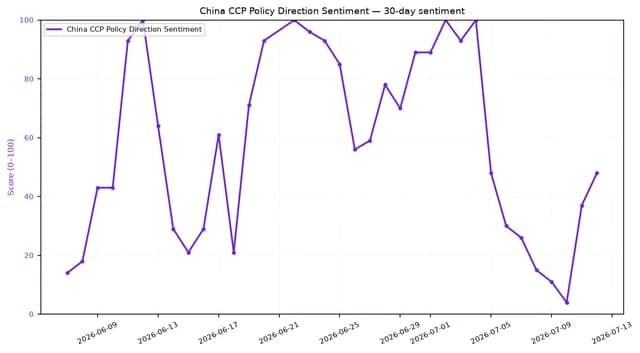
Adalytica’s China CCP Policy Direction Sentiment is neutral at 48, but that masks sharp swings in recent weeks, consistent with a policy environment that is difficult to read and quick to change. The global stability gauge shows extreme fear, underscoring how geopolitics, trade controls and security competition are feeding a broader risk-off tone. For investors, the implication is straightforward: China assets may still rally on stimulus or earnings relief, but the ceiling on valuations remains constrained by policy opacity and geopolitical friction.
What to watch next is whether Beijing uses tighter control to buy stability or whether it unintentionally deepens the very caution it is trying to manage. If the information clampdown widens while export restrictions spread, foreign capital is likely to stay selective, and Chinese equities may keep trading more on policy surprises than on fundamentals. That makes the current story less about one crackdown than about a lasting shift in how China is governed — and how investors are forced to price it.
| Entity | Gains | Losses |
|---|---|---|
| Chinese authorities | ▲control over narrative | ▼policy transparency |
| State-linked sectors | ▲strategic protection | ▼market discipline |
| Foreign researchers/investors | ▲limited access to facts | ▼visibility on risk |
| FXI/MCHI bulls | ▲stimulus-driven rebounds | ▼sustained rerating |