China’s launch of the Yinli-1 vehicle from the sea, carrying nine satellites, underscores how quickly the commercial space race is shifting from one-off missions to repeatable, lower-cost deployment at scale. The immediate significance is not just that another rocket flew successfully, but that China is pairing ocean-based launch logistics with growing satellite production to build a more industrialized orbit economy that could pressure U.S. launch providers and satellite operators over time.
China Sea Launch Raises Space Competition

The launch matters economically because reusable and sea-based launch systems can lower the cost and increase the cadence of putting payloads into orbit. That changes the economics of broadband constellations, remote sensing fleets and space-computing networks, where launch availability and price are often the bottlenecks. China’s push to deploy a 1,000-satellite space-computing constellation suggests the country is no longer treating space as a prestige market alone, but as infrastructure with commercial, strategic and industrial spillovers.
Sentiment IndicatorsⓘProprietary · adalytica.com · July 22, 2026
This is a snapshot — live sentiment, awareness and momentum for 130+ markets update continuously in the dashboard.Open AlphaPulse
For investors, the implication is a more contested market for launch services and satellite-enabled communications. Rocket Lab and Astra Space both trade on the idea that launch frequency and payload execution can grow into durable revenue streams; a Chinese program that can launch from sea and iterate quickly raises the competitive bar. The stocks reflect both the opportunity and the volatility of that thesis: Rocket Lab has seen extreme swings around $65 to $132 this year, while AST SpaceMobile has also moved sharply, with its latest close near $62 after topping $118 in early June. Both names remain highly sensitive to execution risk, capital intensity and any evidence that launch capacity is becoming less scarce.
The technical setup in those stocks points to damaged momentum rather than a clean confirmation of long-term bullish narratives. Rocket Lab’s latest close was far below its 50-day and 200-day moving averages, with RSI readings deep in oversold territory, while AST SpaceMobile also sat below both its moving averages after a steep decline. Iridium, by contrast, looks steadier, reflecting the advantage of an established revenue base over launch-dependent peers. That divergence suggests investors are rewarding recurring cash flow over speculative launch optionality as geopolitical competition in space intensifies.

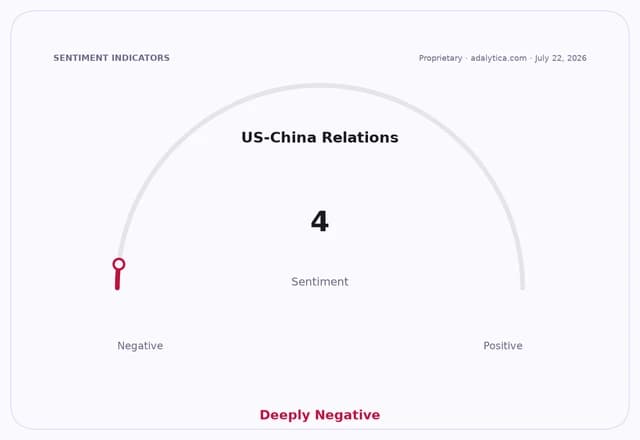
The broader backdrop is a sharpening U.S.-China rivalry in orbit, captured in Adalytica’s US–China relations gauge, which shows extreme fear even as awareness remains elevated. China’s space ambitions also come as policymakers and industry are watching for military and dual-use implications, since launch systems that can move satellites quickly have obvious strategic value. The more China proves it can launch, recover and relaunch with less friction, the more the competitive landscape shifts from engineering novelty to industrial scale.
For now, the key question is whether China can turn a successful sea launch into a repeatable business model that meaningfully cuts costs and expands cadence. If it can, pressure will build on Western launch providers to accelerate reusability and lower prices, while satellite operators may gain a cheaper path to constellation deployment. If the technology proves harder to industrialize, the near-term winners remain the established operators with existing revenue and less dependence on launch-market disruption.
| Entity | Gains | Losses |
|---|---|---|
| China space program | ▲Cheaper launch cadence | ▼U.S. lead in orbit logistics |
| Satellite constellation builders | ▲Lower deployment costs | ▼Launch scarcity premium |
| Launch incumbents | ▲More sector demand | ▼Pricing power |
| Rocket Lab / AST SpaceMobile | ▲Sector attention | ▼Competition and volatility |