China may have found a more practical way to turn the ocean into a strategic energy source, and that matters far beyond a laboratory headline. Researchers say a new process can produce hydrogen and fresh water from seawater while also extracting uranium, bromine and salt, potentially lowering the cost of green hydrogen and widening China’s edge in the race to build next-generation energy infrastructure.
China seawater hydrogen process adds fresh water, uranium
That is important because the bottleneck in clean hydrogen is not ambition, it is economics. Directly using seawater has long been difficult because chloride can damage electrodes and calcium and magnesium can foul equipment, while pre-desalination adds cost and power demand. China’s new system tries to solve both problems at once by capturing waste heat from hydrogen production to drive vacuum distillation, making desalinated water as part of the same process. In other words, it is not just cleaner — it is more efficient.
Sentiment Indicators
The technical claims are significant. The team, led by scientists at the Dalian Institute of Chemical Physics under the Chinese Academy of Sciences, says the process can improve electricity usage by about 14.4% versus conventional methods. The system has already been scaled from a 25-kilowatt unit in 2023 to a 250-kilowatt plant, with the researchers saying it could generate about 380,000 cubic meters of hydrogen a year at 99.9999% purity and also produce roughly 256 tons of fresh water. It reportedly ran stably for 40 days despite repeated daily restarts.
For investors, the story is less about one experimental plant than about what it says regarding the direction of industrial policy and capital allocation. China is trying to link clean fuels, water security and critical materials in a single value proposition. That kind of integration can be powerful in a country that is willing to subsidize scale, optimize supply chains and turn research into deployment quickly. If the economics improve, the winners could include equipment makers, industrial gas suppliers, electrolyzer developers and companies positioned around uranium and broader nuclear-fuel demand.
Uranium investors should not confuse this with a near-term demand shock, but the implication is still real. Seawater uranium extraction has long been viewed as a distant possibility because concentrations are low and recovery costs were high. A process that treats uranium recovery as a by-product of seawater processing does not solve that challenge overnight, but it does reinforce the idea that China is willing to attack resource constraints from multiple angles at once. That is the kind of systems thinking that can move markets over time.
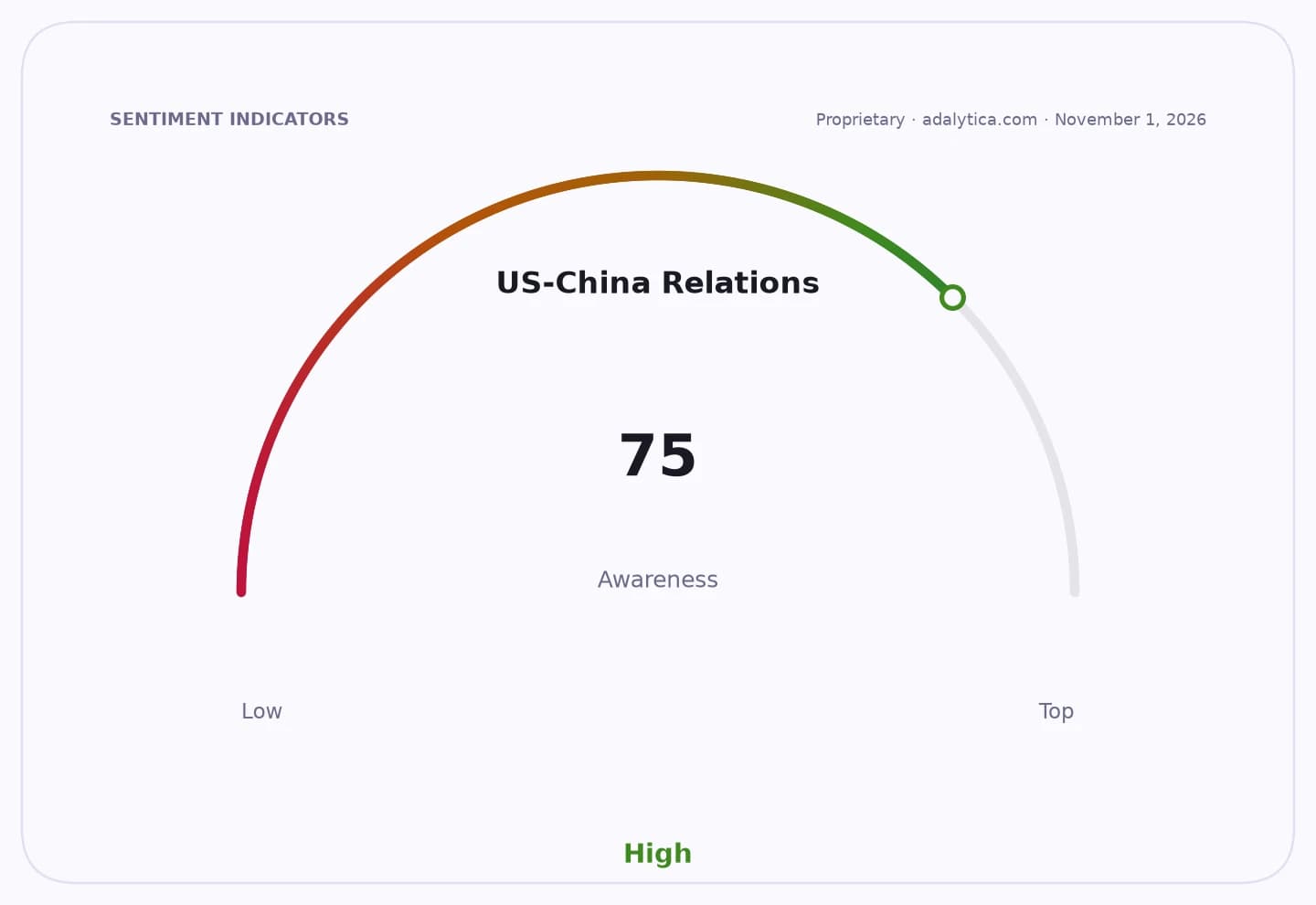
There is also a geopolitical layer here. Adalytica’s US–China relations gauge shows sentiment as neutral but awareness at extreme fear, underscoring how quickly any advance tied to energy security or strategic materials can filter into broader policy anxiety. At the same time, China’s push into seawater-based hydrogen and resource recovery fits a larger national-security narrative: reduce dependence, control inputs and build cleaner energy options without waiting on outside suppliers.
The market takeaway is straightforward. If this technology keeps advancing, it could strengthen the long-term case for hydrogen infrastructure, water-linked industrial systems and uranium exposure, while keeping pressure on competitors racing to commercialize the same themes. For now, the breakthrough is a reminder that the clean-energy transition will be won not just by better climate goals, but by cheaper processes and tougher engineering. Long-term investors should keep it on the watchlist.
| Entity | Gains | Losses |
|---|---|---|
| China | ▲energy security, industrial leverage | ▼slower foreign rivals |
| Hydrogen developers | ▲lower production costs | ▼expensive legacy processes |
| Uranium-linked investors | ▲new long-term optionality | ▼scarcity premium skeptics |
| Water-scarcity markets | ▲fresh-water co-production | ▼standalone desalination vendors |