China has sentenced a government official to death for spying and leaking state secrets, underscoring how far Beijing is willing to go in its counterintelligence crackdown as rivalry with Washington deepens.
China death sentence in spying case
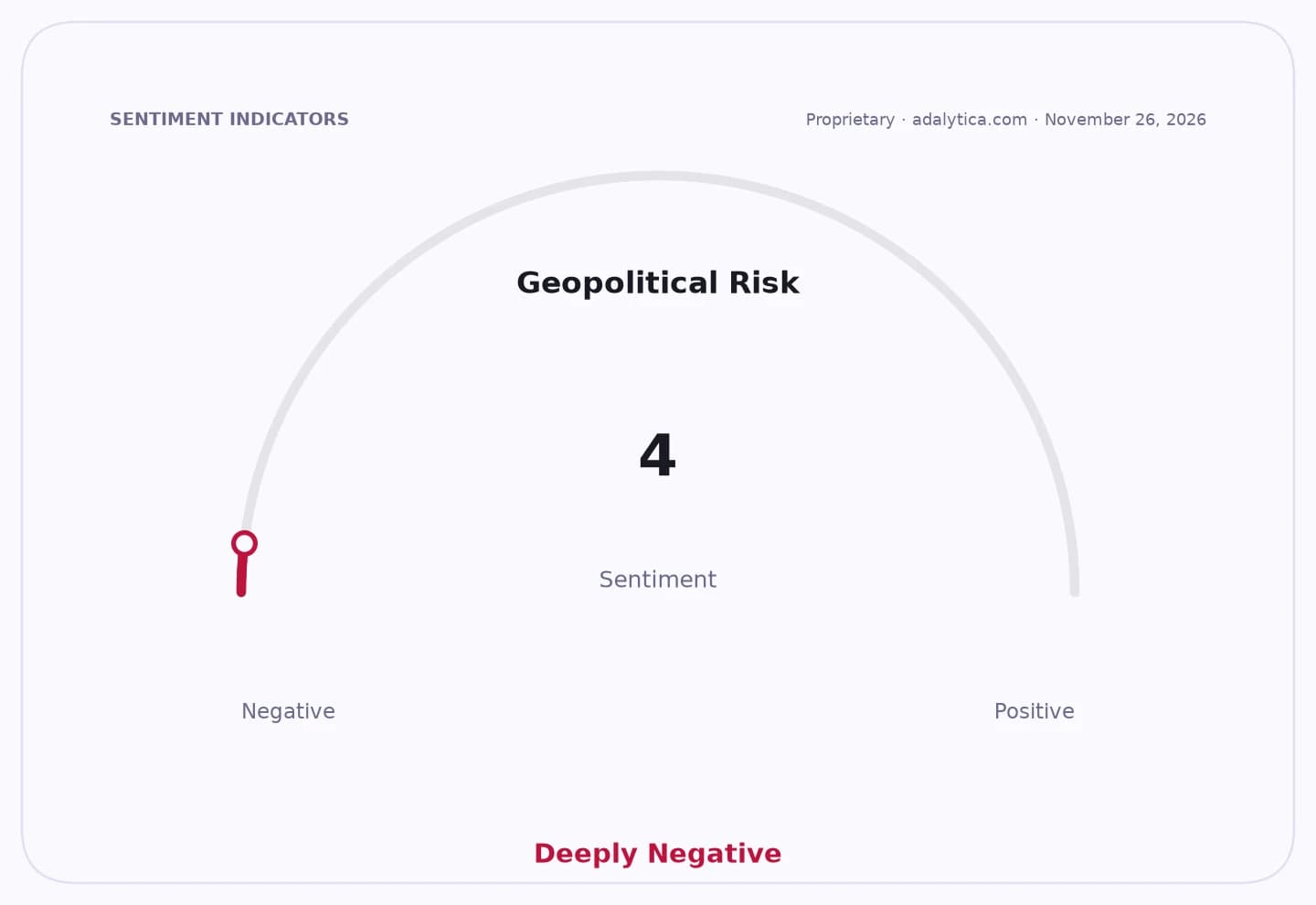
Geopolitical Risk
The case matters beyond the headline penalty because it signals a more aggressive national-security posture at a time when the world’s two largest economies are already locked in confrontation over chips, artificial intelligence, supply chains and access to advanced technology. Beijing is not just punishing one alleged mole; it is amplifying the cost of contact with foreign intelligence services and widening the deterrent message to officials, scientists and executives working in sensitive sectors.
Sentiment Indicators
Gold Wall Press, a publisher tied to China’s State Secrets Protection apparatus, said the official, surnamed Ma, was recruited abroad and later passed on 35 items classified as national secrets in exchange for more than 1 million yuan, or about $150,000. The report said the operative maintained contact through a broader campaign of pressure, inducement and threats, a narrative Beijing often uses to frame foreign intelligence efforts as persistent and manipulative rather than opportunistic.
China rarely discloses details of state security cases, especially at this level, which makes the public announcement itself part of the policy. Over the past few years, the Ministry of State Security and state-linked outlets have increasingly publicized arrests, published warnings on social media and even used films and comics to stoke vigilance. That suggests the leadership sees espionage not only as a legal issue but as a political and ideological risk that needs to be managed in public.
For investors, the case reinforces the scale of geopolitical risk embedded in China exposure, particularly for companies tied to cross-border research, advanced manufacturing, data handling and export-controlled technologies. The more Beijing frames foreign intelligence as a constant threat, the greater the chance of tighter scrutiny on foreign firms, heavier compliance burdens for multinationals and less openness around scientific and commercial collaboration.
The timing also matters. The United States has stepped up efforts to restrict China’s access to advanced semiconductors and AI-related technology, while Washington has also publicized its own attempts to recruit Chinese sources, including Mandarin-language CIA recruitment videos. The tit-for-tat dynamic feeds a security spiral in which both sides justify tighter controls by pointing to the other’s actions, raising the odds of further fragmentation in technology and trade.
The immediate bull case for Beijing is that harsh punishment strengthens deterrence and signals resolve at a moment when internal discipline is a policy priority. The bear case is that highly visible death sentences and broader security campaigns can chill business confidence, widen the trust deficit with foreign partners and further complicate China’s efforts to attract capital and technology.
For markets, the broader takeaway is that security policy remains a core driver of the China story, not a side issue. As the espionage fight intensifies, investors should expect more regulatory uncertainty, more restrictions around sensitive data and more friction in sectors where national security and commercial value overlap.
| Entity | Gains | Losses |
|---|---|---|
| Chinese security apparatus | ▲Deterrence, political control | ▼— |
| Foreign intelligence services | ▲— | ▼Recruitment risk rises |
| Multinational investors in China | ▲Potential clarity on red lines | ▼Higher compliance and political risk |
| China’s tech and research sector | ▲Stronger state protection | ▼Slower cross-border collaboration |