China’s declaration of a state of alert as Hurricane Noul nears is a reminder that weather shocks can quickly ripple beyond public safety into transport, industrial output and investor sentiment, especially when they hit coastal economic hubs.
Storm Risk Pressures Fragile China Equity Sentiment
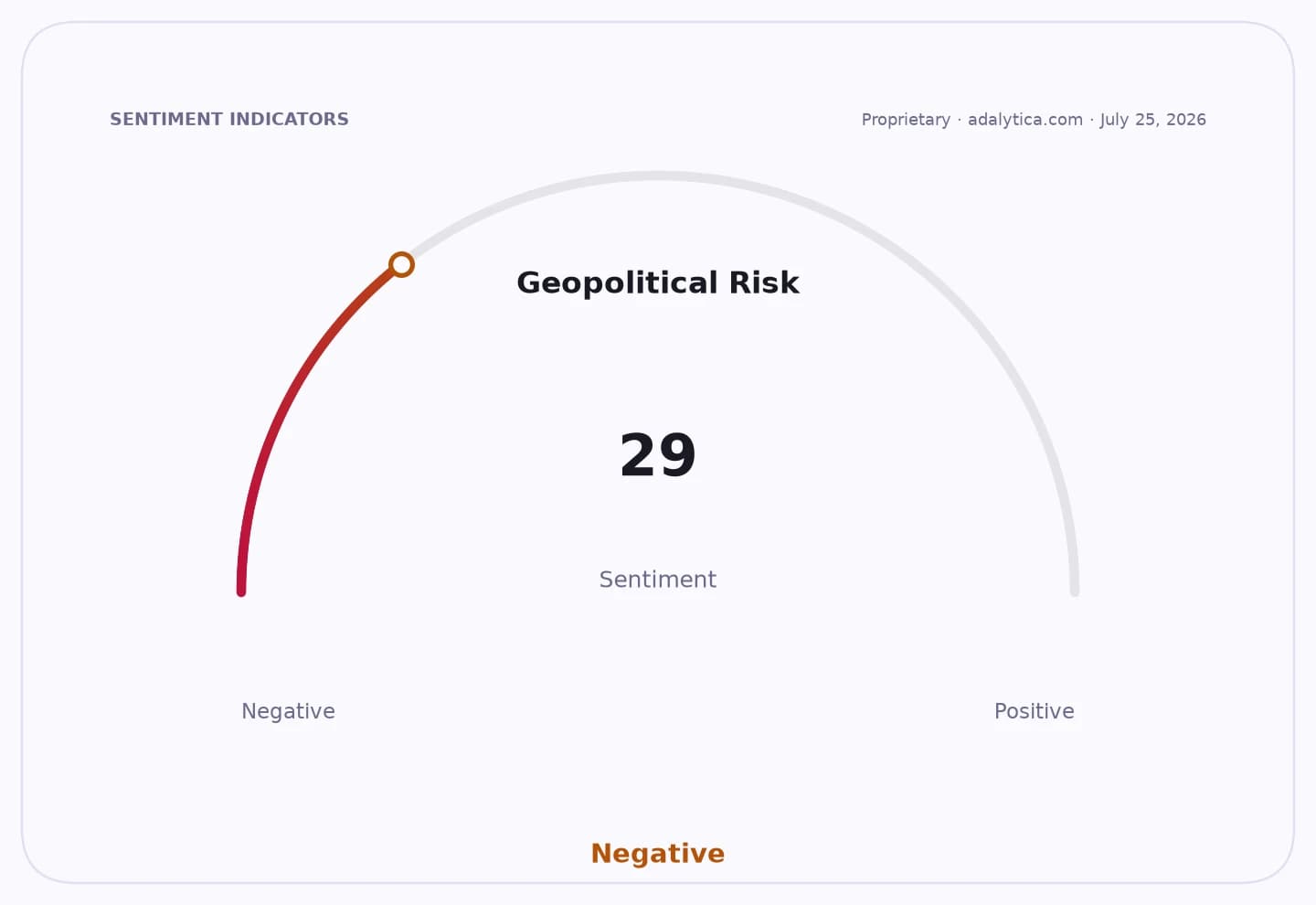
The immediate economic risk is disruption: evacuations, flight cancellations, rail suspensions and port slowdowns can interrupt supply chains, delay business activity and depress consumption in affected regions. In a country where manufacturing, logistics and domestic travel remain tightly intertwined, even a short-lived storm can dent quarterly activity at the margin and force companies to absorb higher operating costs.
Sentiment IndicatorsⓘProprietary · adalytica.com · July 25, 2026
This is a snapshot — live sentiment, awareness and momentum for 130+ markets update continuously in the dashboard.Open AlphaPulse

That matters to investors because disaster response in China tends to show up first in market positioning rather than in long-lived fundamentals. Shares linked to Chinese growth have been choppy, with the iShares China Large-Cap ETF, FXI, recently trading around 34.58, below its 200-day moving average of 37.04 and only marginally above its 50-day average of 34.26. The ETF’s RSI reading of 74.6 suggests the rebound has been stretched, even as momentum indicators remain positive, leaving room for traders to fade strength if the storm worsens or if officials signal broader disruption.
The bigger story is that Noul lands against a fragile backdrop for China assets. The US-listed leveraged China ETF YINN has climbed to 27.70 from recent lows but remains far below its 200-day average of 38.13, underscoring how quickly sentiment can turn and how limited confidence remains in a sustained policy-led recovery. KWEB, which tracks Chinese internet stocks, has also been drifting below longer-term trend lines, showing that investors are still demanding proof of cleaner growth before re-rating China exposure.
US-China Relations vs FXIadalytica.com
Explore this data interactively — full history, time series and cross-market comparisons.Open AlphaPulse
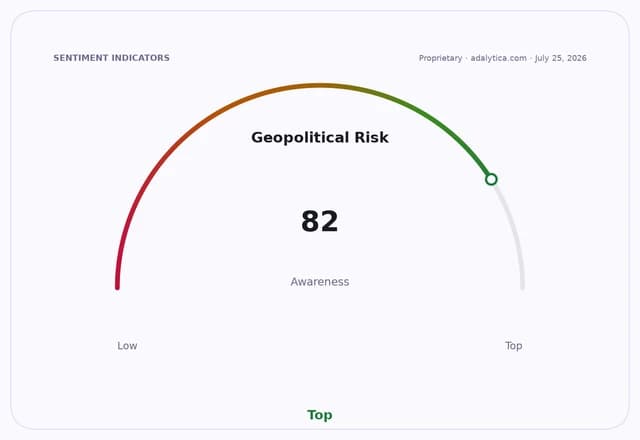
Adalytica’s US–China Relations Sentiment gauge is in “Extreme Fear” at 14, while its Global Stability sentiment has slipped to 29, highlighting a market environment already primed for risk aversion. The US dollar trade signal remains at “Extreme Fear” as well, which suggests investors are still treating geopolitical and macro shocks as reasons to de-risk rather than rotate into cyclical exposure.
The bullish case is that weather-related disruption is temporary and often followed by a catch-up in transport, consumption and logistics once conditions normalize. The bearish case is that repeated shocks, layered on top of slower growth and policy uncertainty, can amplify the sense that Chinese equities need a stronger catalyst than short-term stabilization to sustain gains.
For investors, the key question is not just the storm track but whether Noul becomes another reminder that China’s equity rally is vulnerable to exogenous shocks. The next few sessions will show whether the market treats the alert as a transient event or another reason to keep a defensive stance on China beta, travel-sensitive stocks and mainland-linked assets.
| Entity | Gains | Losses |
|---|---|---|
| Chinese authorities | ▲Public safety credibility | ▼Economic activity near the coast |
| Defensive investors | ▲Lower tail risk | ▼Upside from a China rebound |
| Travel and logistics firms | ▲None | ▼Flight, rail and port revenue |
| China equity bulls | ▲Temporary dip-buying chance | ▼Confidence in a sustained rally |