China’s Ministry of Education approved 219 new transnational education partnerships in its latest round at the end of May, the highest annual pace since 2012 and a sign Beijing is widening access to foreign degrees even as geopolitical tensions remain elevated.
China’s TNE approvals boost education exposure

The approvals matter because transnational education, or TNE, lets overseas universities deliver programs in China through local partners, giving Beijing a way to expand higher-education supply without sending more students abroad. For investors, that can mean more revenue opportunities for international education groups, greater demand for joint programs and a modest boost to cross-border student flows at a time when travel and visa frictions still cloud the sector.

The pickup also points to a policy shift that is more practical than political. China is trying to strengthen its higher-education system, keep more tuition and talent onshore and deepen academic ties with Europe and other partners, while maintaining control over what foreign institutions can offer inside the country.
The market read-through is constructive for listed education names with China exposure, though the reaction has been uneven. New Oriental Education & Technology Group, which has been expanding beyond its legacy test-prep business, was trading at $49.35 on July 23, above its 50-day moving average of $47.61, with RSI readings at 65.6 and a positive MACD, suggesting momentum has improved. Jianzhi Education Technology Group, by contrast, was at $2.59 after a sharp collapse from a recent $93 close, underscoring how quickly sentiment can reverse in the sector.
CCP Policy Direction vs EDUadalytica.com
Explore this data interactively — full history, time series and cross-market comparisons.Open AlphaPulse
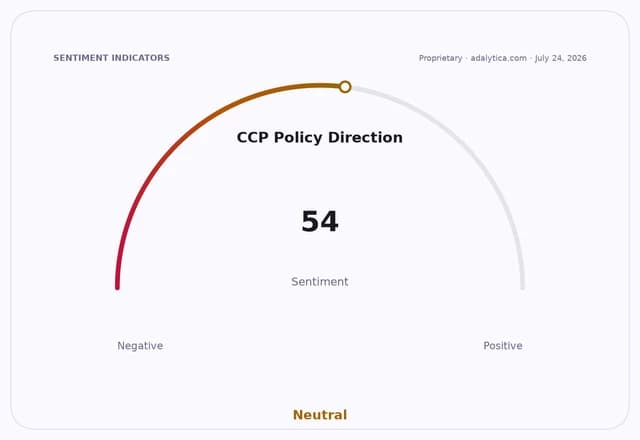
The broader backdrop is still mixed. Adalytica’s China CCP Policy Direction Sentiment is neutral at 54, while US-China relations sentiment remains in extreme fear territory at 4, highlighting the political risk that still hangs over cross-border education. Even so, the surge in approvals suggests China is willing to keep selective academic channels open, especially where they support skills transfer, internationalization and domestic demand.
For investors, the key question is whether the current round is a one-off catch-up or the start of a more durable policy thaw for foreign education partnerships. Another strong approval round would reinforce the case for international university operators, Chinese education service providers and joint-program platforms; any sign of tighter scrutiny would quickly cool the trade.
| Entity | Gains | Losses |
|---|---|---|
| Foreign universities | ▲China revenue access | ▼Regulatory uncertainty |
| Chinese partner schools | ▲Program expansion | ▼Higher compliance burden |
| EDU shareholders | ▲Policy tailwind | ▼Slower-than-expected growth if approvals stall |
| JZ shareholders | ▲Potential sector lift | ▼Volatility and execution risk |