China’s launch of the first weekly freight service between China and the European Union via the Northern Sea Route marks a material shift in global shipping economics, potentially shortening transit times, altering fuel costs and giving traders a new option at a time when traditional routes remain exposed to geopolitical and climate risk.
China launches weekly Northern Sea Route freight service
The development matters because Arctic shipping is moving from a niche seasonal experiment toward a more commercial trade corridor, and China is positioning itself early in a lane that could matter for supply chains linking Asia and Europe. A weekly schedule is especially significant: regularity, rather than one-off voyages, is what turns a route into an investable logistics channel. If the service proves reliable, shippers could use it to bypass chokepoints such as the Suez Canal and reduce voyage time compared with conventional Asia-Europe sailings, though the route still faces ice, insurance and infrastructure constraints.
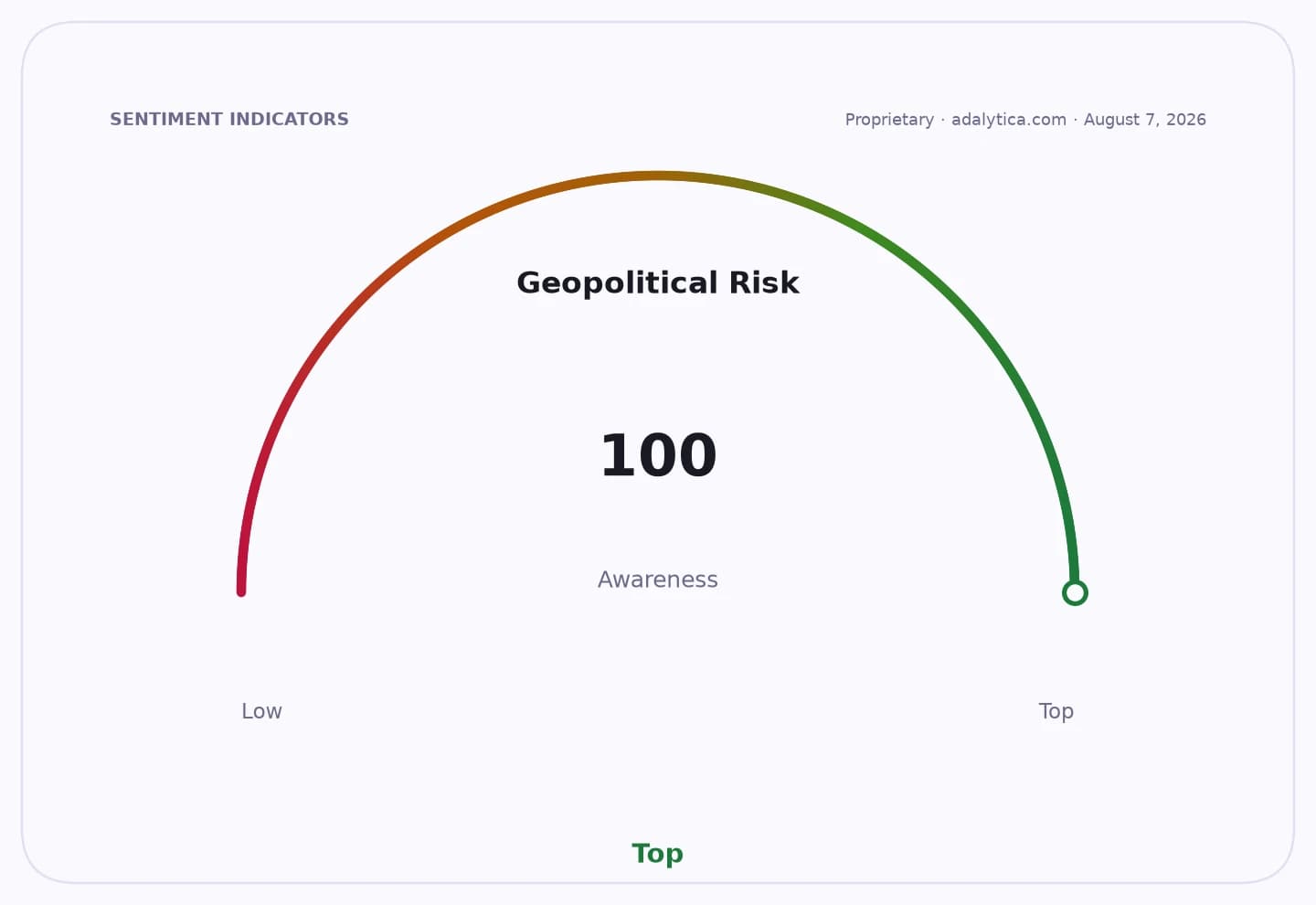
Sentiment IndicatorsⓘProprietary · adalytica.com · August 7, 2026
This is a snapshot — live sentiment, awareness and momentum for 130+ markets update continuously in the dashboard.Open AlphaPulse
For investors, the immediate implication is not a wholesale rerouting of global trade but a gradual repricing of Arctic optionality. Carriers with exposure to China-Europe container flows may see a competitive challenge if cargo owners shift premium or time-sensitive freight north. At the same time, the route could support specialized operators, ice-class tonnage, port services and maritime technology suppliers tied to Arctic navigation. The bigger strategic takeaway is that China is deepening its logistics presence in a region long dominated by Arctic states, underscoring its willingness to invest in alternative trade infrastructure as geopolitical fragmentation pushes companies to diversify routes.
The timing is notable against a backdrop of elevated oil prices and firm global yields, which keep transport costs and financing conditions meaningful for shippers. Brent crude around the mid-$80s a barrel and the US 10-year Treasury yield near 4.6% suggest the cost of moving goods and funding ships remains high, making any route that can cut voyage time economically attractive. But lower sailing days can be offset by higher Arctic operating expenses, while weather windows and ice conditions mean the economics will remain highly sensitive to execution.
For shipping stocks, the news is more of a directional than an immediate earnings event. Operators with strong balance sheets and flexible fleets may benefit if niche Arctic demand expands, while pure-play Asia-Europe container lines could face longer-term pressure on specific cargoes if the route proves dependable. Shares of dry bulk and container-linked names have already reflected an environment of volatile freight expectations, and investors will watch whether Arctic sailings remain symbolic or become a repeatable part of the trade map.
The key question now is whether this first weekly China-EU service becomes a one-season demonstration or the foundation of a durable corridor. If volumes build and insurers, ports and cargo owners follow, the Northern Sea Route could emerge as a strategic release valve for Eurasian trade. If not, it will remain a high-profile but limited supplement to the routes that still carry the bulk of the world’s goods.
| Entity | Gains | Losses |
|---|---|---|
| China-linked shippers | ▲Faster route optionality | ▼Higher Arctic operating risk |
| Arctic service providers | ▲New freight demand | ▼Dependence on short ice windows |
| Traditional Asia-Europe carriers | ▲Limited benefit | ▼Possible cargo diversion |
| Suez-linked logistics networks | ▲Ongoing relevance | ▼Pressure from route diversification |