The U.S. unemployment rate is holding near 4.2%, but a cooler job-openings trend and a sharp drop in global risk sentiment are keeping investors focused on whether demand for workers is easing faster than the headline jobless rate suggests.
Cooling labor data keeps Fed cut hopes alive
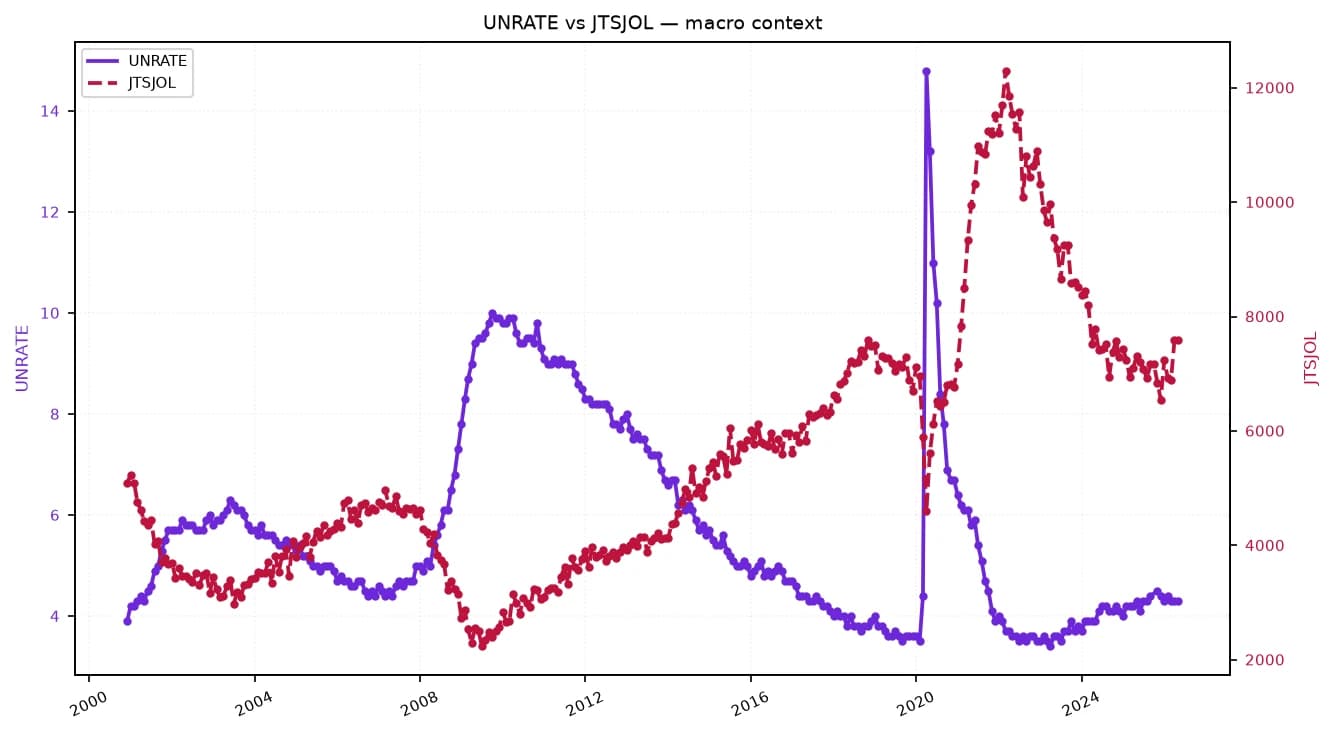
That matters because the labor market remains one of the Federal Reserve’s key gauges for how long it can keep policy restrictive. The unemployment rate is forecast at 4.18% for July, while job openings are seen rising only modestly to 7.66 million in June from 7.59 million in May, a sign that employers are still hiring, but less aggressively than in the post-pandemic surge.
Sentiment IndicatorsⓘProprietary · adalytica.com · July 22, 2026
This is a snapshot — live sentiment, awareness and momentum for 130+ markets update continuously in the dashboard.Open AlphaPulse

The data fits a broader pattern of a labor market that is no longer overheated. Unemployment has drifted down from 4.3% in April to 4.2% in June, but openings have fallen sharply from a peak of 12.3 million in early 2022, underscoring how much the balance of power has shifted away from workers and toward employers.
For investors, that mix matters across asset classes. Slower hiring and softer wage pressure can support hopes for rate cuts and valuations, especially in growth-sensitive sectors, but it also raises the risk that consumer demand cools further and corporate earnings lose momentum. Rate-sensitive exchange-traded funds such as the iShares U.S. Financials ETF, IYF, have been trying to stabilize after a volatile spring; IYF was last up at $133.19, above its 50-day moving average of $127.20 and 200-day average of $124.29.

The market backdrop is fragile. Adalytica’s Global Stability Sentiment gauge sits at 4, or “Extreme Fear,” after a 30-day plunge of 80 points, while the S&P 500 trade signal also remains neutral. That combination suggests investors are still treating labor and growth data as potential catalysts for a broader re-pricing in equities, bonds and the dollar.
A stronger-than-expected labor report would reinforce the case for the Fed to stay patient, while further cooling could revive expectations for easier policy and add support to cyclical and rate-sensitive names. The next read on unemployment and openings will show whether the U.S. economy is moving toward a soft landing or a more pronounced slowdown.
| Entity | Gains | Losses |
|---|---|---|
| Workers | ▲more bargaining power earlier | ▼weaker wage growth ahead |
| Employers | ▲easier hiring, lower labor costs | ▼slower demand if hiring cools |
| Rate-sensitive stocks | ▲lower-rate hopes | ▼growth scare if labor softens |
| Federal Reserve | ▲more room to hold steady | ▼harder read on soft landing |