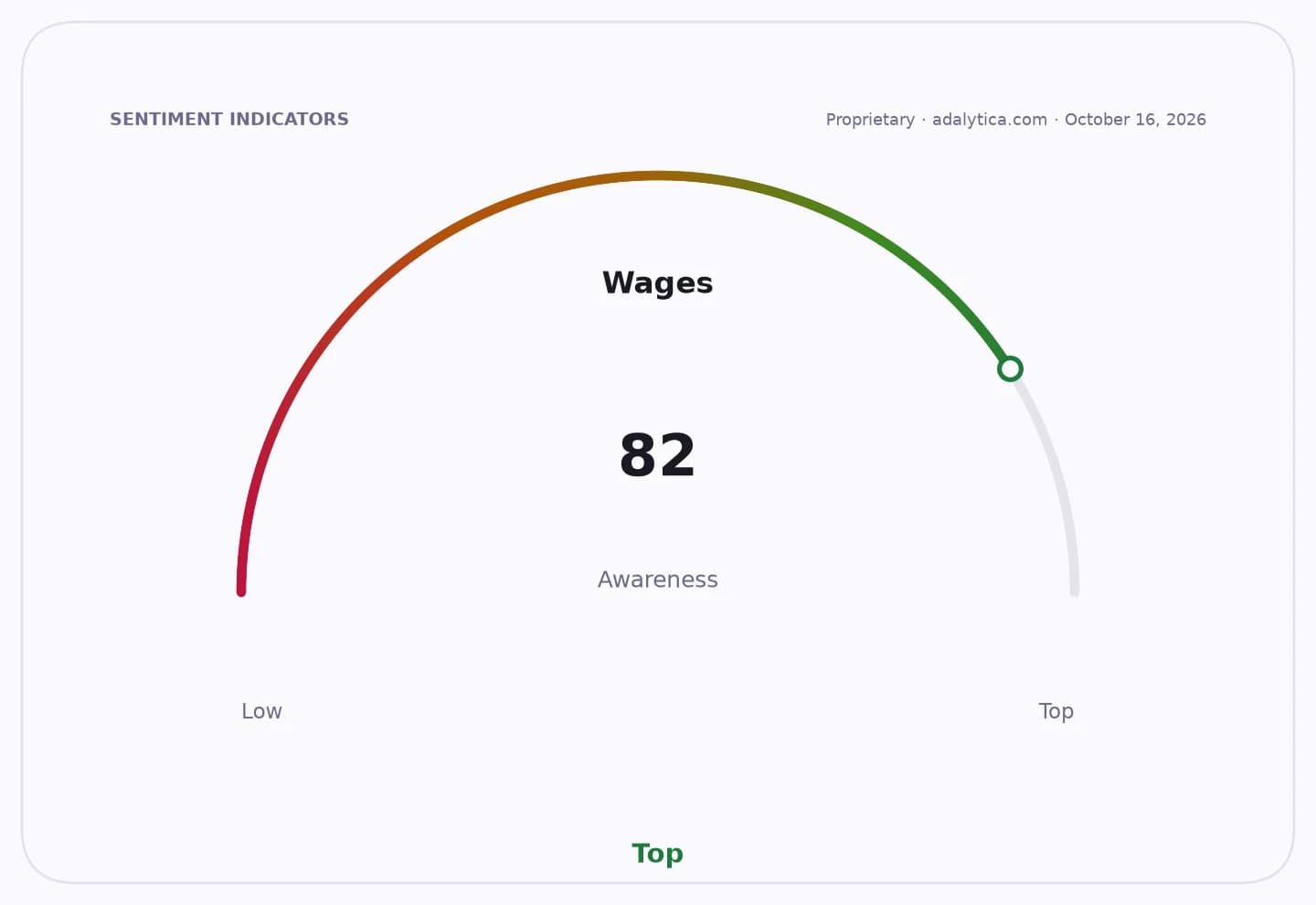
Coop will lift wages by 1.1% in 2027, a move that reinforces the Swiss retailer’s role as one of the country’s more generous employers while adding to labor costs in a sector already managing thin margins and persistent pressure to retain staff.
Coop to Raise Wages 1.1% in 2027
The agreement with unions Unia, Syna/OCST, the Swiss Employees Association and Coop’s own staff group means workers covered by the collective labor contract earning less than 4,900 Swiss francs a month will receive at least the full 1.1% increase, while the rest of the workforce will get individual adjustments that also bring total payroll growth to 1.1%. For investors, the significance is less the size of the raise than the signal: Coop is choosing stability in wage relations and employee retention over holding down labor expense in a period when consumer spending remains price-sensitive.
Sentiment Indicators
Swiss retail has been one of the clearest test cases for how employers balance inflation, productivity and margin protection. Coop said staff pay has risen 11.5% over the past decade, equivalent to 3% in real terms after inflation, and that employees have seen increases in nearly every year since 2000. That matters because steady wage progression can help reduce turnover, protect service quality and support store execution, but it also limits flexibility if consumer demand softens or food-price competition intensifies.
The package goes beyond pay. Coop said it covers two-thirds of pension contributions, while employees pay the rest, and includes loyalty bonuses, benefits and access to internal and external training. The company also highlighted independent checks of its pay structure since 2020, with the “Fair Compensation” and, from 2026, “compFAIR” certifications designed to confirm compliance with Swiss equal-pay rules. That positions the cooperative as a relative winner in the fight for labor, especially in a market where reputational issues around fairness and wage transparency increasingly matter to consumers and workers alike.
The broader economic implication is modest but clear: wage growth of 1.1% is consistent with a cooling but still firm labor market, and it adds a small but recurring cost to the retailer’s operating base. The bull case is that higher wages, training and pension support help Coop defend productivity and loyalty in a sector where staff shortages can quickly erode service. The bear case is that any wage drift, even at this scale, becomes harder to absorb if margins narrow further or if competitors respond more aggressively on price.
For investors, the key question is whether Coop can preserve its labor advantage without sacrificing pricing power. The announcement suggests management believes the trade-off is manageable. The next test will be whether similar wage deals spread more broadly across Swiss retail and whether companies can maintain profitability while keeping pace with employee expectations and regulatory scrutiny on fairness.
| Entity | Gains | Losses |
|---|---|---|
| Coop employees | ▲Higher pay and benefits | ▼None materially |
| Coop management | ▲Labor peace and retention | ▼Higher payroll costs |
| Swiss retail peers | ▲Benchmark for wage talks | ▼Pressure to match raises |
| Consumers | ▲Better staffing and service | ▼Potentially firmer prices |