The Czech Republic’s minimum wage still left full-time workers short of basic living costs in 2025, underscoring the gap between headline pay policy and the cost of housing, food and transport for low earners.
Czech minimum wage still below living costs in 2025
A Rilsa analysis found the net minimum wage of 17,837 koruna, or 737 euros, would have needed to be 7% to 24% higher depending on the region to cover all living expenses. That means an additional 1,250 to 4,280 koruna a month, a shortfall that is especially acute in higher-cost areas and highlights why minimum-wage debates are moving from abstract social policy to a question of household solvency.
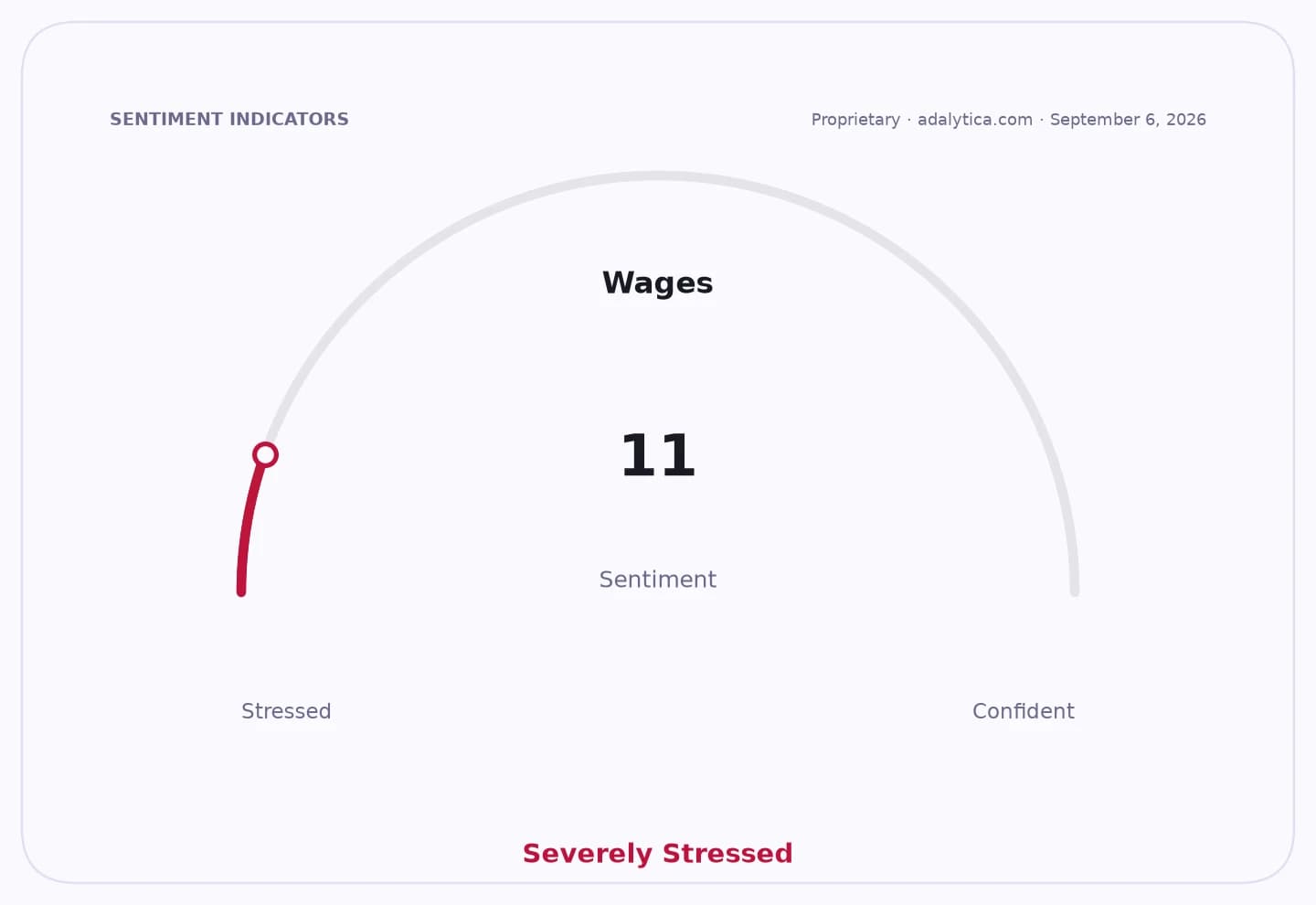
Sentiment IndicatorsⓘProprietary · adalytica.com · September 6, 2026
This is a snapshot — live sentiment, awareness and momentum for 130+ markets update continuously in the dashboard.Open AlphaPulse
The report also points to a broader policy tension. The gross minimum wage stood at 20,800 koruna in 2025, equal to 42.2% of the average wage, still below the European Union’s 50% benchmark. Czech social partners have agreed to lift it to 47% of average pay by 2029, with the wage set at 22,400 koruna this year, or 43.4% of average earnings.
For investors and employers, the key issue is not just the pace of wage growth but whether it can keep up with inflation and local living costs without squeezing labor-intensive businesses. Low-paid households have little room to absorb further price shocks, which can support consumption in the near term if wages rise, but also keeps pressure on policymakers to avoid falling real incomes and widening in-work poverty.
The Czech case fits a wider European pattern in which minimum wages are rising, but real purchasing power remains uneven across regions. That matters for domestic demand, labor supply and corporate margins, particularly in retail, hospitality, logistics and other sectors reliant on lower-paid workers.
The next test is whether planned increases through 2029 are enough to close the gap with both the EU’s wage-share target and actual living costs. If not, the pressure for faster hikes will intensify, even as businesses warn that higher labor costs could feed into prices and weaken competitiveness.
| Entity | Gains | Losses |
|---|---|---|
| Low-paid workers | ▲Higher wage floors | ▼Persistent cost-of-living gap |
| Employers in labor-heavy sectors | ▲Predictable wage path | ▼Higher labor costs |
| Czech policymakers | ▲Progress toward EU targets | ▼Pressure over real incomes |
| Consumers in higher-cost regions | ▲Potentially stronger household support | ▼Continued affordability strain |