The dollar steadied on Thursday after a recent slide, with investors reluctant to push it lower before next week’s central bank meetings and the Federal Reserve’s next signal on rates.
Dollar steadies before Fed and central bank meetings
That pause matters because the currency is still trading on a simple but powerful macro story: interest rates are likely to stay high for longer in the US, Japan and Europe, and that keeps the dollar’s yield advantage intact even after its pullback. For investors, that means the recent softness in the greenback may be less a trend reversal than a breather in a market that remains crowded around the dollar.
Sentiment Indicators

Sterling, the Australian dollar, the New Zealand dollar and the Canadian dollar have all clawed to multiweek highs against the US currency in recent sessions, suggesting some long-dollar positioning has been trimmed. But moves were muted on Thursday as traders waited for policy decisions that are expected to be hawkish holds rather than outright cuts.
The pound held near $1.33955 after touching a one-month high of $1.3409 earlier in the week, helped by hotter-than-expected UK inflation. The Australian dollar hovered above 70 US cents, while the kiwi was near a one-month high at $0.5709 on expectations of a rate hike in New Zealand. The loonie stayed near a one-month top at C$1.4032 per dollar as the Bank of Canada is also seen lifting rates next week.
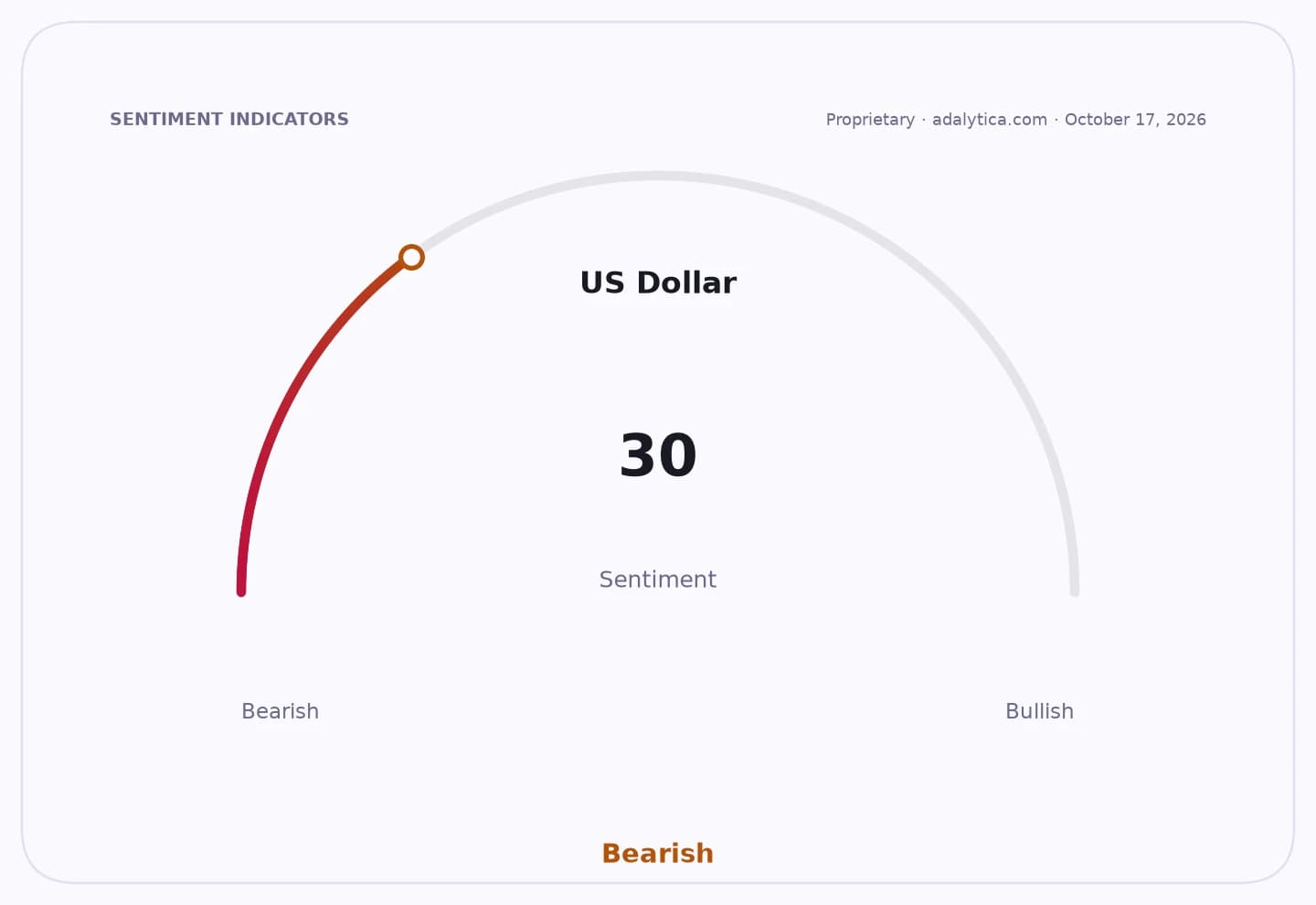
US Dollar — 30-day sentimentadalytica.com
Explore this data interactively — full history, time series and cross-market comparisons.

The euro and yen, meanwhile, remain trapped in narrow ranges. The euro has spent about a month under pressure as investors use it as a funding currency for stronger-dollar bets, with French fiscal worries and Europe’s energy fragility adding to short-selling pressure. Yet it has mostly held above $1.12, underscoring how much of the bad news is already priced in.
Japan’s currency is still being pinned near 158 per dollar by the prospect of intervention and the market’s expectation that the Bank of Japan will stay patient for now. The Fed is widely seen holding rates in October, with a move penciled in for December. That setup helps explain why the dollar has not extended its recent decline: if other central banks only deliver cautious tightening while the Fed stays restrictive, the dollar still has support.
The bigger investment takeaway is that currencies are once again being driven by relative policy, not just absolute growth. The AI-fueled resilience of the US economy has kept investors long dollars for much of the year, and that trade has not fully unwound. If next week’s meetings reinforce the message that inflation is still too sticky for rapid easing, the dollar could regain its footing quickly. For long-term investors, the lesson is to watch the policy gap, not just the headline move.
| Entity | Gains | Losses |
|---|---|---|
| US dollar bulls | ▲Yield support, slower Fed easing | ▼Recent momentum pause |
| Sterling, Aussie, kiwi, loonie | ▲Relief from dollar pullback | ▼Risk of reversal if Fed stays hawkish |
| Euro and yen bears | ▲Carry and policy divergence trade | ▼Limited downside if markets fade dollar shorts |
| Global importers with USD exposure | ▲Cheaper foreign exchange costs | ▼Less benefit if the dollar firms again |