Gold prices in Egypt steadied on Thursday evening after the central bank held interest rates unchanged, leaving the local market to digest a prior drop of 65 Egyptian pounds in 21-karat prices.
Egypt Gold Prices Steady After Central Bank Holds Rates
That stability matters because Egyptian gold is being pulled between two forces: domestic monetary policy and a volatile global bullion backdrop. When rates are held steady, the immediate pressure on local gold from a fresh policy shock eases, but the market still has to price in financing costs, inflation expectations and the exchange-rate channel that often drives retail demand for jewelry and bullion.
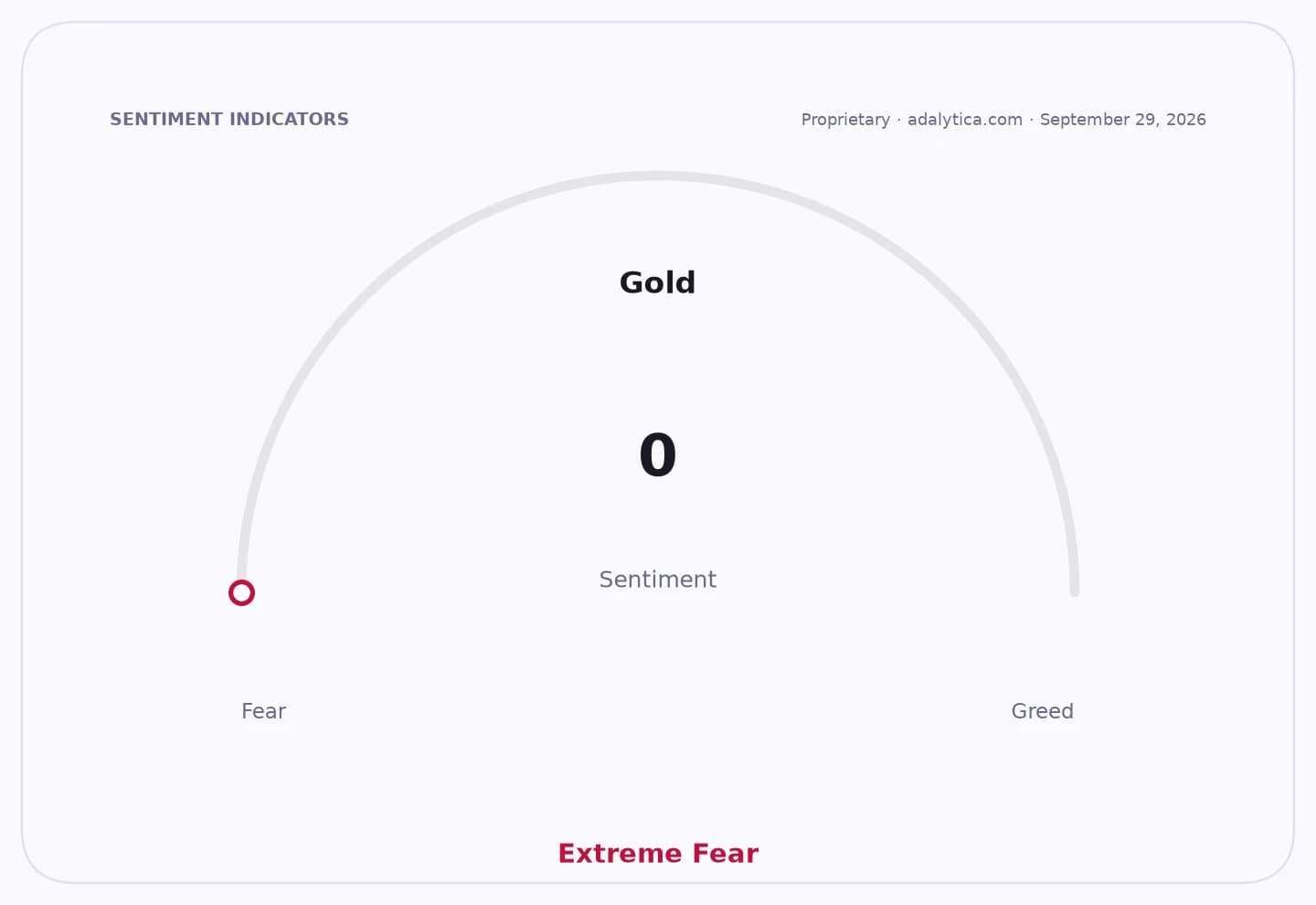
Sentiment IndicatorsⓘProprietary · adalytica.com · September 29, 2026
This is a snapshot — live sentiment, awareness and momentum for 130+ markets update continuously in the dashboard.Open AlphaPulse
The benchmark 21-karat price, the most widely watched in Egypt, was quoted at 6,225 pounds a gram for buying and 6,190 pounds for selling. The 24-karat variety was listed at 7,114 pounds buying and 7,074 pounds selling, while 18-karat stood at 5,335 pounds buying and 5,305 pounds selling. The gold pound was priced at 49,800 pounds to buy and 49,520 pounds to sell. An ounce was quoted at $4,270 to buy and $4,269 to sell.
The pause in Egyptian prices also comes after a sharp global reset in bullion. New York gold futures were trading around $4,204 an ounce, down from $4,321 on Sept. 25, while the GLD ETF closed at $382.18 on Sept. 29, below its 50-day moving average of about $395.91 and well under its 200-day average of $416.36. That technical backdrop suggests the recent advance in gold has cooled, even if the broader uptrend remains intact. Standard indicators such as the relative strength index and MACD have also softened, reinforcing the view that momentum has faded in the short term.
For investors, the more important issue is whether Egypt’s rate hold can stabilize local demand or merely delay another repricing if inflation pressures persist. Gold traditionally benefits when real rates fall or when confidence in paper assets weakens, but it can lose some local appeal when borrowing costs stay elevated and households face tighter budgets. That is especially relevant in Egypt, where jewelry demand, savings behavior and the currency outlook can all affect how quickly global gold moves through to street prices.
Adalytica’s Gold Fear & Greed Index showed extreme fear in the latest snapshot, while the U.S. dollar signal also pointed to extreme fear, underscoring how unsettled broader pricing remains. The immediate takeaway is that Thursday’s calm in Egyptian gold may be more of a pause than a turning point. If global bullion keeps sliding and domestic rates stay restrictive, local prices could soften again; if inflation anxieties intensify, gold’s appeal as a store of value may reassert itself quickly.
| Entity | Gains | Losses |
|---|---|---|
| Egyptian banks | ▲Rate stability | ▼Lower loan demand |
| Gold buyers | ▲Short-term price pause | ▼Missed dip if prices rebound |
| Jewelry sellers | ▲Stable quoting | ▼Slower retail turnover |
| Gold bulls | ▲Inflation hedge narrative | ▼Near-term momentum |