Europe’s latest accommodation with China is landing as a practical win for consumer-goods groups that rely on cross-border supply chains, while also easing — for now — the risk of a wider trade confrontation between Brussels and Beijing. The surprise benefit for ice cream producers underscores a broader point: when trade tensions rise, the winners and losers often show up first in everyday products, not just in industrials or autos.
EU-China trade truce lifts Unilever and Nestle
The agreement matters economically because Europe is trying to rebalance a trade relationship that has become increasingly skewed toward China. Chinese exports surged 36.3% year on year in September, helping push the country’s January-to-September surplus to $938 billion and intensifying pressure inside the EU for tougher action. That backdrop had raised the odds of retaliatory measures and more fragmentation in trade flows, with European policymakers increasingly uncomfortable about a deficit that could top 100 billion euros by 2026.
Sentiment IndicatorsⓘProprietary · adalytica.com · October 17, 2026
This is a snapshot — live sentiment, awareness and momentum for 130+ markets update continuously in the dashboard.Open AlphaPulse
For investors, the immediate significance is that the deal appears to reduce one of the more underappreciated cost and margin risks facing multinational food and personal care companies with exposure to both Europe and China. Unilever, which has been one of the more obvious beneficiaries of easing trade friction, rose to 66.16 on Oct. 16 from 63.86 two days earlier, trading above its 50-day moving average and with its RSI at 67.4, a sign of improving momentum. Nestle also advanced to 99.65 from 94.54 over the same period, while Mondelez climbed to 63.91 from 62.57.
Those moves matter because the companies are not just trading on sentiment; they sit in a sector where tariffs, customs bottlenecks and regulatory retaliation can quickly pressure pricing, sourcing and distribution. Mondelez has already warned in its filings that additional protectionist measures and retaliation could increase costs, disrupt consumer spending patterns and hurt market stability. That risk is especially relevant in a world where food and snack companies depend on finely tuned global supply chains and where even modest policy changes can alter freight costs, ingredient sourcing and shelf pricing.
The ice cream angle is a useful illustration of how trade diplomacy can distort or preserve niche categories. A carve-out or procedural easing that helps a low-profile consumer segment is also a signal that both sides prefer managed friction to open escalation. That reduces the chance of sudden shocks to companies with European manufacturing bases selling into China, or Chinese inputs flowing into Europe’s packaged-food ecosystem.
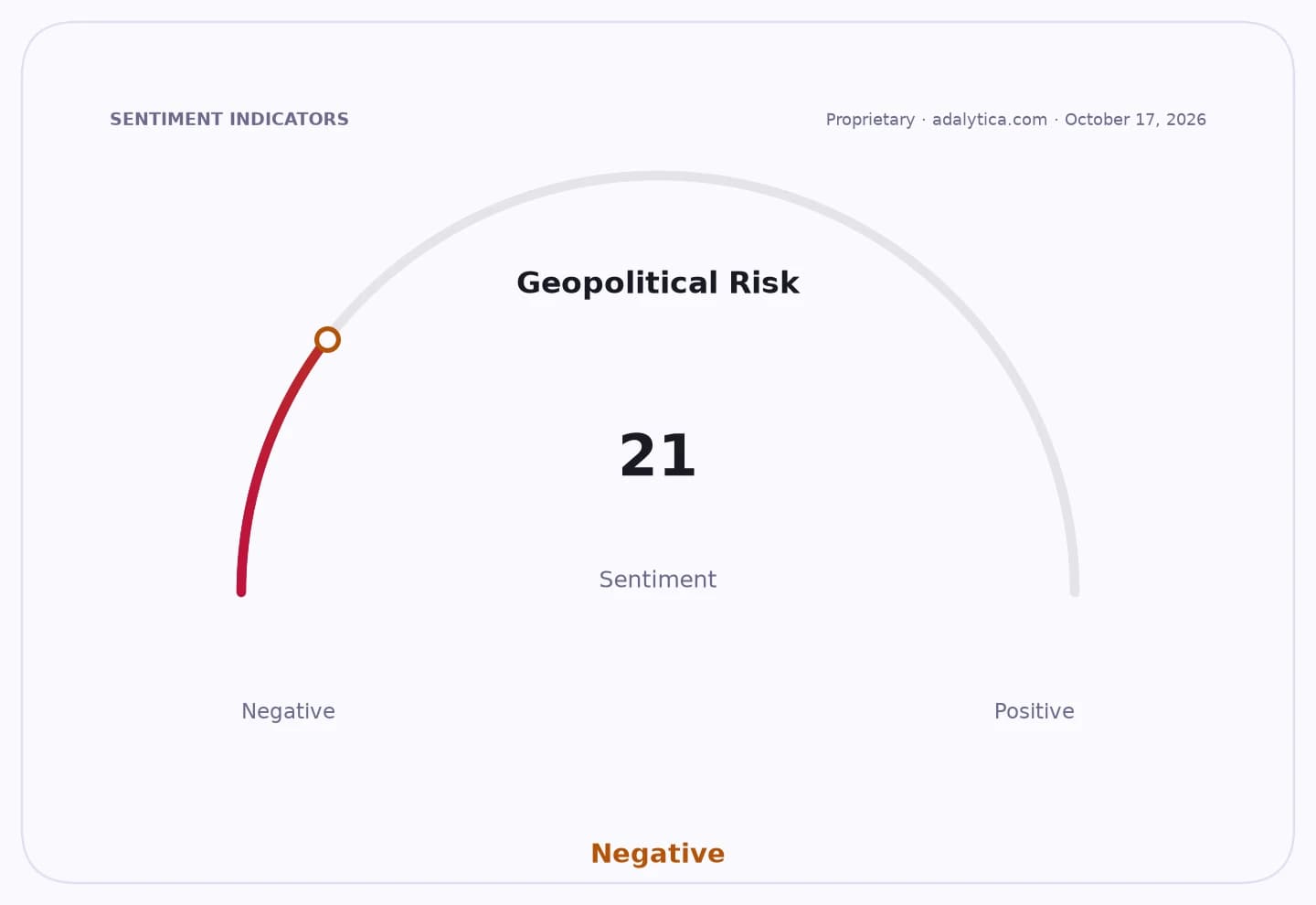
The macro backdrop is still volatile. Adalytica’s Global Stability Sentiment is in “Fear” territory at 21, with “Extreme Fear” awareness, reflecting the broader market’s sensitivity to geopolitics. Yet the U.S. dollar trade signals have weakened sharply over the past month, suggesting markets are not pricing an immediate rush to defensive positioning. For consumer staples investors, that combination argues for selective optimism: the trade environment remains fragile, but the probability of a near-term EU-China tariff spiral appears lower than it did before the talks.
What to watch next is whether this is a tactical truce or the beginning of a broader framework to manage Europe’s widening trade imbalance with China. If Beijing keeps expanding exports while Europe pushes back only incrementally, pressure will return quickly. But if negotiations continue to produce sector-specific concessions, multinational consumer companies with strong European brands and Asian distribution should keep benefiting from reduced policy risk and more predictable supply chains.
| Entity | Gains | Losses |
|---|---|---|
| Unilever | ▲Lower trade friction | ▼Tariff and sourcing risk |
| Nestle | ▲Supply chain stability | ▼Margin pressure from retaliation |
| Mondelez | ▲Fewer policy shocks | ▼Higher input and logistics costs |
| EU policymakers | ▲Short-term de-escalation | ▼Leverage for tougher trade action |