Immigrant employment in the European Union reached a record last year, a small but important sign that Europe’s labor market is becoming more inclusive just as businesses keep hunting for workers.
EU Immigrant Employment Hits Record
The share of employed immigrants rose to 68.2% from 67.8%, according to the Rockwool Foundation Berlin economic institute, leaving it close to the employment rate of people born in the bloc. For investors, that matters because labor supply is one of the biggest constraints on Europe’s growth story. When more newcomers move into work, it helps ease staffing shortages, supports tax receipts and gives consumer demand a firmer base.
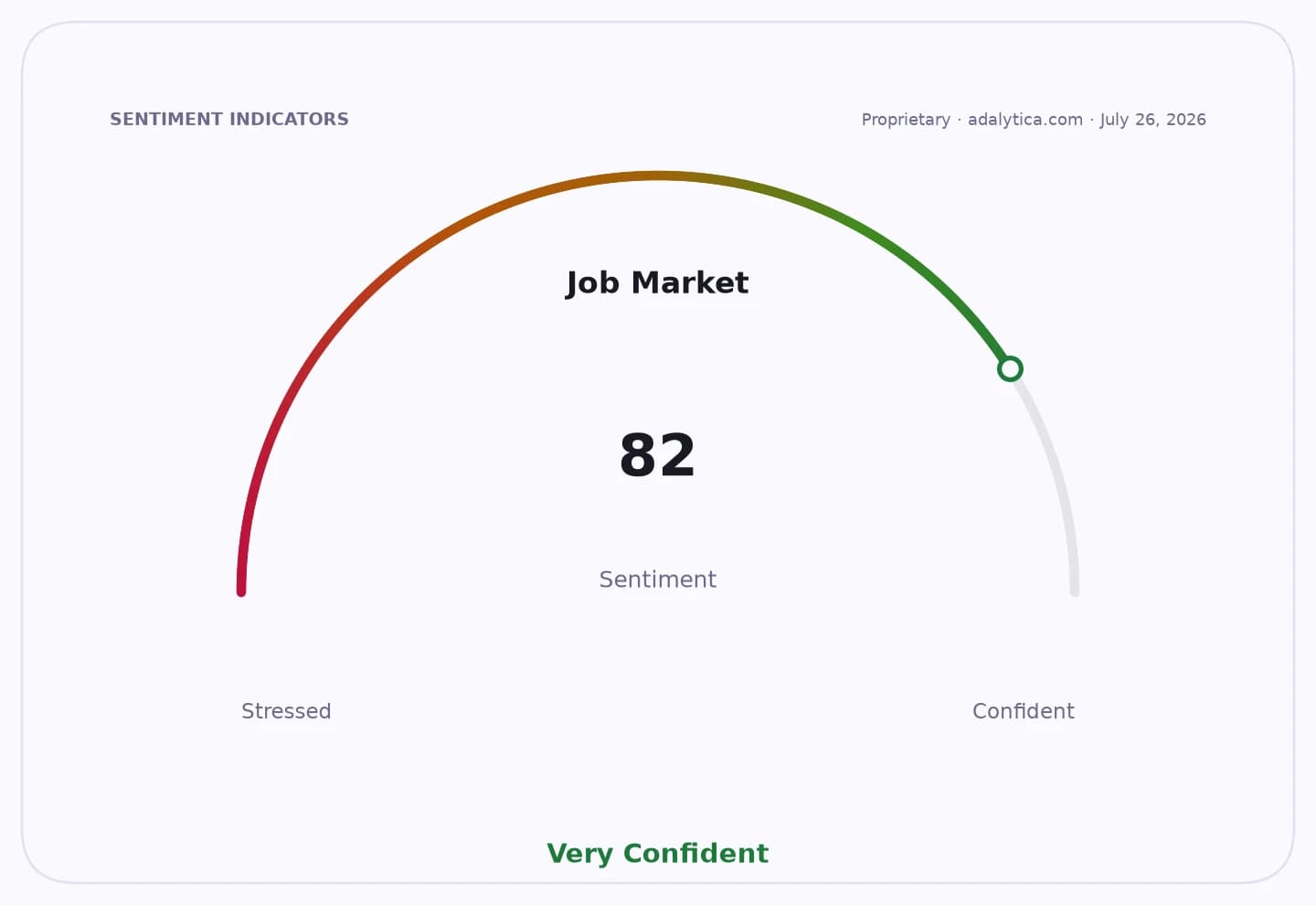
Sentiment IndicatorsⓘProprietary · adalytica.com · July 26, 2026
This is a snapshot — live sentiment, awareness and momentum for 130+ markets update continuously in the dashboard.Open AlphaPulse
That backdrop helps explain why European labor-market conditions have remained resilient even as growth has slowed. In the U.S., where the data also point to a stable job market, the unemployment rate is forecast at 4.18% for July, while nonfarm payrolls are seen edging up to 159,170,900. Europe is not the U.S., but the same broad lesson applies: tight labor markets can persist even in a cooler economy when employers need workers more than workers need employers.
For Europe, the immigrant employment milestone is especially meaningful because it suggests the region is getting better at absorbing foreign-born labor rather than leaving it on the sidelines. That can soften the economic drag from aging populations and low birth rates, two structural headwinds that have long weighed on potential growth. It also points to a labor market that is becoming more efficient, with companies filling vacancies faster and workers integrating more quickly.
The market implications are subtle but real. A stronger employment base supports consumer spending, which matters for European retailers, banks, housing-related names and domestically focused cyclicals. It also reduces the odds that labor scarcity alone will force wages sharply higher, which would squeeze margins for employers already dealing with weak demand in parts of the economy. For exchange-traded funds such as the iShares MSCI Europe ETF and the Vanguard FTSE Europe ETF, the trend reinforces the case for patience: Europe’s equity story is still about steady compounding, not explosive growth.
Technical indicators on those funds have also pointed to improving momentum. EUFN has climbed well above its 50-day and 200-day moving averages, while VGK has recovered to levels above both its 50-day and 200-day averages, suggesting investors have been willing to lean back into European exposure. That does not make the region a fast-growth market, but it does show the labor backdrop is being read as supportive rather than threatening.
The risk is that stronger immigrant employment does not automatically translate into stronger productivity. If Europe keeps adding workers without lifting investment, innovation and output per worker, the boost to growth will be limited. But over a multi-year horizon, investors should see this as constructive: more people working usually means more economic resilience, better fiscal math and less pressure on policymakers to rely on emergency fixes.
For long-term investors, the takeaway is straightforward. Europe’s record immigrant employment rate is not just a social milestone. It is a reminder that the region’s labor market is still adapting to demographic change — and that companies with access to broader, deeper talent pools may be better positioned to compound earnings over time.
| Entity | Gains | Losses |
|---|---|---|
| Immigrant workers | ▲Higher employment | ▼Labor-market exclusion |
| European employers | ▲Larger labor pool | ▼Persistent staffing shortages |
| EU economy | ▲Stronger consumer demand | ▼Less if integration stalls |
| Domestic workers facing competition | ▲Better wage discipline | ▼More competition for jobs |