The euro edged higher against the dollar on Tuesday, showing that weak German sentiment data still matters less to traders than the market’s wider hunt for safety and a potential easing in geopolitical risk.
Euro Edges Higher on Risk Sentiment and Dollar Moves

At 1.1246 dollars in afternoon trade, the common currency was only modestly firmer on the day, but the move came after the European Central Bank set its reference rate at 1.1215 dollars, down slightly from 1.1225 on Monday. That resilience matters because it suggests the euro is no longer trading purely on Germany’s domestic outlook: it is being pulled by the dollar side of the pair, where investors are watching war headlines and U.S. rate expectations just as closely.
Sentiment IndicatorsⓘProprietary · adalytica.com · October 25, 2026
This is a snapshot — live sentiment, awareness and momentum for 130+ markets update continuously in the dashboard.Open AlphaPulse

The immediate support came from vague hopes that mediation efforts by Qatar and Pakistan could help de-escalate the Iran war, a factor that tends to reduce demand for the dollar as a haven and can briefly lift risk-sensitive currencies. That offset a disappointing ZEW survey, which showed German economic expectations deteriorating for the first time in five months and by more than economists had anticipated.
But the ZEW data does not change the bigger euro story. It confirms that Europe’s recovery remains fragile, with private consumption and investment still constrained by high energy costs, tighter financing conditions and disrupted supply chains. German third-quarter growth was already weak, and the latest survey suggests the fourth quarter is not starting with any real momentum.
US Dollar — 30-day sentimentadalytica.com
Explore this data interactively — full history, time series and cross-market comparisons.Open AlphaPulse
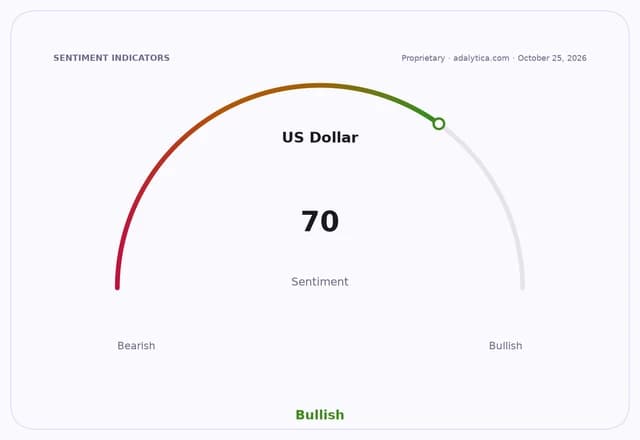
For investors, that is the key tension: the euro can rise even when Europe’s growth narrative is poor, but only if the dollar weakens faster. That dynamic is a warning for those betting on a durable euro breakout from stronger German data alone. Until the Federal Reserve path turns clearly easier or geopolitical risk subsides enough to keep the dollar under pressure, the currency is likely to remain range-bound and headline-driven.
The market backdrop fits that view. The euro’s technical structure remains subdued, with the pair hovering below its 50-day and 200-day moving averages in recent sessions, while conventional momentum readings have cooled from earlier strength. By contrast, the dollar has held firm enough to keep pressure on most major currencies, even as broader FX volatility has eased.
Gold near $4,150 an ounce reinforces the same message: investors are still carrying defensive hedges, and that keeps currency moves tied to risk appetite rather than to one regional data point. For European exporters, a softer euro would remain a modest tailwind, but for investors the bigger opportunity is in the asset classes that benefit if geopolitics and slower U.S. inflation keep the dollar from resuming a sustained rally.
The next test for the euro is whether Tuesday’s relief bid can survive beyond the headlines. If it cannot, the market will quickly refocus on Europe’s weak growth and the ECB’s limited room to reprice the currency higher.
| Entity | Gains | Losses |
|---|---|---|
| Euro | ▲Brief lift from risk sentiment | ▼Weak German outlook |
| US Dollar | ▲Safe-haven support if war fears persist | ▼Softer if de-escalation continues |
| German exporters | ▲Marginal competitiveness boost from weaker euro | ▼Less benefit from domestic demand |
| European consumers | ▲Lower import-price pressure if euro firms | ▼Squeezed by weak wages and high energy costs |